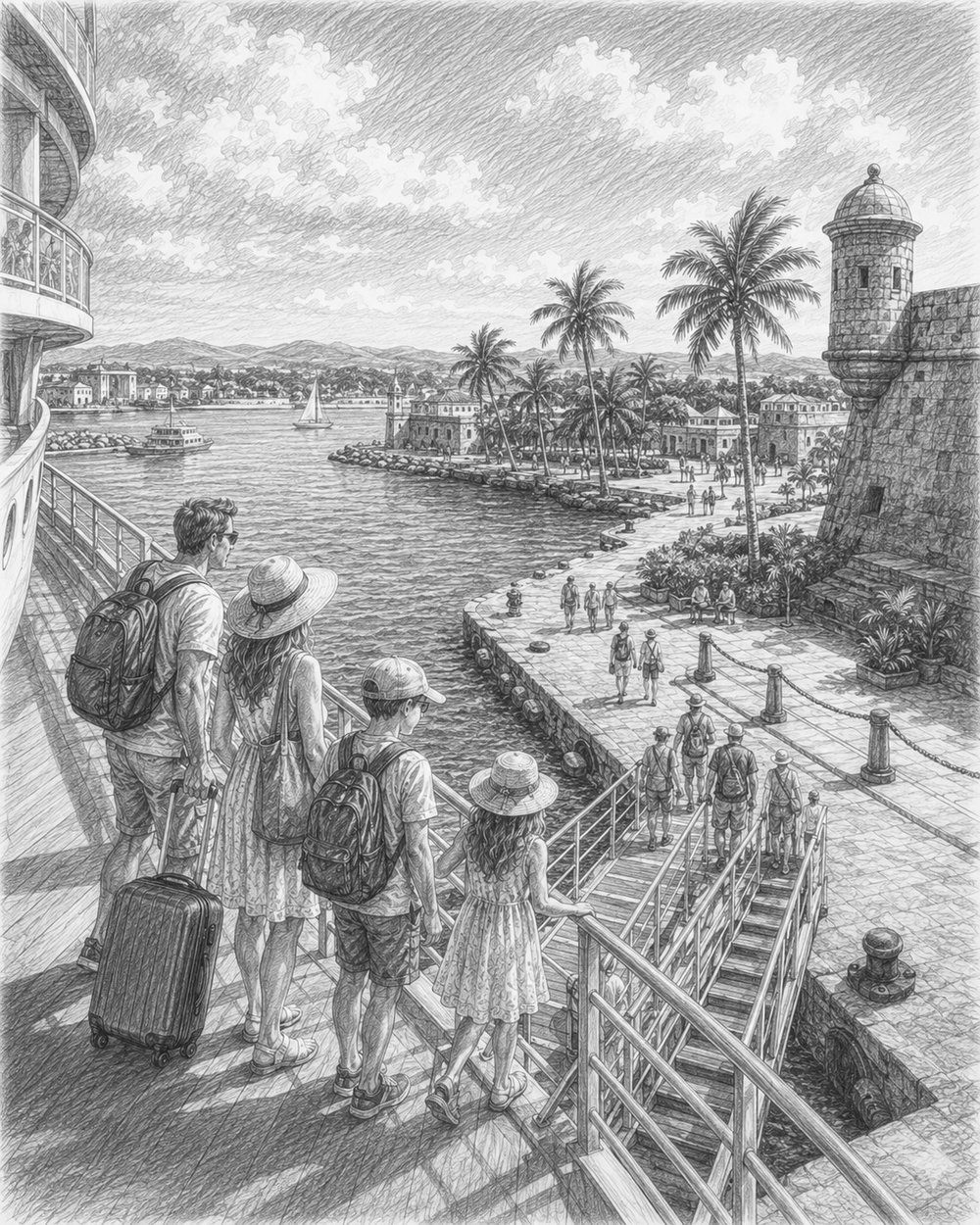
Which ports does Symphony of the Seas visit, and what should you actually do once you step off the gangway? On a seven-night Caribbean sailing, Symphony of the Seas typically alternates between a Western route (with stops such as Perfect Day at CocoCay, Nassau, Falmouth in Jamaica, and Labadee in Haiti, or a Gulf-based run to Cozumel, Costa Maya, and Roatan) and an Eastern route (with stops such as Perfect Day at CocoCay, San Juan, St. Thomas, and St. Maarten). The exact lineup depends on your departure port and date, and that matters more than usual right now, because Symphony’s home port has shifted over the years. This guide walks through each port she calls on, what each one is known for, a couple of grounded things to do, and how to decide between a ship-run tour and going independent — plus a booking strategy, docking and all-aboard logistics, money and tipping ashore, and how to make the sea days count.
Everything in this article and far more, deck by deck, in The Ultimate Guide to Sailing on Symphony of the Seas.
Get the book →Confirm your itinerary before you plan anything
Start with one honest disclaimer: Symphony of the Seas has sailed from Miami and from Cape Liberty in the past, and she has been moving toward Galveston, Texas. Because of that, two guests both “sailing Symphony” can visit completely different ports. A cruise leaving from a Florida or New Jersey port tends to reach the classic Bahamas-and-Caribbean islands, while a Gulf-based departure swings toward the western Caribbean coastline of Mexico and Honduras. Neither is better; they’re just different maps.
So before you book a single excursion, open the Royal Caribbean app and confirm three things for your specific sailing: the departure port, the exact ports of call, and the arrival and departure time at each one. The app doubles as your boarding pass, deck map, daily schedule, and reservation hub, and it’s the single source of truth for times that occasionally shift. Broadly, the Eastern-style week leans into deep-blue water, Spanish colonial history, and famous beaches; the Western-style week leans into Maya archaeology, reef snorkeling, and Royal Caribbean’s own private destinations. Many sailings also bookend the week with Perfect Day at CocoCay. Use the sections below as a menu rather than a fixed schedule.
Perfect Day at CocoCay: the resort-day port
Perfect Day at CocoCay is Royal Caribbean’s private island in the Bahamas, and it appears on both Eastern- and Western-style itineraries. It’s the one “port” where the ship basically follows you ashore: your SeaPass still works, the included food is covered, and you can wander back aboard whenever you like. It’s known for a clean split between free and paid experiences, so your only real job is deciding how much to spend.
On the included side you get the beaches, the enormous Oasis Lagoon freshwater pool, freshwater play areas, and a tram around the island — a full day for most families at no extra cost. On the paid side sit the Thrill Waterpark with its tall slides, the zip line, the beachfront Coco Beach Club, and the adults-only Hideaway Beach. Two grounded plans: claim a free lounger early and treat the day as pure downtime, or commit to the Thrill Waterpark if you have kids who live for slides.
Ship-versus-independent doesn’t apply here — it’s a private island, so everything is booked through Royal Caribbean. The only decision is whether to pre-book the paid attractions in the app (recommended, since the popular ones sell out) or keep the day free. If you want just one easy splurge on the whole cruise, this is it, because you never have to leave the ship’s ecosystem.
Nassau, Bahamas: history in town, resorts across the bridge
Nassau is a busy, walkable capital where the cruise dock sits close to town, which makes it one of the easiest ports to do on your own. It’s known for the Paradise Island resort complex, Atlantis, and a compact historic core. Within a few minutes you can be either climbing colonial staircases or lounging at a sprawling water-park resort.
Two grounded things to do: walk up the Queen’s Staircase to Fort Fincastle for history and a view over town, or head to Junkanoo Beach, close enough to reach without a big excursion if you just want sand for a few hours. Families chasing the big water-slide day gravitate to Paradise Island and Atlantis across the bridge, which is worth doing but is a full-commitment outing. Nassau is one of the strongest cases for going independent because the town is right there; save the ship tour for the Atlantis package, where a booked pass removes friction and guarantees you’re back before all-aboard.
Falmouth, Jamaica: waterfalls, river rafting, and a historic town
Falmouth is a purpose-built cruise port with a genuinely historic town attached, and it’s the gateway to Jamaica’s most famous natural attractions. What draws most people here is Dunn’s River Falls, the terraced waterfall you can climb in a human chain — the signature Jamaica excursion and the reason many guests pick this port day for their big outing.
Two grounded options: book the trip to Dunn’s River Falls if a hands-on natural attraction appeals and you don’t mind a longer transfer, or choose Martha Brae river rafting for something calmer, gliding on a bamboo raft instead of scrambling up rocks. If you’d rather stay local, the historic streets of Falmouth and nearby beaches give you a lower-key day. Because the headline sites sit a fair distance from the pier, this is a day where a guaranteed ride back matters — the ship’s own excursion is the safest choice because the ship waits for its own tours; if you book independently, pick an operator that explicitly promises to return you before all-aboard.

Labadee, Haiti: another private-peninsula beach day
Labadee is Royal Caribbean’s private peninsula on the north coast of Haiti, and like CocoCay it functions as a controlled, all-in beach day rather than a town you explore. It’s known for calm beaches, a dramatic hillside setting, and a small cluster of adventure activities run by the line.
Two things to do: ride the zip line or the alpine coaster for a jolt of adrenaline with an ocean backdrop, or simply pick a beach and settle in with the included lunch and water sports. The peninsula is compact, so you can mix both. As with CocoCay, there’s no independent alternative — everything is booked through Royal Caribbean, so the only decision is which add-ons to reserve in advance. The adventure activities are the ones that sell out, so pre-book those in the app if they’re your priority; if you’re happy with beach time, you can arrive with no plan and still have a full day.
Cozumel, Mexico: reefs, beach clubs, and Maya history
Cozumel is one of the Caribbean’s premier snorkeling and diving islands, and a frequent stop on Gulf-based Western itineraries. It’s known for its reef system, its easygoing beach clubs, and the San Gervasio Maya site inland — something here for divers, beach loungers, and history-curious travelers alike.
Two grounded choices: book a reef snorkeling or diving trip to see the marine life the island is famous for, or spend the day at a beach club, trading a small fee or minimum spend for loungers, pools, and food. If you’d rather get off the coast, the San Gervasio Mayan ruins give you a compact archaeological visit without the long haul mainland sites require. Cozumel is friendly to both approaches: go independent to save money and set your own pace, or choose the ship’s excursion for boat-based reef trips if you want the transport, gear, and timing handled for you.
Costa Maya, Mexico: Maya ruins and a quiet beach town
Costa Maya is a smaller, purpose-built port on Mexico’s Caribbean coast, best known as a launch point for inland Maya ruins. The two big archaeological draws are Chacchoben and Kohunlich, both a drive from the pier, plus the low-key beach town of Mahahual nearby for those who want sand instead of stone.
Two things to do: take the excursion to the Chacchoben ruins for a guided walk through Maya temples surrounded by jungle, or keep it simple with a beach day and snorkeling at Mahahual, close enough for an easy outing. Costa Maya is a calmer, less crowded stop than Cozumel, which some travelers prefer. Ship-versus-independent leans toward a guided tour for the ruins, because the sites are inland and a good guide adds real context; for the beach, independent is easy and cheap. Pay for guidance when the value is interpretation and distance, and self-guide when it’s just a lounger and the sea.
Roatan, Honduras: West Bay Beach and world-class reef
Roatan sits along one of the largest barrier reefs in the world, which makes it a snorkeler’s and diver’s port. It’s known for West Bay Beach, the reef just offshore, and a set of nature and animal parks for families who’d rather meet the local wildlife than get in the water.
Two grounded options: head to West Bay Beach, where you can wade out and snorkel the reef directly from shore, or book a nature or animal park for a wildlife-focused day. Roatan rewards guests who commit to a single plan rather than cramming everything in, because getting around takes time. Both approaches work: independent travelers arrange transport to West Bay and enjoy the reef on their own schedule, while ship excursions bundle the transfer and often include gear and a set beach area. If your ship’s port is a longer drive from West Bay, the ship tour’s timing guarantee becomes more valuable.
San Juan, Puerto Rico: Old San Juan on foot
San Juan is a highlight of Eastern-style itineraries, and it’s one of the most walkable ports in the entire Caribbean. The ship docks close to Old San Juan, the historic colonial district known for its cobblestone streets, colorful facades, and two massive Spanish fortresses: El Morro and Castillo San Cristóbal.
Two things to do that need nothing more than good shoes: walk out to El Morro, the star-shaped fort guarding the harbor entrance, and wander the ramparts and grassy esplanade, then loop back through the old town toward Castillo San Cristóbal. Between the two forts you’ll pass most of what makes Old San Juan memorable, entirely on your own. This is the clearest independent port on the whole route — the historic core is right at the pier, so a self-guided walk costs nothing. Reserve a ship tour only if you want guided commentary or a longer trip out of the city; otherwise save the budget for a port where the sights are farther from the dock.
St. Thomas: Magens Bay and the viewpoints
St. Thomas, whose main town is Charlotte Amalie, is known for one of the most photographed beaches in the Caribbean, Magens Bay, along with duty-free shopping and sweeping island viewpoints. It’s a beach-and-scenery port more than a history port, which makes it an easy day to plan.
Two grounded options: spend the day at Magens Bay, a long, calm, U-shaped beach that consistently ranks among the region’s best, or ride up to one of the island’s high viewpoints for the postcard panorama before browsing the shops in town. Getting to Magens Bay involves crossing the island, so the transport question decides things: a ship excursion or arranged transfer takes the guesswork out of getting there and back, while going fully independent works but means managing your own timing against all-aboard. If you just want to shop and stay near the pier, you don’t need an excursion at all.
St. Maarten: two nations, one island
St. Maarten, with its main cruise town of Philipsburg, is unusual because the island is split between a Dutch side and a French side. It’s known for Maho Beach — where planes famously come in low right over the sand — the shop-lined Front Street in Philipsburg, and the French-side town of Marigot for a change of pace and cuisine.
Two things to do: head to Maho Beach for the singular experience of watching aircraft skim the shoreline, or stroll Front Street in Philipsburg for shopping and beach access right in town. With more time, a trip over to Marigot on the French side gives the day a different flavor. Philipsburg is easy to do independently since Front Street and its beach are close to the dock; for Maho Beach or the French side you’ll want transport, so weigh a ship excursion against an independent taxi. Independent is cheaper and flexible; the ship tour buys you the timing guarantee if you’re nervous about being back on schedule.
An excursion booking strategy that actually works
Divide your ports into two buckets. In the first go the ports where the main attraction is right at the pier — Nassau’s old town, San Juan’s forts, Philipsburg’s Front Street. These are self-guide days; you don’t need to pre-book anything, and you keep your money and flexibility. In the second go the ports where the best sights sit a long drive inland or across the island — Falmouth’s waterfalls, Costa Maya’s ruins, St. Thomas’s Magens Bay. Those are the days to consider a booked tour.
Within that “booked” bucket, the choice between a Royal Caribbean shore excursion and an independent operator comes down to one thing: the ship waits for its own tours. If a cruise-line excursion runs late, the ship holds for it. If you’re on an independent tour or a taxi you arranged and you miss all-aboard, the ship leaves without you, and you catch up at the next port at your own expense. That’s why nervous first-timers should lean toward ship excursions for anything far from the dock, and why experienced cruisers often book independently to save money and dodge crowds.
Book the popular, capacity-limited experiences early in the app — private-island thrills at CocoCay and Labadee, marquee snorkeling trips, big-name ruins tours — because these sell out before sailing. Leave the pier-side ports unbooked, and whatever you reserve, cross-check the timing against your ship’s posted arrival and departure, since a tour that returns after all-aboard is worthless. For a wider view of the whole week, the Symphony of the Seas cruise guide ties the port days together with everything happening on board.
Docking, tendering, and the all-aboard clock
Most of Symphony’s ports have piers large enough for an Oasis-class ship to dock directly, so you simply walk down the gangway once the ship is cleared. Perfect Day at CocoCay, Labadee, Falmouth, Costa Maya, Cozumel, and San Juan are typically alongside-dock experiences — a real advantage of sailing a ship this size, since you spend less time waiting on tenders. Some ports may involve tendering, anchoring offshore and ferrying guests in by boat, depending on traffic and berth availability. When that happens, guests on ship-sponsored excursions usually get priority for early tenders, another quiet argument for booking through the line on a tight day; if you’re independent at a tender port, get in line early. Your app shows whether a given port is dock or tender for your sailing.
The single most important number in any port is the all-aboard time, typically set a little before actual departure. Note it the moment you step off, and build your day backward from it with a comfortable buffer — traffic, slow taxis, and long lines are real. Many islands keep local time that may differ from ship time; the ship always runs on ship time, so set your watch to the ship and ignore everything else. For more first-day habits, the first-time cruise on Symphony of the Seas guide is a useful companion.
Money and tipping ashore
On board, Symphony runs on a cashless SeaPass account with daily gratuities auto-added, but ashore you’re back in the world of cash and card. In the Caribbean ports the US dollar is widely accepted, which keeps things simple for guests boarding from a US home port. Even so, carry small bills — taxis, beach vendors, market stalls, and tip jars all run more smoothly with cash, and small denominations save you from haggling over change.
For tipping, tip tour guides and drivers directly in cash at the end of a good outing, and tip beach-club and restaurant staff the way you would at home. Keep prices in perspective: beach-club minimums, excursion costs, and taxi fares vary widely by island, so confirm the current rate before you commit. Agree on a taxi fare before you get in, and ask whether a quoted price is per person or per group. You rarely need to change money into local currency for a few hours ashore if you’re carrying dollars. Finally, keep onboard and ashore spending mentally separate — it’s easy to overspend on excursions and be surprised by the SeaPass total, so a quick daily check in the app keeps the budget honest. For more on stretching your dollars, see these Royal Caribbean Symphony of the Seas tips.
Making the sea days count
A seven-night Caribbean sailing includes sea days, and on Symphony of the Seas those are as much a part of the trip as the ports. She’s an Oasis-class ship built around seven distinct neighborhoods, so a day at sea is less about killing time and more about choosing which version of the ship you want.
For thrill-seekers, sea days are when you tackle the Ultimate Abyss dry slide, the Perfect Storm waterslide trio, the FlowRider surf simulators, the rock wall, and the zip line over the Boardwalk. For families, there’s laser tag, an escape room, the handcrafted carousel, Splashaway Bay, and the Adventure Ocean youth program. For anyone who wants to slow down, Central Park’s open-air garden and the adults-only Solarium hold the quiet end of the ship. Hit the popular attractions on sea days rather than port days, since the whole ship is aboard and lines build. Sea days are also when the shows shine — the Broadway production of Hairspray in the Royal Theater, the HiRo show in the open-air AquaTheater, and the “1977” ice show in Studio B — so reserve those in the app and build your day around them. For the full neighborhood breakdown, the what to expect on Symphony of the Seas guide covers the ship in depth.
Get the complete Symphony of the Seas playbook
If you want every port, excursion, and sea day mapped out with clear action steps, “The Ultimate Guide to Sailing on Symphony of the Seas” walks you through it chapter by chapter. It’s part of the Ultimate Ship Guides series by Leo Sotropa, written to turn a big, overwhelming ship into a simple plan you can actually follow.
Frequently asked questions
Which ports does Symphony of the Seas visit?
On seven-night Caribbean sailings, Symphony typically runs an Eastern-style route with stops such as Perfect Day at CocoCay, San Juan, St. Thomas, and St. Maarten, or a Western-style route with stops such as Perfect Day at CocoCay, Nassau, Falmouth in Jamaica, and Labadee, or a Gulf-based run to Cozumel, Costa Maya, and Roatan. Her home port has shifted over time — she has sailed from Miami and Cape Liberty and has been moving toward Galveston — so always confirm the exact ports for your specific sailing in the Royal Caribbean app.
Should I book excursions through Royal Caribbean or independently?
The deciding factor is that the ship waits for its own tours but not for independent ones. For ports where the sights are far from the dock, or on any tight-timing day, a Royal Caribbean excursion buys peace of mind. For pier-side ports like San Juan, Nassau, and Philipsburg, going independent saves money and gives you more flexibility. Match the method to the port rather than picking one approach for the whole cruise.
Which ports can I do without an excursion?
San Juan is the strongest self-guide port — El Morro and Castillo San Cristóbal are a short walk from the pier. Nassau’s historic core, including the Queen’s Staircase and Fort Fincastle, is also walkable, as is Philipsburg’s Front Street in St. Maarten. The private destinations, Perfect Day at CocoCay and Labadee, need no independent planning at all since everything is arranged through the line.
Does Symphony of the Seas dock or tender at its ports?
Most of her ports have piers large enough to dock an Oasis-class ship directly, so you usually walk off the gangway. Some ports may involve tendering depending on traffic and berth availability, in which case guests on ship excursions typically get earlier tender access. Check your app, which shows whether each port on your sailing is a dock or tender.
What is the all-aboard time and why does it matter?
All-aboard is the time you must be back on the ship, set a little before the actual departure. It matters because the ship runs on ship time and will leave without guests who miss it — unless they’re on a ship-sponsored excursion, which the ship waits for. Note the all-aboard time as you step off, keep a comfortable buffer, and set your watch to ship time rather than local island time.
Do I need local currency in the ports?
For a typical Caribbean cruise day, US dollars are widely accepted, so you generally don’t need to change money for a few hours ashore. Carry small bills for taxis, vendors, and tips, agree on taxi fares before you get in, and confirm whether prices are per person or per group. On board, everything runs on your cashless SeaPass account with daily gratuities added automatically.
What should I do on sea days?
Sea days are the best time to hit Symphony’s headline attractions — the Ultimate Abyss, the Perfect Storm waterslides, the FlowRiders, the zip line, and the family activities like laser tag and the escape room — because everyone’s aboard and port-day lines don’t apply. Reserve the big shows in the app, such as Hairspray, the HiRo AquaTheater show, and the “1977” ice show, and balance the thrills with quiet time in Central Park or the adults-only Solarium.
Ready for the whole ship in one place? It is all in The Ultimate Guide to Sailing on Symphony of the Seas.
Get the book →
Meet Leo: The Heartbeat Behind ‘A Country A Month’
Journeying through the pages of A Country A Month, you might often feel the rhythm of a storyteller’s heartbeat, pulsating through each line, each image, and each adventure shared. That heartbeat belongs to none other than our remarkable website editor, Leo.
With a lens in one hand and a pen in the other, Leo seamlessly marries his passions for photography and writing. His eye captures moments that words can barely describe, yet his eloquence brings those images to life, transcending borders and connecting us all through shared stories. An avid traveler, every country he’s visited has added another chapter to his expansive tale, and through our platform, he generously shares these chapters with us.