What is an Endicott Arm Dawes Glacier cruise, exactly? It is a day when your ship trades ports for wilderness, sailing deep into a narrow Alaskan fjord to sit in front of a living, calving glacier. You do not get off the ship. The whole vessel becomes your viewing platform: the captain threads past icebergs and forested cliffs to the head of the fjord, holds position at Dawes Glacier, and slowly turns so both sides get the view before heading back out. The best way to spend the day is simple: dress warmly, get outside early, and give yourself unhurried hours to watch the ice.
What a scenic-cruising day actually is
A scenic-cruising day is different from a normal port stop. There is no pier, no tender, no gangway into town; the ship never docks. The destination is the scenery itself, and the “arrival” is the moment the ship reaches the glacier and slows to a near stop. Because you never leave the ship, there is nothing to book and no all-aboard time to race against. Your only job is to be in a good spot when the ship reaches the ice. This is one of the signature experiences of an Alaska cruise, and for many passengers it is the highlight of the trip. Check your cruise line’s app for the exact timing, since the schedule is built around tides, daylight, and ice.
What Endicott Arm and Dawes Glacier are
Endicott Arm, a fjord off Stephens Passage
Endicott Arm is a long, steep-walled fjord that branches off Stephens Passage in Southeast Alaska, south of Juneau. It was carved by ice over thousands of years, which is why the walls rise so sharply and the water runs so deep. As the ship works its way in, the fjord narrows and the scenery closes around you: granite cliffs streaked with waterfalls, patches of forest, and an increasing scatter of ice in the water.
Dawes Glacier, a tidewater glacier that calves
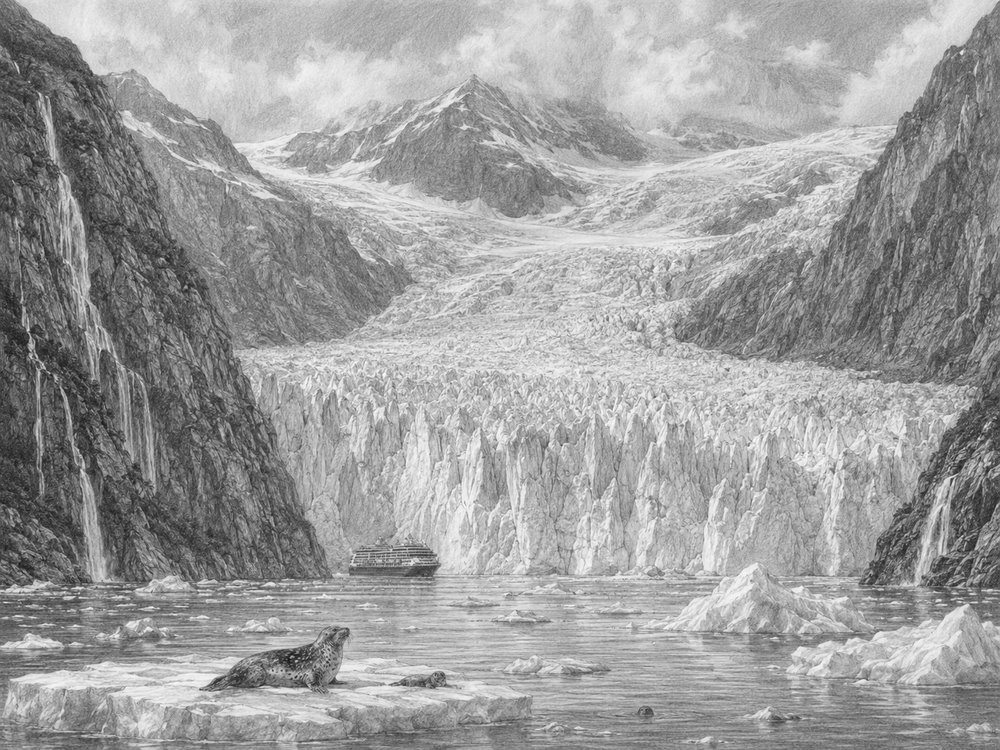
At the head of Endicott Arm sits Dawes Glacier, a tidewater glacier, meaning its face reaches right down into the sea rather than ending on land. That is what makes it so dramatic. Where the moving ice meets the water it calves: slabs and towers of ice break off the face and crash down, sometimes with a sharp crack that reaches you a second or two after you see the ice fall. The face is tall and deeply blue in places, because dense, old glacial ice reflects blue light back. No two calving events are the same, so the reward goes to whoever is watching patiently.
When the ship enters and how long it stays
On a typical glacier day, the ship turns off the main channel and begins its slow run up Endicott Arm in the morning, then holds position near Dawes Glacier before easing back out. Plan for the whole thing to take much of the day rather than a quick hour. The approach itself is part of the show, so be outside well before the glacier comes into view. Captains take these fjords slowly, both to protect the ship from ice and to give passengers a long, steady look. Your daily program lists the expected window, but treat it as approximate; ice and weather push the schedule around.
The best viewing spots on the ship
Because the ship itself is your grandstand, where you stand matters. There are three strong options, and the ideal move is to use more than one.
The forward decks
If your ship has a forward-facing outdoor deck or open area near the bow, this is prime real estate on approach: the head-on view straight up the fjord as the glacier grows in front of you. These spots fill up, so arrive early for the rail. Not all ships offer open bow access.
Your balcony
If you booked a balcony cabin, a glacier day is when it earns its keep: a private, sheltered view, a place to duck inside and warm up, and no jostling for position. The catch is that the glacier sits on one side of the ship, depending on how the captain turns the vessel. This is why the ship usually rotates while holding near the face, so both sides get their turn. Be patient if the glacier is on the far side at first; your view is coming.
The top deck
The highest open decks give the widest perspective: the whole sweep of the fjord, the icebergs strung across the water, and the glacier set against the mountains behind it. It is also the windiest, coldest spot, so it rewards good layers.
Icebergs, harbor seals, and wildlife
The water in front of Dawes Glacier is often busy with ice. Bergs, bergy bits, and growlers drift down the fjord in a range of shapes and that same deep glacial blue, and the ship picks its way among them. Look closely at the flatter floes and you may spot harbor seals hauled out on the ice. They use the floating ice near tidewater glaciers to rest and raise their pups, relatively safe from predators, and seeing them lounging on a passing berg is one of the quiet delights of the day.
Beyond the seals, watch the sky and shoreline. Bald eagles perch in the trees along the cliffs, and the wider region is home to whales, sea otters, mountain goats, and bears along the shore. Wildlife is never guaranteed, but the fjord is a rich place, so keep binoculars handy and keep scanning.
How it compares to Tracy Arm and Glacier Bay
Endicott Arm is often mentioned alongside its neighbor Tracy Arm. The two are twin fjords branching off the same stretch of Stephens Passage, both steep, both fed by tidewater glaciers. Ships visit one or the other depending on ice, and Endicott Arm is frequently chosen because its approach can be more navigable when Tracy Arm is choked with ice. If your itinerary lists either, expect the same class of experience: a deep fjord run to a calving glacier.
Glacier Bay is a different scale of thing: a large national park with several glaciers, park rangers aboard to narrate, and a full day inside the park. Access is limited by permits, so not every ship gets in. An Endicott Arm and Dawes Glacier day is more focused, one spectacular fjord and one glacier face seen up close. Neither is better; they are different flavors of the same Alaskan magic. If your sailing includes both this fjord and a day at Glacier Bay, you have an especially strong glacier itinerary.
Dressing warm and photography tips
The single biggest mistake on a glacier day is underdressing. Standing still outside in wind that rolls off a wall of ice gets cold fast, even when the rest of the cruise has felt mild. Layer up: a warm base layer, a fleece or sweater, and a windproof, water-resistant outer shell. Add a hat, gloves, and a scarf, and wear shoes that handle a wet deck. On the exposed top deck, dress warmer than you think you need to.
- Keep your lens or phone wiped dry; mist fogs things up quickly.
- Include something for scale, the tree line or a kayak, so photos show how enormous the glacier really is.
- Cold drains batteries fast, so keep a spare warm in an inside pocket.
- Shoot in short bursts when the face looks active rather than trying to catch the single instant of a calving.
- Bright ice and dark water confuse automatic exposure, so adjust if you can so the ice does not blow out to pure white.
- Do not spend the whole time behind a screen. Put the camera down and simply watch and listen.
What can change the day: ice and weather
A scenic-cruising day is at the mercy of nature. If too much ice is packed into the fjord, the captain may not reach the glacier face and will hold farther back or turn earlier. Heavy fog can hide the glacier, rough weather can shorten the visit, and in some cases a ship swaps to a different glacier. None of this is a failure; it is the reality of sailing into wild, ice-filled water, and the crew’s caution keeps the experience safe. Go into the day flexible, treat any calving or clear moment as a gift, and keep checking your ship’s app for updates.
Cruise ships that visit Endicott Arm and Dawes Glacier
A range of ships work Endicott Arm and Dawes Glacier into their Alaska itineraries as a scenic-cruising day. To see what your vessel offers for glacier viewing, from open bow access to balcony layout, read its dedicated guide below. Always confirm the glacier day on your specific sailing.
Frequently asked questions
Do I get off the ship at Endicott Arm and Dawes Glacier?
No. This is a scenic-cruising day, not a port stop. The ship sails up the fjord to the glacier, holds position, and turns around before heading back out. There is no pier and no tender, so you experience the whole day from the ship’s decks.
How long does the ship stay at the glacier?
Expect the glacier portion to take much of the day once you include the slow run up the fjord and back. The ship holds near Dawes Glacier and rotates so both sides get a view. Check your daily program for the expected window, and treat those times as approximate, since ice and tides shift the schedule.
Will I see the glacier calve?
Often, but never on demand. Dawes Glacier calves regularly, but there is no schedule to it. Watch the face patiently, listen for the crack, and keep your camera ready during active spells.
How is this different from Glacier Bay?
Glacier Bay is a large national park with multiple glaciers, ranger narration aboard, and permit-limited access, so not every ship gets in. An Endicott Arm and Dawes Glacier day is a more focused visit to one dramatic fjord and one calving glacier face. Some itineraries include both.
What should I wear on a glacier-viewing day?
Dress warmer than the rest of the cruise. Wind coming off the ice makes the open decks cold even in summer. Wear layers with a windproof, water-resistant outer shell, plus a hat, gloves, and sturdy shoes for a wet deck. Standing still outside is far colder than moving around.
What happens if the weather or ice is bad?
The captain adjusts. Heavy ice may keep the ship from reaching the glacier face, and fog or rough weather can limit visibility or shorten the visit; occasionally a ship substitutes a different glacier. Stay flexible and enjoy whatever the fjord offers. Many travelers pair this with a busier stop like Juneau to round out an Alaska sailing.

Meet Leo: The Heartbeat Behind ‘A Country A Month’
Journeying through the pages of A Country A Month, you might often feel the rhythm of a storyteller’s heartbeat, pulsating through each line, each image, and each adventure shared. That heartbeat belongs to none other than our remarkable website editor, Leo.
With a lens in one hand and a pen in the other, Leo seamlessly marries his passions for photography and writing. His eye captures moments that words can barely describe, yet his eloquence brings those images to life, transcending borders and connecting us all through shared stories. An avid traveler, every country he’s visited has added another chapter to his expansive tale, and through our platform, he generously shares these chapters with us.