A good Dublin food plan is not a list of dishes detached from the trip. It accounts for when people eat, which neighborhoods suit different meals, where reservations matter, what prices mean, and how to recognize a place designed only for passing visitors.
Use this article with the complete Dublin travel guide, the three-day itinerary, and the where-to-stay guide.
This is the chapter to dog-ear. Dublin rewards a visitor who commits to one district at a time rather than one who tries to sprint between landmarks, and the difference shows in what you remember afterward: not a checklist of ticked-off sights, but the particular light on Merrion Square’s Georgian doors at nine in the morning, or the particular hush inside the Cobblestone the moment a fiddle tune starts. Each section below is built as a self-contained half day: a one-line identity, a walkable route with real street names, where to eat and drink along the way, the best time to go, and a quieter alternative for a second pass through the same territory.
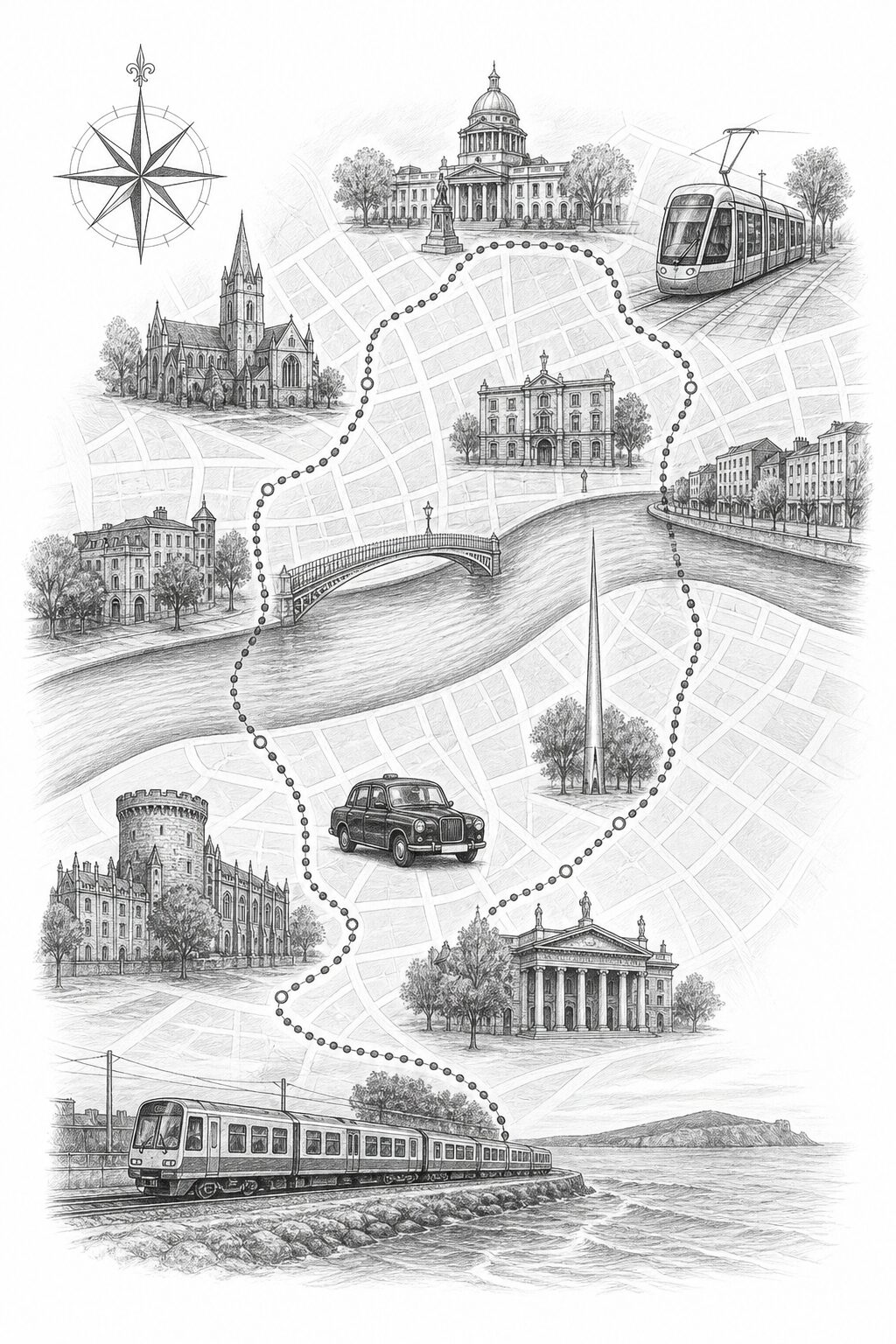
How the city fits together, in one paragraph: the River Liffey splits Dublin into the Northside and the Southside, a divide locals still joke about, and nearly everything a first-time visitor wants sits on the Southside within a walkable arc between Trinity College and the Guinness Storehouse. The Southside runs, roughly west to east, from the Liberties (old, working, distillery-scented) through Temple Bar and Trinity’s civic heart to the Georgian squares around Merrion Square, then out to the modern glass of the Docklands. South of that arc, the Grand Canal loops through the residential canal villages. The Northside carries its own weight: Smithfield and Stoneybatter’s cobbled village feel, and Phoenix Park’s enormous green sweep further west. Nothing in this article sits more than a Luas stop or a twenty-minute walk from something else in it.
Four habits make every walk below better. Time your visits with the crowd tides: the Guinness Storehouse and Book of Kells both fill up from midmorning through midafternoon, so an early start rewards you twice, once with thinner crowds and once with better light. Solve coffee and bathrooms together, since Dublin has fewer public facilities than visitors expect; any cafe purchase buys you both. Carry a light rain shell regardless of the forecast (the complete guide explains why Dublin’s weather refuses to commit to any season’s promises), and walk on the assumption that the district itself, not just its named sights, is the point; some of the best moments in this article happen on the connecting streets, not at the stops.
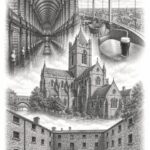
A short scene to carry with you before the first route: a first-time visitor, three days into her trip, admitted she had nearly skipped the Liberties entirely because it was not on her original must-see list, then found herself standing outside Marsh’s Library on a quiet Tuesday morning, the only visitor in the building, turning the pages of a locked reading cage built to stop eighteenth-century scholars from stealing rare books. That is the whole argument for this article in one image: the named sights get you into a district, but the district itself is what you remember.
Trinity College and Grafton Street: the civic heart
Who will love it: everyone, and especially first-time visitors on their opening afternoon.
The route (about two hours): Enter Trinity College through the Front Arch on College Green and cross Parliament Square toward the Old Library and the Book of Kells (the complete guide; book the timed entry ahead). Exit onto Nassau Street and turn onto Grafton Street, the pedestrianized spine where buskers set up most afternoons, an informal stage that has launched more than one Irish musical career and functions as genuine street culture rather than background noise. Stop at Bewley’s Cafe, trading on Grafton Street since 1927, for coffee and a pastry under its stained-glass windows. Continue to St Stephen’s Green, a Victorian park with a duck pond and shaded paths that makes an easy stop to sit down, and finish the loop at the landmark corner of the Shelbourne Hotel.
Food and coffee: Bewley’s for the full institution experience; the food stalls inside the Powerscourt Townhouse Centre, a Georgian townhouse turned shopping arcade, for a wider range of quick lunch options.
When to go: the buskers are the district’s afternoon show, so aim for 2 to 5pm if street music is part of the draw; for a calmer version of the same walk, arrive at opening, before the midday crowds arrive on Grafton Street.
Quieter alternative: the Georgian Dublin walk below covers the same general area with a fraction of the foot traffic.
Worth adding if time allows: the Powerscourt Townhouse Centre is worth a look even if you buy nothing beyond its food stalls, tucked into a converted Georgian mansion between the Book of Kells and Grafton Street proper. Trinity’s own cobbled quads reward a few minutes of unhurried wandering beyond the Old Library itself, a working university campus that happens to sit at the exact center of the city’s busiest shopping and sightseeing streets, a contrast worth noticing as you walk through it.
Temple Bar: the cobbled quarter, by day and by night
Who will love it: first-time visitors wanting the postcard version of Dublin, weekday afternoon browsers, and, on weekend nights, a very different crowd altogether.
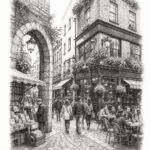
The route (about ninety minutes): Enter from College Green via Fleet Street and find the red-fronted Temple Bar pub itself, the most photographed building in the district. Cut through Merchant’s Arch to the Ha’penny Bridge, the elegant white pedestrian bridge over the Liffey named for the toll once charged to cross it. Back on the Temple Bar side, browse the weekend Temple Bar Book Market and the Cow’s Lane market if your visit lands on a Saturday, then find Meeting House Square, a small plaza that hosts outdoor film screenings and markets, and the Irish Film Institute alongside it.
Food and drink: mostly tourist-priced inside the core lanes; walk a street or two beyond the main block for better value at similar or better quality, a rule that applies across the whole district and is worth repeating (the complete guide covers the full logic).
When to go: by day for the arts-and-market atmosphere, genuinely worth seeing; the same lanes turn into a considerably rowdier stag- and hen-party scene after 9 or 10pm on weekends, which some visitors enjoy and others actively avoid.
Quieter alternative: cross the river and walk the north quays toward the Custom House instead, trading Temple Bar’s density for open river views.
Worth adding if time allows: Dublin Castle sits a short walk south of Temple Bar’s core lanes, its State Apartments open for a self-guided visit (the complete guide), and inside its grounds the Chester Beatty holds one of Europe’s finest small museum collections, entirely free and rarely crowded even when Temple Bar itself is heaving. Pairing the two turns a Temple Bar afternoon into a genuinely rounded half day: market atmosphere first, quiet scholarly treasure second.
Georgian Dublin: Merrion Square and St Stephen’s Green South
Who will love it: history readers, architecture admirers, and anyone who wants a slow, uncrowded morning even in peak season.
The route (about two hours): Start at Merrion Square, a garden square ringed by brightly colored Georgian doors and brass fanlights, a look so specifically Dublin it has its own postcard rack; Oscar Wilde’s childhood home faces the square from its northwest corner. Cross to the National Gallery of Ireland (free), whose collection runs from Caravaggio to the definitive Irish national collection. Walk to Leinster House, seat of the Irish parliament, then to the National Museum of Ireland’s Archaeology branch on Kildare Street (also free), home to the Tara Brooch, the Ardagh Chalice, and the preserved Iron Age bog bodies that stop most visitors cold. Finish at Fitzwilliam Square, the best-preserved of the Georgian squares, and walk back via Baggot Street.
Food and drink: Georgian-era pubs like Doheny & Nesbitt anchor Baggot Street with dark wood and a long political-drinking history attached.
When to go: any morning; this district carries very few crowds even at the height of summer, which makes it the calmest possible start to a Dublin day.
Quieter alternative: there is barely a busier version of this walk to avoid; it is already the quiet option in this article.
The Liberties: Dublin’s oldest quarter, and the Guinness Quarter
Who will love it: history lovers, drinkers of stout and whiskey, and anyone who wants to see a working, lived-in Dublin district rather than a polished one.
Frequently asked questions
How many days are enough for Dublin?
Three well-planned full days cover a strong first visit, while four or five allow slower neighborhoods, additional museums, or a day trip. Count usable sightseeing days rather than hotel nights.
What should be booked first?
Reserve the experience you would be most disappointed to miss, then secure lodging and any limited-entry sights. Verify current rules and opening information on the official operator’s website shortly before travel.
How do you avoid rushing?
Group each day geographically, allow time for security and transport, and treat extra stops as optional. One demanding reservation plus nearby flexible experiences usually produces a better day than a chain of timed entries.
Continue planning Dublin
- Complete Dublin travel guide
- 3 days in Dublin: first-time itinerary
- Where to stay in Dublin
- Best things to do in Dublin
- Dublin food guide
- Dublin first-time tips
- Dublin on a budget

Meet Leo: The Heartbeat Behind ‘A Country A Month’
Journeying through the pages of A Country A Month, you might often feel the rhythm of a storyteller’s heartbeat, pulsating through each line, each image, and each adventure shared. That heartbeat belongs to none other than our remarkable website editor, Leo.
With a lens in one hand and a pen in the other, Leo seamlessly marries his passions for photography and writing. His eye captures moments that words can barely describe, yet his eloquence brings those images to life, transcending borders and connecting us all through shared stories. An avid traveler, every country he’s visited has added another chapter to his expansive tale, and through our platform, he generously shares these chapters with us.