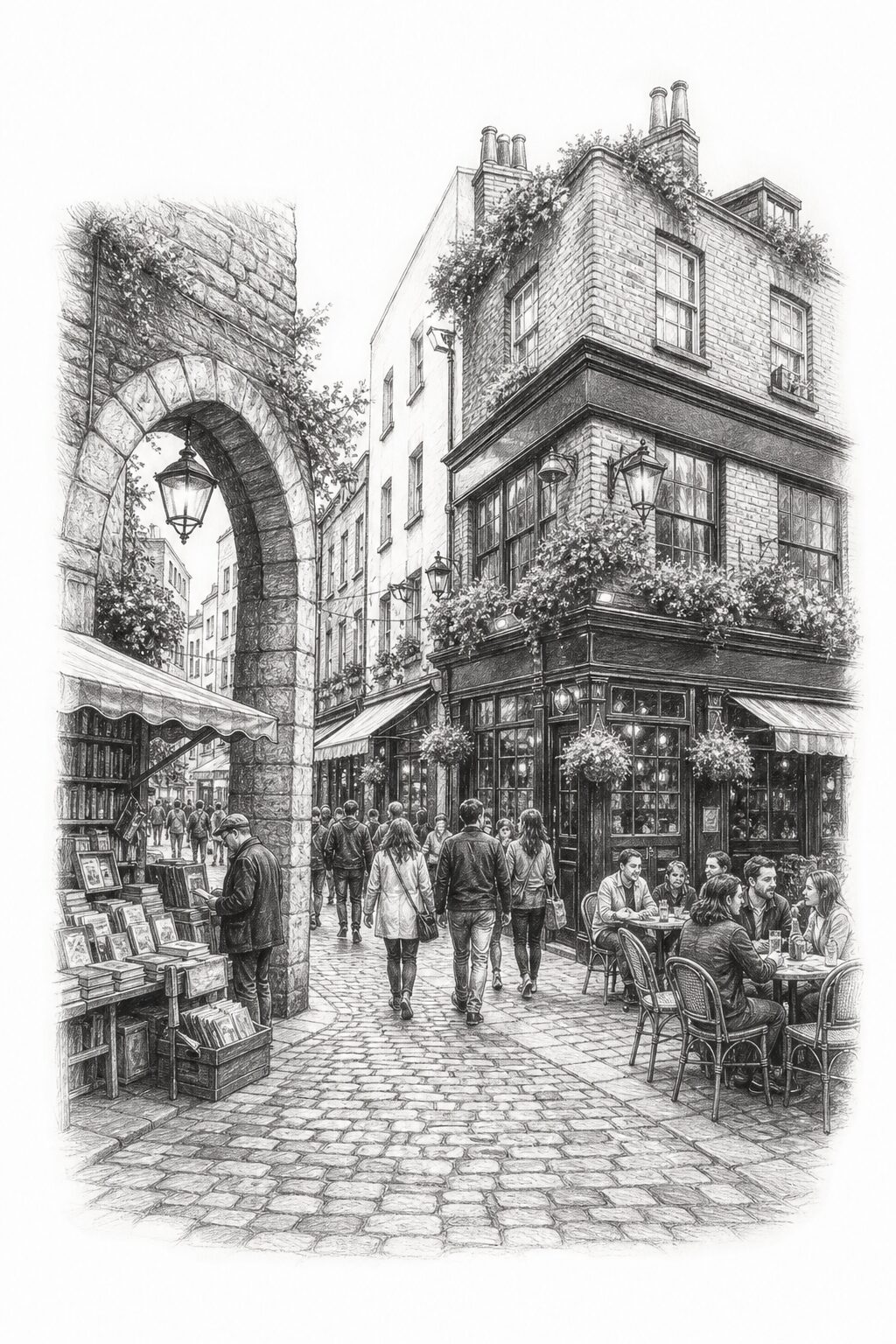
Visiting Dublin on a budget does not require stripping the trip of its best experiences. The useful approach is to control the large costs, use public space deliberately, spend on the few reservations that truly matter, and avoid convenience charges that add little value.
Use this article with the complete Dublin travel guide, the three-day itinerary, and the where-to-stay guide.
Here is the sentence that saves you the most time in Dublin: the city center is smaller than it looks on the tourist map, and most first-timers spend money on taxis for trips that are faster, cheaper, and more interesting on foot. Dublin never built the sprawling metro of London or Paris, and it shows, but what it lacks in rail coverage it makes up for in scale: this is a capital you can walk across, end to end, in under an hour.
From Dublin Airport to the center
Dublin Airport (DUB) sits about 10 kilometers north of the city center, and you have four honest ways in. Fares below are as of this writing and worth confirming on the operators’ sites before you fly, since airport transport prices tend to creep.
Aircoach’s route 700 runs around the clock, every 15 minutes at peak times, and covers the city center loop (O’Connell Street, St Stephen’s Green, and the main hotel districts) in 20 to 40 minutes depending on traffic, for about EUR 6 one way or EUR 8 return booked online, with discounts for students and families. It is the closest thing Dublin has to a default airport bus. Airlink Express (routes 747 and 757) runs a similar city-center loop with stops at O’Connell Street, Trinity College, and Heuston Station, useful if your hotel sits near one of those, in 30 to 45 minutes; check Dublin Bus’s site for the current fare before you travel. Dublin Express (routes 782 to 784) offers a third bus option at broadly comparable timing, with fares that vary by route. A metered taxi takes 30 to 45 minutes and runs roughly EUR 25 to 40 to the center depending on traffic and time of day, sensible for a group of three or four splitting the fare, or for a late arrival when the buses have thinned out. For a solo traveler or a couple with light bags, the bus wins on value every time.
One honest caveat for the years ahead: a long-planned underground MetroLink line to the airport has been in construction and planning as of this writing, and its status and any opening date are worth checking before you travel, since a direct rail link would change this whole equation.
The Leap Card and how fares actually work
Dublin’s contactless smartcard is the Leap Card, valid across Dublin Bus, Go-Ahead Ireland buses, the Luas trams, and DART and commuter rail. Visitors can buy a Leap Visitor Card, preloaded and ready to tap, at the airport or in the city center, which spares you the separate step of registering a card. Single adult fares on Dublin Bus with a Leap Card run about EUR 1.50 for a short hop, EUR 2.00 for a longer trip, and EUR 2.40 for the Xpresso limited-stop routes; paying cash on board costs more and drivers do not carry change, so the card is worth having from your first day.
The feature that quietly rewards a longer stay is fare capping. Across a single Zone 1 day, running 4:30am to 4:29am the next morning, an adult’s combined spending on bus, Luas, and DART tops out at about EUR 6.00; across a week, the cap is about EUR 24.00. You still tap on and off every journey (this matters: skipping the tap-off can cost you the higher fare), but once you cross the cap the rest of the day, or week, rides free. For a visitor doing three or four journeys a day between sights, hotel, and dinner, the daily cap usually kicks in without you trying, which makes the Leap Card better value than pre-buying any tourist transit pass. Confirm current fares and cap amounts on the Leap Card website before you travel, since fares are reviewed periodically.
Luas and DART: Dublin’s two rail lines
The Luas is Dublin’s light rail, two lines that do not directly meet. The Red Line runs from the Docklands and Connolly Station through the city center out to Tallaght and Saggart in the southwest, useful for reaching the Docklands, the Collins Barracks museum campus, and the western suburbs. The Green Line runs from Broombridge through St Stephen’s Green out to Bride’s Glen in the south, useful for the Georgian southside and the coastal suburbs beyond Dundrum. The two lines cross near O’Connell Street, but changing between them means a short walk rather than a same-platform transfer, so build a few extra minutes into any journey that needs both.
The DART, Dublin Area Rapid Transit, is the electrified coastal railway, and it might be the single most pleasant transit ride in any city in this series. It runs roughly from Malahide and Howth in the north down through the central stations (Connolly, Tara Street, Pearse) to Greystones in the south, tracing Dublin Bay the whole way. It is the fastest and most scenic way to reach Howth for the day (the complete guide), and simply riding it along the coast on a clear afternoon counts as a sight in its own right, not just a means of getting to one.
Buses fill in everywhere the trams and trains do not, run by Dublin Bus and Go-Ahead Ireland, but they share the road with the same traffic you do, and central Dublin has no dedicated rapid-transit corridor yet, so a bus can be the slowest option at busy hours even when it is the most direct one on the map.
Walking Dublin: the city’s real transit system
Central Dublin rewards walking more than any other mode, and the distances are shorter than visitors expect. Trinity College to Temple Bar is a five-minute stroll. Trinity to the Guinness Storehouse runs about 25 to 30 minutes along the river or through the Liberties, a genuinely enjoyable walk rather than a chore. Most of the sights a first-time visitor actually wants sit inside a 20-minute walking circle centered roughly on Trinity College and Grafton Street. The practical lesson: before you hail a taxi for a short hop, check the distance; on a compact, flat, low-rise city like this one, you will often arrive on foot before the taxi even clears traffic near the quays.
Taxis, ride-hail, and the classic traps
Dublin taxis are metered, with a flag fare of around EUR 4.10 plus roughly EUR 1.14 per kilometer, and rates step up after 8pm on weekdays and all day on Sundays and public holidays, so a fare that felt reasonable at 2pm can run noticeably higher for the same trip home at midnight. Sample fares run around EUR 10 for a 5-kilometer hop, EUR 15 for 10 kilometers, and EUR 21 for 15 kilometers, useful benchmarks for spotting a meter running unusually fast. Uber operates in Dublin, but unlike many cities it dispatches licensed, metered taxis rather than private drivers, so the price stays close to what a street-hailed cab would charge; it buys you convenience and a fixed pickup point rather than a discount. Tip by rounding up to the nearest euro or two, and add EUR 2 to 3 more for an airport run involving luggage. The one genuine trap to watch for is the same one that trips up visitors everywhere: an unmetered “taxi” idling near a nightlife strip late at night. A real Dublin taxi always runs a meter; if a driver quotes a flat fare instead of switching it on, walk to the next car.
Bikes, and why not to drive
Dublinbikes, the public bike-share scheme, has docking stations across the city center and is genuinely well used for short hops, particularly along the canals and the river, where the cycling infrastructure is decent; it thins out once you push into the older, narrower streets of the historic core. As for driving, resist it inside the city: Georgian Dublin was built around narrow, one-way streets never designed for modern traffic, parking is scarce and pricey, and nothing in the center benefits from a rental car. Save the car rental, if you want one, for the day you actually leave the city for the wider countryside beyond the complete guide day trips.
Frequently asked questions
How many days are enough for Dublin?
Three well-planned full days cover a strong first visit, while four or five allow slower neighborhoods, additional museums, or a day trip. Count usable sightseeing days rather than hotel nights.
What should be booked first?
Reserve the experience you would be most disappointed to miss, then secure lodging and any limited-entry sights. Verify current rules and opening information on the official operator’s website shortly before travel.
How do you avoid rushing?
Group each day geographically, allow time for security and transport, and treat extra stops as optional. One demanding reservation plus nearby flexible experiences usually produces a better day than a chain of timed entries.
Continue planning Dublin
- Complete Dublin travel guide
- 3 days in Dublin: first-time itinerary
- Where to stay in Dublin
- Best things to do in Dublin
- Dublin food guide
- Dublin first-time tips
- Dublin on a budget

Meet Leo: The Heartbeat Behind ‘A Country A Month’
Journeying through the pages of A Country A Month, you might often feel the rhythm of a storyteller’s heartbeat, pulsating through each line, each image, and each adventure shared. That heartbeat belongs to none other than our remarkable website editor, Leo.
With a lens in one hand and a pen in the other, Leo seamlessly marries his passions for photography and writing. His eye captures moments that words can barely describe, yet his eloquence brings those images to life, transcending borders and connecting us all through shared stories. An avid traveler, every country he’s visited has added another chapter to his expansive tale, and through our platform, he generously shares these chapters with us.