Planning a trip to Athens is easier when the city is treated as a set of connected neighborhoods and decisions, not a checklist of famous names. This complete guide brings together the essential sights, the right time to visit, transport, places to stay, food, realistic costs, and the choices that most affect a first trip.
Use this article with the complete Athens travel guide, the three-day itinerary, and the where-to-stay guide.
Stand at a red light on almost any downtown Athens street corner, wait for a gap in the scooters, and look up. There it is again: the Acropolis, lit gold in the evening or pale gray under midday haze, sitting directly above the traffic and the graffiti and the orange trees, exactly where it has sat for two and a half thousand years. Nobody points at it. Athenians walk past it the way New Yorkers walk past the Empire State Building, which is precisely the thing that makes it extraordinary. Nowhere else on earth does a monument this consequential to human history sit this close to ordinary life, visible from a bus stop, a rooftop bar, a balcony hung with laundry.
That collision, ancient marble and modern mess, sacred ruin and unpretentious neighborhood, is what this book is for. Greece welcomed roughly 36 million international visitors in a recent year, and Athens is the country’s front door, the place nearly everyone lands before scattering to the islands. The Acropolis alone drew over 4.5 million of them, making it Greece’s single most visited site by a wide margin. Those numbers can make a first-time visitor brace for crowds and queues and nothing else, and there is some truth to that (the complete guide gives you the crowd-beating playbook). But the real Athens story is different: this is a city that rewards a slower pace than its headline sights suggest, where the food is cheap by Western European standards and genuinely, unfussily good, and where a metro ride can double as a small archaeology museum.
Athens is not conventionally pretty the way Paris or Prague are pretty. Long stretches of it are 1960s and 1970s apartment blocks, heavy on concrete and graffiti, and the approach from the airport or the main transit hubs can feel gritty before it feels charming. This book will not pretend otherwise. What it will do is tell you honestly where the beauty concentrates (the marble streets of the Acropolis slopes, the whitewashed lanes of Anafiotika, the golden hour view from Lycabettus), where the grit is worth pushing through, and where it genuinely is not.
This guide is built the way a longtime resident would build it for a friend who is finally coming to visit. First the city itself, what it feels like to arrive and what shaped it into the place you are about to walk through. Then its signature sights, with honest verdicts about which ones earn a place in a short visit and which are optional. Then the planning layer: when to come, how to move through the city, and where to sleep. Then Athens up close, neighborhood by neighborhood, each with a walkable route you could follow this afternoon. Then the food, the culture, the day trips to the islands and beyond, and ready-made itineraries for one, two, and five days. And at the end, the deeper story: how Athens became Athens across three very different eras, and the people (the licensed guides, the market traders, the Evzones at Syntagma, the taverna families) who keep it running today.
A word on what this book is not. It is not a directory. Athens has apps and official sites for exhaustive listings, and they update faster than any book can. What a book can still do better is judge, sequence, and tell you the truth at length: which timed-entry slot to book and how far ahead, which famous ruin is quietly skippable, what order turns a scattered list of sights into one satisfying day, and why the city looks the way it does, so that what you are seeing means something when you see it. Where a specific restaurant or price appears in these pages, it has either outlived decades of trends or it is hedged and dated, because nothing ages a guidebook faster than false confidence about things that change season to season.
Two promises about how this book works. Every price and rule here was accurate when this was written, and where things move often (ticket prices, timed-entry rules, transit fares, heat-closure policies), you will see the phrase “as of this writing” and a pointer to the official site to confirm, because Athens revises these more often than any guidebook’s print run. And nothing in here is padding. If a famous stop is genuinely optional for your trip, this book will say so plainly and tell you what to do instead.
One honest note before the complete guide: Athens tends to surprise people who arrive expecting either a museum piece or a rough transit hub and get neither. Consider yourself warned, and read on.
Action Steps
- Decide your trip length now; three focused days cover the essentials, four to five let you add a day trip and a slower pace, and the itineraries in the complete guide are built for one, two, and five days.
- Before booking flights, skim the complete guide for which sights need timed-entry tickets and the complete guide for the month-by-month reality, especially if you are traveling June through September.
- Keep a running list of what needs advance booking (the Acropolis in peak season, popular day tours, festival performances) and revisit it as your dates firm up.
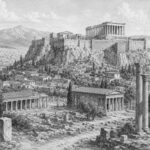
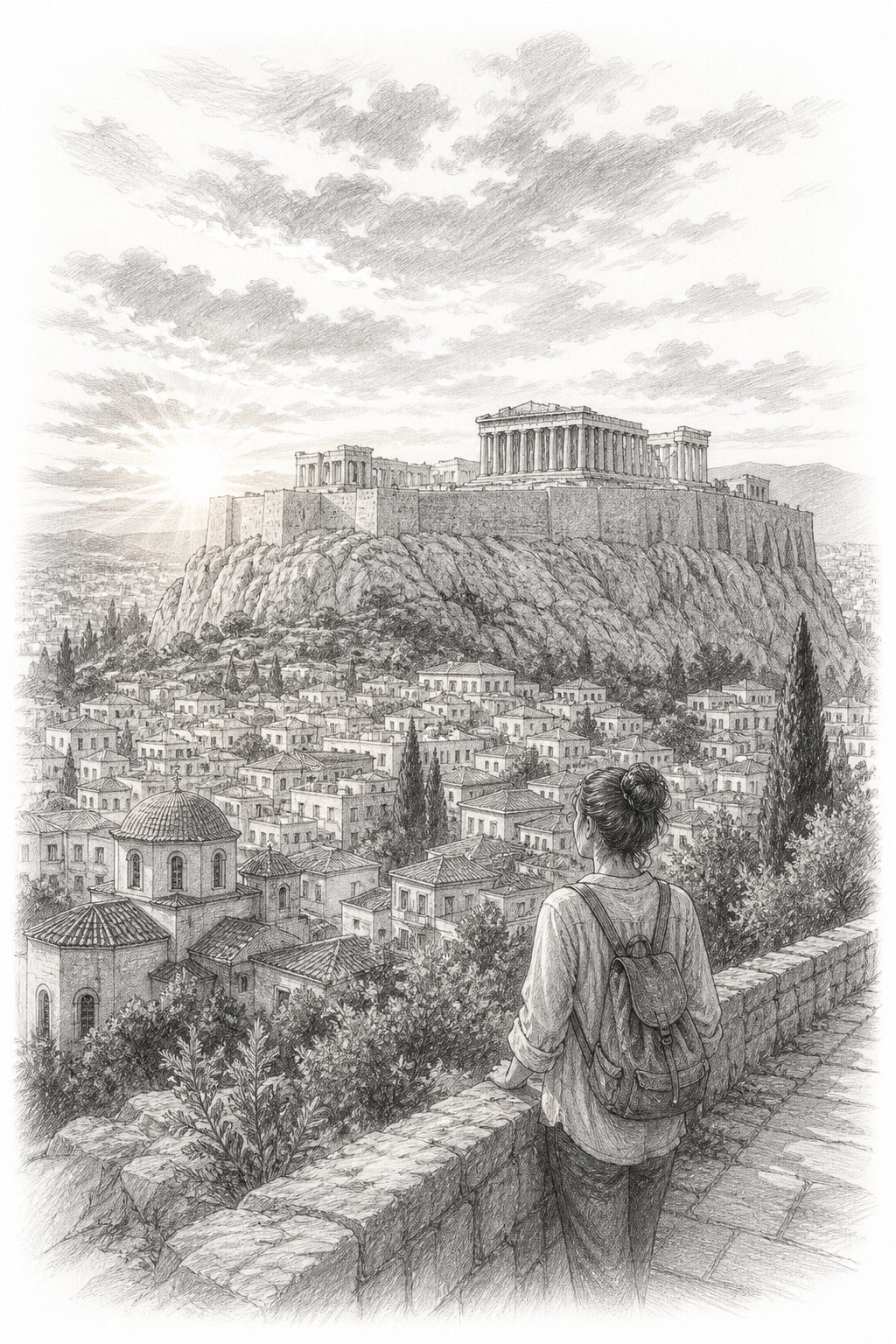
Come up out of the Acropoli metro station, cross Dionysiou Areopagitou, and look up. The Parthenon sits directly above you, close enough that you can make out individual column flutes without a zoom lens, its marble somewhere between honey and bone depending on the hour. Scooters buzz past. A café pours frappés twenty feet from a fence marking two and a half thousand years of continuous history. Somewhere behind you a stray cat naps in a patch of shade cast by an olive tree that might itself be older than your own country. This is not a recreation, a viewing platform, or a themed district built to look old. It is simply where Athens has always been, and you have just walked into it.
Now here is the thing that takes most visitors a day or two to absorb: that view is not one city but three, stacked on the same patch of ground so thoroughly that you can often see all three eras from a single street corner. There is Classical Athens, the fifth-century-BC city of Pericles and Socrates that gave the world democracy, philosophy, and tragedy, and that built the marble you are looking at right now. There is Byzantine and Ottoman Athens, the long, quieter centuries when the Parthenon served at times as a church and then a mosque, and the city shrank to a provincial town clustered around this rock. And there is modern Athens, the sprawling twentieth-century capital of apartment blocks and boulevards, built almost from scratch after 1834 specifically because this ancient prestige made the small hillside town worth crowning a nation’s capital. Learning to see all three at once, rather than hunting for one and tuning out the other two, is the real skill this book wants to teach you.
A city built on three eras
Athens has been continuously inhabited for roughly 7,000 years, but the city that draws travelers today is really defined by three distinct chapters, each of which left something you can still stand inside.
The first is the Classical city of the fifth century BC, Athens’ defining moment and the one most visitors come for. After the Persians burned the earlier buildings on the Acropolis in 480 BC, the statesman Pericles directed a rebuilding program that produced the Parthenon (dedicated to the goddess Athena, built between 447 and 438 BC under the sculptor Phidias), the Erechtheion, and the Propylaea gateway you walk through to reach them. This was also the golden age of Athenian democracy, of Socrates teaching in the Agora below the rock, and of the tragedians Aeschylus, Sophocles, and Euripides, whose plays premiered at the Theatre of Dionysus on the Acropolis’ south slope, a stage you can still walk into today.
The second chapter is centuries long and far quieter: decline after Athens’ defeat by Sparta in the Peloponnesian War, then rule by Macedonians, Romans (who left the Roman Agora, the Tower of the Winds, and Hadrian’s Library), Byzantines, and finally the Ottomans, who held the city for nearly four hundred years, from 1458 to 1833. The Parthenon spent part of this era as a mosque, and in 1687 a Venetian mortar shell struck an Ottoman gunpowder store inside it, a single explosion that did more physical damage to the building than the previous two thousand years combined; the scars are still visible on the ruin you visit today.
The third chapter is the modern city around you. In 1834, the newly independent Kingdom of Greece chose Athens as its capital specifically for that ancient prestige, despite it being at the time a small town of only a few thousand people clustered around the Acropolis and Plaka. Bavarian and Greek architects laid out the neoclassical grid, Syntagma Square, the university-academy-library “trilogy,” that still shapes downtown. The city then swelled dramatically after 1922 and 1923, when roughly 1.2 million Greek refugees arrived from Asia Minor following a population exchange with Turkey, nearly doubling Athens’ population almost overnight and founding entire neighborhoods, among them Nea Smyrni and Nea Ionia, still named for the homelands their first residents lost. the complete guide tells this whole story properly; for now, the point is simply this: nearly everything you will walk past this week, the graffiti, the concrete, the neoclassical mansion beside the parking garage, is a visible trace of one of these three eras layered onto the last.
A basin ringed by hills
Athens sits in a bowl, hemmed by four mountains (Hymettus, Penteli, Parnitha, and Aigaleo) and opening south to the Saronic Gulf and the port of Piraeus, the city’s lifeline to the sea and the islands since antiquity. Building height near the center is limited by law, so Athens has almost no skyline in the way Paris or New York has one; instead it spreads low and wide, apartment block after apartment block, with the Acropolis rock rising straight out of the middle of it as the one unmistakable landmark. Once you know that shape, the city stops feeling like a maze. The historic core (Plaka, Monastiraki, Syntagma, Thiseio, Koukaki) rings the rock and is compact and walkable. Kolonaki and Lycabettus climb the slope northeast of it. Everything else radiates outward from there, and Piraeus sits at the bottom of the bowl to the south, twenty to twenty-five minutes away by metro.
The Municipality of Athens itself holds roughly 640,000 to 665,000 residents, but the wider metropolitan area, some fifty-eight municipalities across Attica, holds somewhere between 3.1 and 3.8 million people depending on how the boundary is drawn, easily Greece’s largest urban area and home to about a third of the country’s entire population. You will feel that scale the moment you leave the compact historic center; Athens is a real, sprawling capital, not a boutique old town, and this book is built to help you move through it efficiently rather than pretending it is smaller than it is.
A day in the life
To understand what you are joining, run the city through one rotation. Before dawn, the Varvakios Central Market on Athinas Street is already loud, fishmongers and butchers working a trade that has continued on the same spot for generations, and the market’s late-night soup stalls are only just finishing feeding the night’s last customers. By 7am the metro is filling with commuters who walk straight past the excavated antiquities behind glass at Syntagma and Acropolis stations without a second glance, the way you might ignore an advertisement, because to them it is simply the wall of the platform. Mid-morning belongs to the sightseers: this is your shift, when the Acropolis gates open, the guard changes on the hour at Syntagma, and the museums settle into their quietest rhythm of the day. At midday in summer, the rhythm changes entirely; shutters come down over smaller shops, cafés fill with people waiting out the heat over a slow frappé, and in the worst heatwaves the open-air sites close their gates until the afternoon eases. Evening is when Athens exhales: tavernas do not really start filling until 8:30 or later, rooftop bars around Monastiraki and Plaka turn on their lights with the floodlit Acropolis as the backdrop no interior designer could improve on, and dinner runs late into the night, particularly in summer. The city has kept some version of this rhythm for millennia, heat and all. You are stepping into a long-running show, not a performance staged for your visit.
The numbers, briefly
For sightseers, the headline figures set expectations well. As of this writing, Greece welcomes roughly 36 million international arrivals in the most recent full year on record, a figure that keeps climbing year over year, and Athens is the country’s primary gateway. The Acropolis alone draws over 4.5 million visitors a year, Greece’s most visited archaeological site by a wide margin, and the Acropolis Museum below it draws close to 2 million, Greece’s most visited museum. Across the country, archaeological sites and museums together log more than 20 million visits a year, generating roughly €171 million. Those numbers explain both the crowds you will occasionally meet at the Acropolis gate around midday and the very good reason the complete guide spends so much energy on timing your visits around them.
What genuinely makes Athens special
Plenty of cities have ancient history behind glass or roped off in a park. Athens has it in the middle of daily life. You will see the Parthenon from a gym window, a rooftop laundry line, a bar stool, and a bus stop, not because the city has been dressed up for you but because that is simply where the buildings are and always were. The archaeology runs directly under the modern street grid too; building the metro turned into one of the largest archaeological excavations in Europe, and the finds are now displayed inside the stations themselves at Syntagma and Acropolis, so a normal commute doubles as a small museum visit.
Then there is the food, unpretentious and genuinely good rather than performed for visitors (the complete guide goes deep on this), and the price advantage: Athens remains noticeably gentler on the wallet than Western Europe’s other major capitals for meals, coffee, and much of daily life. And there is the island connection: Piraeus, twenty minutes from the center by metro, is one of the busiest passenger ports in the Mediterranean, which means Athens naturally combines with a ferry onward to the Saronic Gulf or beyond, an option few European capitals can offer so easily (the complete guide).
Now the honest cons, because this book deals straight with you. Athens is not conventionally pretty in the postcard sense; much of the city outside the historic core is plain, graffiti-heavy apartment blocks from the 1960s and 1970s, and the approach from the airport or the main hubs can feel gritty before it feels charming. Summer heat is serious and getting worse: the city now regularly sees days above 40°C (104°F) in July and August, and authorities have repeatedly closed the Acropolis and other open-air sites at midday during recent heatwaves, so check the current-season policy before you build a July itinerary. Pavements are uneven citywide, and Plaka’s lanes are steep and cobbled, genuinely difficult terrain for strollers or mobility devices. Petty theft and a handful of recurring scams exist, mostly around crowded metro cars and major squares (the complete guide tells you exactly what to watch for). None of this should keep you away. All of it is easier to handle when someone tells you in advance, which is the entire point of this book.
The districts at a glance
You will get the full walking-route treatment in the complete guide, but start forming the mental map now. Plaka and Anafiotika hold the postcard old town at the Acropolis’ foot, pedestrian lanes and a tiny whitewashed hillside quarter. Monastiraki is the chaotic, central market district, best and fullest on Sunday morning. Syntagma is the civic core: Parliament, the changing of the guard, and the National Garden’s shade. Koukaki, tucked behind the Acropolis Museum, is the residential, café-lined neighborhood this book recommends as your first-visit base. Thiseio and Philopappou Hill are the green, quiet side of the ancient city, with the best sunset view in Athens. Kolonaki climbs the slope toward Lycabettus and does upscale boutiques and museums; Lycabettus itself is the city’s highest viewpoint. Psiri and Gazi carry the street art and the nightlife, with Kerameikos, the least crowded of the major ancient sites, sitting between them. And Pangrati, a quiet residential quarter near the Panathenaic Stadium, is the neighborhood this book’s readers consistently discover is their favorite by the second visit, precisely because so few visitors give it enough attention on the first.
Who this city is best for
Athens suits history and mythology lovers, food-focused travelers who want flavor without performance, anyone combining a city stay with island-hopping from Piraeus, walkable-city fans who enjoy a mix of ancient grandeur and gritty-cool modern texture, and travelers who want a genuinely lower cost of living than Western Europe’s marquee capitals. It rewards a slower, less checklist-driven pace than its famous ruins might suggest; the visitors who leave happiest are usually the ones who gave the city a little unstructured time rather than sprinting between timed-entry slots.
Who might prefer somewhere else? Travelers who want manicured, postcard-pretty streets at every turn (that city exists elsewhere in Greece, not really here), anyone very heat-sensitive planning a July or August trip, and travelers dreaming of a flat, car-free, cobblestone fairy tale in every direction; Athens is bigger, hotter, and more workaday than that fantasy, even as its historic core delivers plenty of genuine magic. If your idea of a great trip is a rock rising out of ordinary life rather than a city entirely arranged around it, keep reading.
Action Steps
- Hold the three-eras map in your head: Classical Athens (the rock and the Agora), the long Byzantine-Ottoman middle, and the modern capital built after 1834; most of what you see this week is a trace of one of the three.
- Accept the scale: Athens is a sprawling capital of several million people, not a boutique old town; plan days around the compact historic core and treat everything farther out as a deliberate excursion.
- Note the heat pattern now if you are traveling June through August, and read the complete guide before you lock your dates.
- If it is your first visit, give Athens three to five days; it is the difference between checking off the Acropolis and actually meeting the city.
Every city has a short list of things you would regret missing, and in Athens that list is dominated by one extraordinary hill and a handful of worthy companions around it. This article is that list: the sights visitors cross oceans for, each with the practical truth attached, what it costs, how far ahead to book, when to go, and, where it matters, an honest worth-it verdict. If you see nothing else in Athens, see these; and where one of these is genuinely optional for your trip, this article will say so plainly.
A note that will save you time and money all week: Athens’ single essential paid ticket, the Acropolis, is also its single most crowded morning. Everything else on this list is calmer, cheaper, or both, so spend your planning energy where it counts most, and do not let the one famous queue convince you the rest of the city works the same way.
The Acropolis
The reason you are here. The rock has been fortified and inhabited since the Bronze Age, but the buildings you have come to see, the Parthenon, the Erechtheion with its six caryatid maidens holding up the porch roof, and the monumental Propylaea gateway, date to the rebuilding program Pericles directed in the mid-400s BC after the Persians destroyed the earlier temples. As of this writing, a single ticket covering the whole site runs €30 for adults year-round (roughly $32 to $33), with reduced and free categories for students, seniors, and children under conditions worth checking on the official site. Timed-entry booking is essential, especially June through September, when walk-up queues have run to two hours; book online as far ahead as you can once your dates are fixed, and expect to book one to two weeks out in peak summer.
Frequently asked questions
How many days are enough for Athens?
Three well-planned full days cover a strong first visit, while four or five allow slower neighborhoods, additional museums, or a day trip. Count usable sightseeing days rather than hotel nights.
What should be booked first?
Reserve the experience you would be most disappointed to miss, then secure lodging and any limited-entry sights. Verify current rules and opening information on the official operator’s website shortly before travel.
How do you avoid rushing?
Group each day geographically, allow time for security and transport, and treat extra stops as optional. One demanding reservation plus nearby flexible experiences usually produces a better day than a chain of timed entries.
Continue planning Athens
- Complete Athens travel guide
- 3 days in Athens: first-time itinerary
- Where to stay in Athens
- Best things to do in Athens
- Athens food guide
- Athens first-time tips
- Athens on a budget

Meet Leo: The Heartbeat Behind ‘A Country A Month’
Journeying through the pages of A Country A Month, you might often feel the rhythm of a storyteller’s heartbeat, pulsating through each line, each image, and each adventure shared. That heartbeat belongs to none other than our remarkable website editor, Leo.
With a lens in one hand and a pen in the other, Leo seamlessly marries his passions for photography and writing. His eye captures moments that words can barely describe, yet his eloquence brings those images to life, transcending borders and connecting us all through shared stories. An avid traveler, every country he’s visited has added another chapter to his expansive tale, and through our platform, he generously shares these chapters with us.