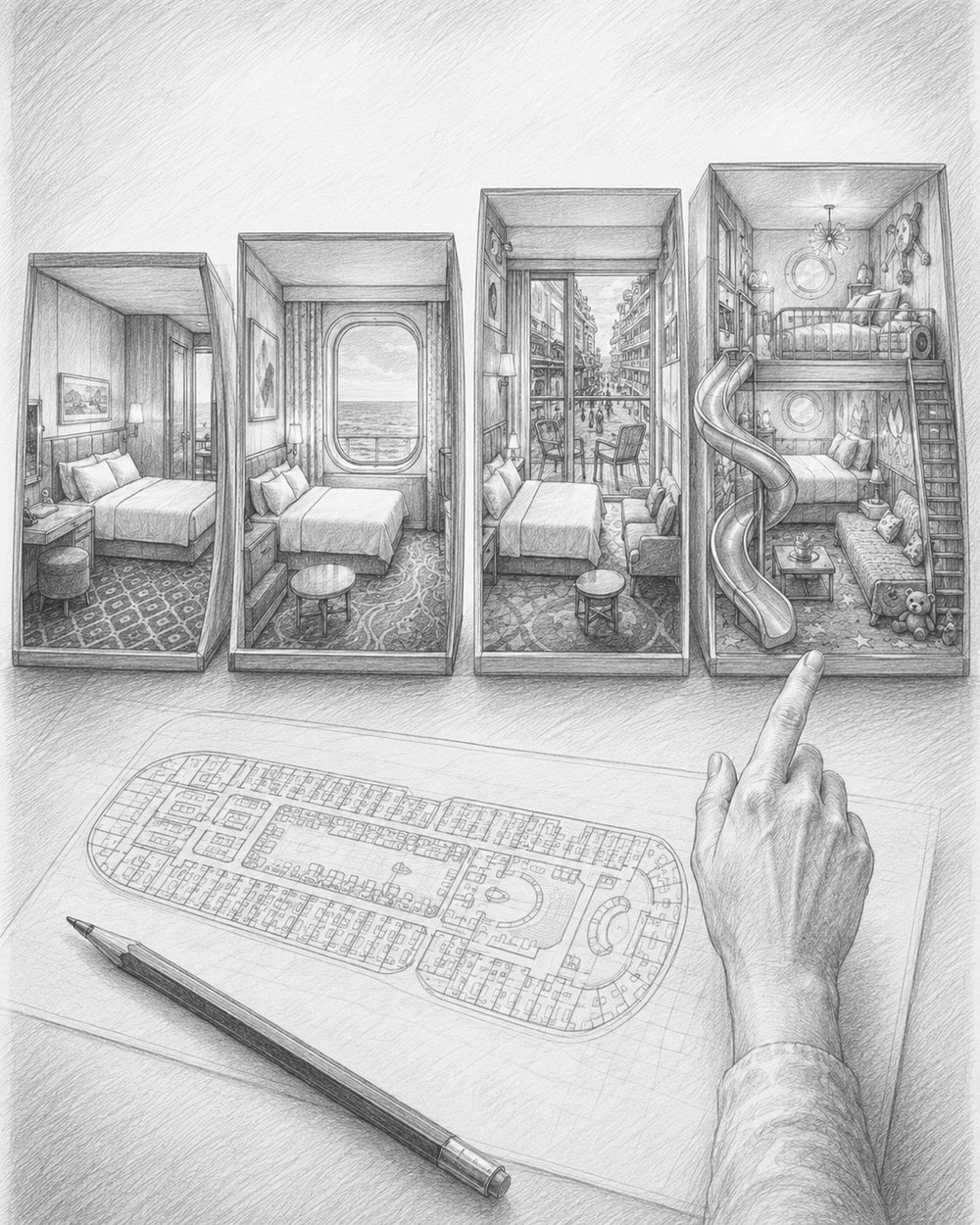
What are the best cabins on Harmony of the Seas? For most people the honest answer is a midship balcony on one of the mid-decks: close to the elevators and neighborhoods, steady underfoot, and giving you real ocean light and fresh air without paying suite money. If you are watching the budget, a plain interior or one of the value Central Park-view and Boardwalk-view interiors gets you aboard for the least, and you will spend most of your waking hours out in the ship anyway. The trick is knowing which rooms are worth the money, which “view” is actually a view, and which spots to avoid so a bargain does not turn into a week of broken sleep. This guide walks through every category and the trade-offs that matter.

Everything in this article and far more, deck by deck, in The Ultimate Guide to Sailing on Harmony of the Seas.
Get the book →Harmony of the Seas is the third ship in Royal Caribbean’s Oasis Class, and for a time she was the largest cruise ship in the world. She carries roughly 5,400 guests at double occupancy and up to about 6,600 when full, spread across around sixteen guest decks and seven neighborhoods. That scale is the whole reason cabin choice matters here. On a smaller ship a room is just a place to sleep; on a ship this size your cabin decides how far you walk to breakfast, whether you wake to a sunrise or a stranger’s balcony, and whether the AquaTheater show is a spectacle you stroll down to or a bassline through your floor.
How cabins are organized on an Oasis-Class ship
Before you pick a room, it helps to understand what makes this class unusual. Two of the ship’s seven neighborhoods, the open-air Central Park with its thousands of live plants and the Boardwalk with its hand-carved carousel and aft AquaTheater, run down the middle of the ship like open canyons. That architecture created a family of cabins that do not exist on ordinary ships: rooms that face inward over a park or the rides rather than out to sea. So on Harmony you are choosing along two axes at once. The first is the traditional ladder from interior to ocean view to balcony to suite. The second is which direction your window points: out to the ocean, or in over a neighborhood. The best value on the ship comes from playing them off each other.
Keep in mind that within any single category, the exact room location still matters enormously on a vessel this long. A balcony near the middle of the ship and a balcony far forward are the same price and a completely different week. That is why the deck plan in the Royal Caribbean app is your most important tool once you have settled on a category. For a broader picture of how the whole ship fits together, our Harmony of the Seas cruise guide maps the neighborhoods, and what to expect on Harmony of the Seas covers the daily rhythm your cabin choice plugs into.
Interior cabins: the smart budget play
The interior cabin is the least expensive way onto Harmony of the Seas, and on a ship with this much to do it is a genuinely defensible choice rather than a compromise. You are out at the FlowRider, the Ultimate Abyss, the pools, Central Park, and dinner for most of the day. The room is where you shower, change, and sleep. Traditional interiors have no window at all, which means darkness so complete you may sleep past a port arrival, so set an alarm on mornings you want to catch.
Where the interior category gets interesting on this class is the two special sub-types. The Central Park-view interior and the Boardwalk-view interior both have a real window, but instead of the ocean it looks inward over one of those open neighborhoods. A Central Park-view room wakes you to greenery, string lights, and the quiet murmur of the park; a Boardwalk-view room looks down over the carousel, the rock walls, and the AquaTheater stage. These cost more than a windowless interior but usually less than an ocean-view or balcony room, and for travelers who want light and a sense of place without the full balcony price, they are the sweet spot. Just understand the trade: you are trading a sea horizon for a courtyard, and on the Boardwalk side you are trading it for noise, which we will come back to.
There is a third clever option. Some interiors come with a Virtual Balcony, a floor-to-ceiling screen streaming a live feed from the ship’s exterior cameras in real time. It is not fresh air, but it hugely reduces the closed-in feeling of a true inside room and lets you glance at the sea state from bed. If a windowless interior makes you claustrophobic but a balcony is out of budget, it is the compromise to look for.
- Standard interior — cheapest fare, pitch-dark, great for people who treat the room as a place to sleep.
- Virtual Balcony interior — windowless but with a live exterior screen; the anti-claustrophobia upgrade.
- Central Park-view interior — a real window over the garden; calm, leafy, and quiet.
- Boardwalk-view interior — a real window over the carousel and AquaTheater; lively but louder.
Ocean View: a window on the sea for less than a balcony
Ocean View cabins sit between interiors and balconies. You get a sealed window or porthole looking straight out at the water, natural light, and a proper sense of where you are, but no outdoor space and no sliding door. For a lot of cruisers this is the honest value pick: the biggest jump in cabin quality is going from no window to a window, and the second jump, from a window to a door you can open, costs proportionally more for less added benefit. If you love waking to the sea but rarely picture yourself sitting outside, an Ocean View room saves money without the closed-in feeling of an interior. It also beats a neighborhood-view room on an unobstructed horizon and real daylight rather than a courtyard.
The caution with Ocean View is obstruction. Lifeboats and tender platforms run along certain lower, outer decks, and some Ocean View windows look straight onto that equipment instead of open water. These rooms are usually sold at a discount, which can be a fine deal if you only want light, but check the deck plan closely so you know what you are getting before you book.
Balcony cabins: the best all-round choice
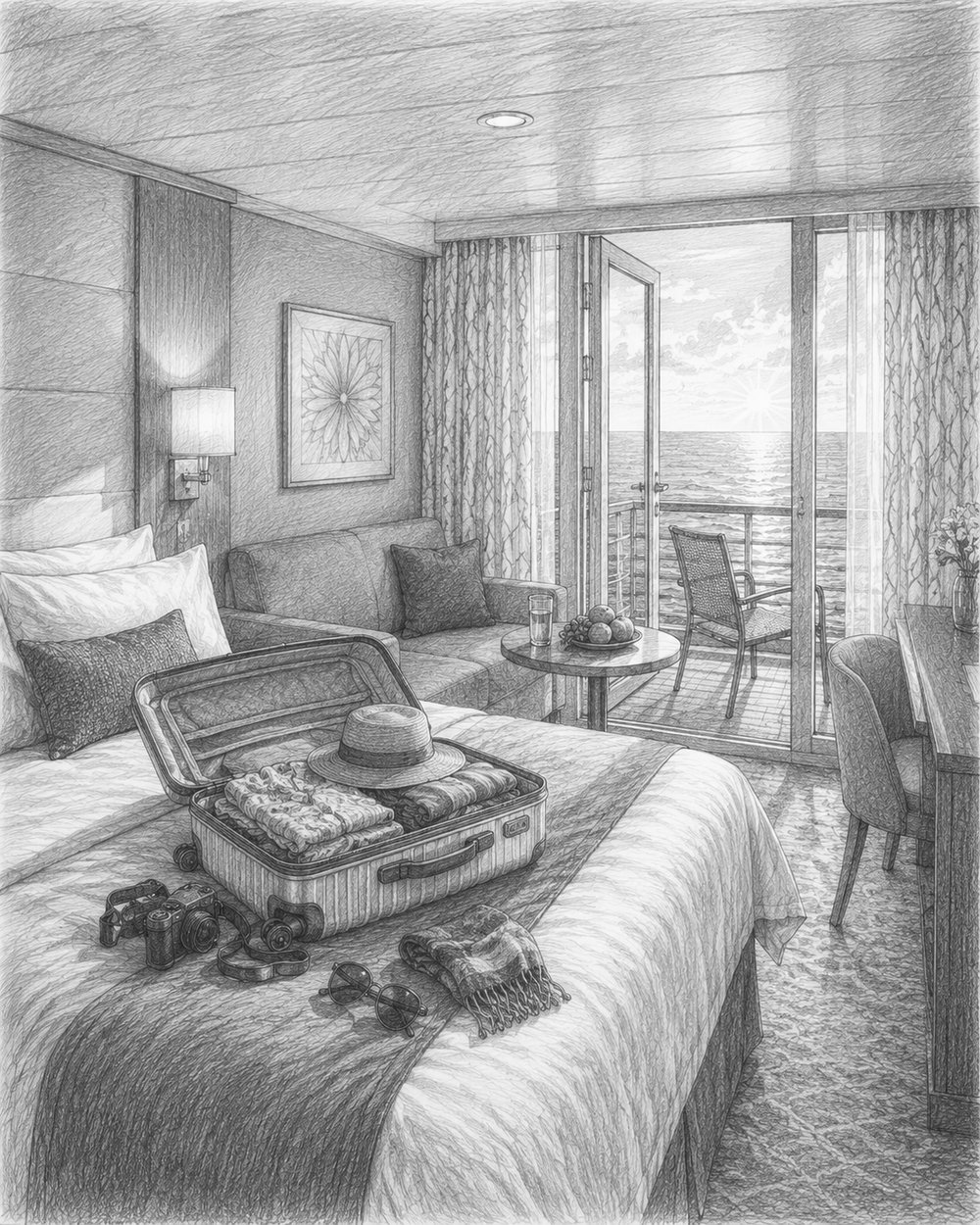
Ask most experienced cruisers which single category to book on Harmony of the Seas and the answer is a balcony, specifically a midship one on the mid-decks. This is where the room stops being just a place to sleep and becomes part of the vacation: coffee outside at sunrise, a quiet spot to read at sea, fresh air on demand, and a private view of the ports as you sail in and out. On this ship, though, the word “balcony” splits three ways, and the three are not equal.
Ocean balcony
An ocean-facing balcony is the classic and, for most people, the best of the three. You look straight out at the water, get the most light and air, and the sail-away view is uninterrupted. This matters especially in the Western Mediterranean season, where the scenic sail-ins past coastlines and harbors are part of the show; a private balcony turns those approaches into a highlight instead of a fight for railing space up on deck. Either season, an ocean balcony beats a neighborhood balcony for brightness and breeze, and it is the one to point a first-timer toward if the budget stretches. Our first-time guide to Harmony of the Seas goes deeper on why that outdoor space pays off on a ship this busy.
Central Park balcony
A Central Park balcony faces inward over the garden neighborhood. These are lovely in a different way: your railing looks down onto live trees and softly lit paths, the air is calm because you are sheltered inside the ship, and the park is a deliberately quiet space. The trade-offs are real, though. You get less direct sunlight, no sea horizon, and less breeze, and because you look across an open-air canyon, people on the balconies opposite can see into yours. For travelers who value quiet and charm over a sweeping view, it is a wonderful and often slightly cheaper alternative to an ocean balcony.
Boardwalk balcony
A Boardwalk balcony faces inward over the carousel, the rock-climbing walls, the Boardwalk Dog House, and, at the aft end, the AquaTheater. When it is good, it is great: a front-row perch over the liveliest neighborhood on the ship and, from the right rooms, a view of the high-diving AquaTheater show without leaving your railing. When it is bad, it is because that same energy runs late into the evening. The Boardwalk is the loudest of the three balcony types, and the closer you sit to the stage the more that matters. Families who want the buzz love these rooms; light sleepers should think twice and read the next section first.
Suites: from a step up to the Royal Loft
At the top of the ladder are the suites, running from a comfortable step up in space to two spectacular flagship rooms. Suites bring more square footage, better bathrooms, and, at the higher tiers, perks that change the day: priority boarding, a private suite lounge and restaurant, reserved show and pool seating, and a concierge. On a ship carrying up to about 6,600 people, the ability to skip lines and retreat to a quieter reserved space is the real luxury, arguably more than the floor space. If crowds worry you about a ship this large, a suite is one answer, and our Harmony of the Seas tips cover other ways to sidestep the busiest moments whatever cabin you book.
Two rooms sit at the summit. The Royal Loft Suite is a two-deck home at sea, with a soaring living space, floor-to-ceiling windows, and room to host, priced accordingly. The AquaTheater Suites are the other showpiece: they sit at the very aft and open onto enormous wraparound balconies overlooking the AquaTheater and the wake behind the ship. Those balconies are among the largest private outdoor spaces afloat. The catch is the same as any aft Boardwalk room, amplified: you are directly above a performance venue with late shows, so factor the evening noise into whether that giant balcony is worth it for how you actually sleep.
Neighborhood view or ocean view: how to choose
This decision is unique to Oasis-Class ships, and it trips people up because a neighborhood-view room looks like a bargain next to an ocean one. An ocean-facing room, window or balcony, gives you the most natural light, real breeze, an open horizon, and the best privacy. A neighborhood-view room over Central Park or the Boardwalk gives you charm, a sense of being inside a living ship, and often a slightly lower price, but at the cost of light, air, sea views, and privacy.
The way to decide is to be honest about how you use a room. If you want to open the door, feel the wind, watch the coast slide by, and sleep in a dark quiet space, go ocean-facing, and lean toward Central Park over Boardwalk if you must go inward. If you love the theater of the ship and do not mind trading brightness and quiet for atmosphere, a neighborhood view is a characterful choice you will not get on an ordinary ship. What you should not do is pick a Boardwalk view purely to save money without registering the noise, because that is the most common cabin regret on this class.
| Priority | Best pick | Why |
|---|---|---|
| Lowest fare | Standard interior | Cheapest way aboard; you live out in the ship anyway. |
| Light on a budget | Central Park-view interior | A real window over the garden, usually below balcony prices. |
| Value with a sea view | Ocean View | Natural light and horizon without paying for a door you rarely use. |
| Best all-round | Midship ocean balcony | Light, air, steady ride, close to everything. |
| Quiet and charm | Central Park balcony | Calm, sheltered, leafy; less sun and privacy. |
| Space and perks | Suite | Room to spread out plus line-skipping on a very full ship. |
Cabins to avoid on Harmony of the Seas
No cabin on this ship is a disaster, but several specific locations cause the great majority of complaints, and all are avoidable by studying the deck plan before you book. These issues are about where a cabin sits, not what category it is, so always confirm the exact position of any room against the app’s deck plan.
Directly over the AquaTheater
The aft Boardwalk balconies and AquaTheater Suites that sit right above the stage get noise from evening performances, sound checks, and late shows. The view is spectacular, but if you plan to be asleep before the second show ends, this is the classic trade of a jaw-dropping balcony for a compromised night’s sleep. Book these with open eyes.
Under the pool deck or the Windjammer
Rooms directly beneath the Pool and Sports Zone or under the Windjammer Marketplace buffet can pick up early-morning noise: deck chairs dragged into place at dawn and a buffet setting up before you would choose to wake. On the deck plan, look at what sits on the deck above your room, not just your own, and avoid putting a bedroom under a high-traffic public space.
Forward on the high decks
The front of the ship and the highest decks feel the most motion in open water. Harmony is enormous and very stable, so most people never notice, but if anyone in your party is prone to seasickness, choose a midship room on a lower or middle deck where motion is least, and steer clear of forward high-deck cabins on itineraries with open-sea stretches.
Obstructed lower-deck balconies
Some lower-deck balconies and Ocean View windows look onto lifeboats or other equipment rather than clear water. If the fare looks too good for a balcony, that is usually why. It can be a smart saving if you only want the outdoor space and the light, but never book one expecting an open sea view, and always check the deck plan to see exactly what is in front of the railing.
Matching your cabin to your season
Harmony has an unusual split season, and it can nudge your cabin choice. In summer she runs Western Mediterranean sailings, typically round-trip from Barcelona or Civitavecchia for Rome, with scenic approaches to ports like Palma de Mallorca, Marseille, La Spezia or Livorno for Florence and Pisa, and Naples for Pompeii and the Amalfi Coast. Those sail-ins reward an ocean balcony, where you watch a coastline arrive with coffee in hand. In winter she sails the Caribbean, with stops that can include Perfect Day at CocoCay, San Juan, St. Thomas, St. Maarten, Cozumel, Costa Maya, and Roatán, and warm sea days where outdoor space pays for itself in a different way. Ports vary by sailing, so always confirm your itinerary in the app. For port-by-port planning, see our guides to Harmony’s Mediterranean ports and the Harmony Caribbean cruise guide.
Whichever season you sail, the logic holds. Decide your budget ceiling first, choose the highest category you are comfortable paying for, then use the deck plan to place it midship and away from the noise traps above. Do those three things in order and you will land on a room that fits both your wallet and the way you actually cruise.
Get the complete Harmony of the Seas playbook

If you want the deck-by-deck cabin picks, dining strategy, and show reservations worked out for you, “The Ultimate Guide to Sailing on Harmony of the Seas” lays it all out. It is part of the Ultimate Ship Guides series by Leo Sotropa, with clear action steps in every chapter so you book the right room the first time.
Frequently asked questions
What is the best cabin on Harmony of the Seas overall?
For most travelers it is a midship ocean-facing balcony on one of the mid-decks. It gives you natural light, fresh air, and a real sea view, sits close to the elevators and neighborhoods, and rides the most smoothly. A suite adds space and line-skipping perks if your budget stretches, but the midship balcony is the best value-to-experience balance.
Are the Central Park and Boardwalk interior cabins worth it?
Yes, if you want a real window without paying balcony prices. A Central Park-view interior wakes you to a quiet garden, while a Boardwalk-view interior looks over the carousel and AquaTheater and is livelier. Both cost more than a windowless interior but usually less than an Ocean View or balcony. Choose Central Park if you value calm and Boardwalk if you want energy and do not mind more noise.
What is a Virtual Balcony and is it worth paying for?
A Virtual Balcony is a floor-to-ceiling screen in an interior cabin that streams a live feed from cameras on the ship’s exterior, so you see the sea and daylight in real time. It is not fresh air, but it greatly reduces the closed-in feeling of a windowless room. If a standard interior feels too claustrophobic but a balcony is out of budget, it is a worthwhile middle option.
Which cabins should I avoid on Harmony of the Seas?
Avoid Boardwalk balconies and AquaTheater Suites directly over the AquaTheater if you sleep early, since late shows carry noise. Avoid rooms directly under the pool deck or the Windjammer buffet, which pick up early-morning clatter. If anyone is prone to motion, skip forward high-deck cabins, and check the deck plan for obstructed lower-deck balconies that look onto lifeboats rather than open water.
Is a Central Park balcony better than an ocean balcony?
It depends what you value. A Central Park balcony is calmer, sheltered from wind, and often a little cheaper, with a pretty garden view. An ocean balcony gives more direct sunlight, real breeze, an open horizon, and better privacy. For scenic sail-ins, especially in the Mediterranean, the ocean balcony wins; for quiet and charm, the Central Park balcony is a lovely alternative.
Are the AquaTheater Suites a good choice?
They offer some of the largest private balconies at sea, sitting at the aft of the ship with sweeping views over the AquaTheater and the wake. If you love outdoor space and a dramatic view, they are stunning. The trade-off is that they sit directly above a performance venue, so evening shows bring noise. Book one if the giant balcony matters more to you than an early, quiet night.
Where is the most stable cabin location for seasickness?
Midship on a lower or middle deck feels the least motion, because the front of the ship and the highest decks move most in open water. Harmony is very large and stable, so most guests never feel much, but if you are sensitive, choose a midship room and avoid forward high-deck cabins, particularly on itineraries with longer open-sea stretches.
Ready for the whole ship in one place? It is all in The Ultimate Guide to Sailing on Harmony of the Seas.
Get the book →
Meet Leo: The Heartbeat Behind ‘A Country A Month’
Journeying through the pages of A Country A Month, you might often feel the rhythm of a storyteller’s heartbeat, pulsating through each line, each image, and each adventure shared. That heartbeat belongs to none other than our remarkable website editor, Leo.
With a lens in one hand and a pen in the other, Leo seamlessly marries his passions for photography and writing. His eye captures moments that words can barely describe, yet his eloquence brings those images to life, transcending borders and connecting us all through shared stories. An avid traveler, every country he’s visited has added another chapter to his expansive tale, and through our platform, he generously shares these chapters with us.