Nervous that a cruise means being handed a fixed dinner time, an assigned table with strangers, and a formal night you have to pack a suit for? On Norwegian Escape, none of that applies. NCL’s Freestyle Cruising throws out the rigid schedule: you dine when you want, where you want, and with whom you want, and you dress however you’re comfortable. For a first-timer, that freedom is the whole point of sailing NCL, and once you understand how it works, the ship becomes a lot easier to enjoy. This guide walks you through exactly how Freestyle works on Escape, plus everything else a first cruise on a Canada & New England sailing from New York throws at you.
Everything in this article and far more, deck by deck, in The Ultimate Guide to Sailing on Norwegian Escape.
Get the book →What Freestyle Cruising actually means on Norwegian Escape
Norwegian Escape is the ship that launched NCL’s Breakaway Plus Class, and she was built from the keel up around Freestyle Cruising. If you’ve heard cruise veterans talk about “early seating” and “late seating,” or about being locked into the same table every night, put that out of your head. Escape has no fixed dining times, no assigned tables, and no formal dress codes. There is no maître d’ handing you a seating card at check-in and no schedule dictating when you eat.
In practice, this means your evening looks more like dining ashore in a city with a lot of good restaurants. Hungry at 6, or not until 8:30? Both are fine. Want a quick buffet plate one night and a long sit-down dinner the next? Also fine. Traveling as a couple who’d rather eat alone, or a group of eight who want one big table? You choose. The ship runs a large range of restaurants precisely so that thousands of guests aren’t all funneled into two rigid seatings.
If you’re coming from a fixed-dining line and this sounds like it might be chaos, here’s the reassurance: it isn’t. The main dining rooms still exist, still serve multi-course dinners with table service, and still feel like a proper cruise dinner. The only thing that’s changed is that you walk up when you’re ready instead of being told when to show up. Many first-timers who were skeptical end up preferring it by day two.
Complimentary vs specialty dining, and when to reserve
The most useful thing to learn before you board is the difference between complimentary and specialty dining, because it drives how you plan your evenings and where any extra money goes.
Complimentary dining is included in your cruise fare. On Escape that means the two main dining rooms, Savor and Taste, plus the Garden Café, the large buffet. The main dining rooms give you a rotating menu and a sit-down experience at no extra charge, and the buffet covers breakfast, lunch, casual dinner, and the in-between grazing that a port-heavy cruise generates. You could eat every meal of the week without paying a cent beyond your fare and eat well doing it.
Specialty dining is the extra-charge tier, and Escape has a strong lineup: Cagney’s Steakhouse, Le Bistro for French, La Cucina for Italian, Teppanyaki for Japanese hibachi cooked at your table, Food Republic, and Ocean Blue for seafood, among others. Each carries a cover charge or runs through a dining package. These aren’t better than the main dining rooms in every way, but they’re a change of pace and a bit of an occasion, and Teppanyaki in particular is as much entertainment as dinner.
- Book specialty restaurants you care about before you sail, or early in the cruise, through the NCL app. Popular tables at peak times fill up.
- Teppanyaki runs on set showtimes with communal tables, so it books out fastest. Reserve it first if it’s on your list.
- The main dining rooms don’t require a reservation, but at the busiest hour, around 7 to 8, you may get a short wait or a pager. Eat a little earlier or later and you’ll usually walk straight in.
- A dining package can pay off if you plan several specialty nights, but do the math against how many you’ll realistically use on a port-intensive week when you’ll be ashore for lunch most days.
The honest first-timer advice: don’t over-book specialty dinners. On a Canada & New England sailing you’ll be off the ship and eating lobster rolls and chowder in port most days, so you have fewer dinners aboard than a sea-day-heavy Caribbean week. Two or three specialty nights across the voyage is plenty for most people.
Your key card runs everything
At check-in you’ll get your key card, sometimes called the Cruise Card. Treat it as the single most important object you carry all week. It’s your cabin key, your ID for getting on and off the ship at each port, and your onboard wallet. Escape is a cashless ship: you don’t pay with cash or a credit card at the bars and shops, you tap or hand over the key card, and everything lands on your onboard account linked to a card you registered at check-in.
That gangway scan matters more than new cruisers expect. Every time you leave the ship in port and every time you return, your key card is scanned so the ship knows exactly who is aboard. Miss the all-aboard time and the ship can and will leave without you, so keep the card on you at all times ashore and note the all-aboard time posted at the gangway, which is set to local time.
One category of guest gets a special key card: The Haven suites and the solo Studios both use keycard access to private spaces. Haven guests tap into an exclusive suite complex with its own courtyard, pool, restaurant, and lounge, while Studio guests get keycard access to the shared Studio Lounge. If you booked one of those, your card unlocks a door most guests never see.
Service charges, gratuities, and Wi-Fi
Two costs surprise first-timers because they aren’t in the headline fare. The first is the daily service charge, NCL’s gratuity, which is added per guest per day to your onboard account to cover the crew who look after you. It’s standard across the fleet and you should budget for it as part of the true cost of the cruise rather than being caught out at the end. Some drinks and specialty bookings also add a gratuity on top of the price.
The second is Wi-Fi. Internet at sea is a paid plan, not free, and it’s satellite-based, so it’s slower and pricier than what you have at home. If you need to stay connected, buy a plan; if you can stand a week mostly offline, you’ll save money and probably enjoy the cruise more. A useful middle ground on this itinerary: your phone often picks up regular cellular coverage while docked in the US and Canadian ports, so you can handle messages ashore and switch to airplane mode at sea to avoid maritime roaming charges.
Prices for drink packages, Wi-Fi plans, and dining packages change, so confirm the current rates in the NCL app rather than relying on a number a friend quoted you. Relative to the base fare, these add-ons can meaningfully raise your total, so decide which ones you actually want before you’re aboard and tempted by everything.
The NCL app runs your day
Download the NCL app before you leave home and get comfortable with it, because on board it’s your daily command center. It carries the day’s schedule, show and dining reservations, deck maps, your onboard account balance, port information, and the all-important all-aboard times. Many first-timers waste half a day wandering a 20-deck ship looking for a venue that the app would have pointed them to in seconds.
- Use the app to book specialty restaurants and reserve the Broadway-style shows as soon as reservations open.
- Check it each evening for the next day’s schedule, sunrise and sunset, port arrival time, and all-aboard time.
- Watch your onboard account through the week so the final bill holds no surprises.
- Confirm venue hours and entertainment in the app, since the lineup and times can shift by sailing.
Booking a Canada & New England sailing
Escape’s marquee season in this guide is Canada & New England, and it’s a genuinely different cruise from the sun-and-sea trips most people picture. These are typically seven-night voyages round-trip from New York City in the cooler, colorful months, sailing up the Northeast coast and into the Canadian Maritimes. It’s port-intensive, with a new town or city almost every day, so you’re trading pool-deck lounging for shore time in places with real history and scenery.
Ports across these itineraries typically include Newport, Rhode Island, with its Gilded Age mansions and Cliff Walk; Boston, with the Freedom Trail and Faneuil Hall; Portland, Maine, and its Old Port and lighthouses; Bar Harbor, the gateway to Acadia National Park; Saint John, New Brunswick, for the Bay of Fundy’s record tides; Halifax, Nova Scotia, with its Citadel and harbor; and Sydney on Cape Breton. Exact ports vary by sailing, so confirm your specific itinerary in the app before you build your plans around any one stop.
If autumn timing is possible for you, an autumn sailing coincides with the famous Northeast fall foliage, which turns the trip into one of the great seasonal sights in North America. Foliage timing shifts year to year and moves north to south, so there are no guarantees, but the season and the more northerly, inland stops give you the best chance. There’s much more on that in our guide to a Norwegian Escape fall foliage sailing, and a broader look at the season in our Canada & New England overview.
Embarkation day in New York
The single best decision a first-timer can make is to arrive in New York a day early. Flights get delayed, and a missed ship on embarkation day is a ruined cruise. Arriving the day before also gives you a night in one of the world’s great cities: the skyline, Times Square, Central Park, the Statue of Liberty, and the museums and neighborhoods are right there. A pre-cruise night takes the stress out of getting to the terminal on time.
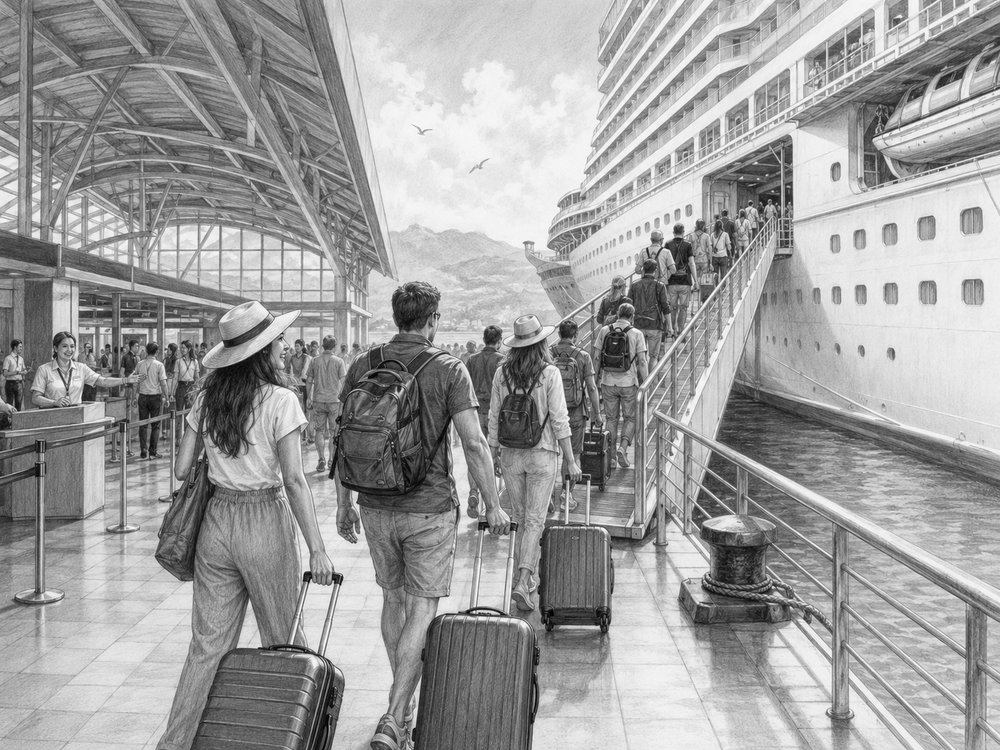
Embarkation itself follows a check-in window you’ll select in advance through the app. Show up in your assigned window rather than all crowding the earliest slot, and the process is smoother. You’ll pass through security, complete check-in, collect or activate your key card, and walk aboard. Carry your travel documents, a change of clothes, and anything you can’t do without in your day bag, because checked luggage is delivered to your cabin later in the afternoon, not the moment you board.
Your first hours aboard
When you first walk on, your cabin may not be ready yet. That’s normal, and it’s the moment where knowing the ship pays off. Rather than standing around, use the first couple of hours to get oriented and to lock in the things that sell out.
- Grab lunch at the Garden Café buffet, which is open and busy on embarkation day.
- Open the app and book any specialty dinners and shows you want before they fill.
- Walk the Waterfront, the quarter-mile open-air oceanfront promenade lined with restaurants and bars, to get your bearings.
- Find your muster station location so the safety drill later is quick and painless.
- Scope out the signature attractions so you know where they are when the crowds thin: the Free Fall slides, the three-story ropes course, and the Aqua Park.
Speaking of those signatures, Escape has a specific set worth knowing. The Aqua Park includes the Free Fall, among the fastest slides at sea with a near-vertical drop, plus the Aqua Racer tube-racing slide and a family slide. The three-story ropes course is one of the largest at sea, with sky rails and two planks that jut out over the side of the ship, high above the water. Spice H2O is the adults-only sundeck at the stern if you want a quieter corner. One thing to set expectations: Escape does not carry the go-kart Speedway or the two-deck Observation Lounge found on some later NCL ships, so don’t go looking for those.
For a fuller room-by-room tour of what’s aboard, our guide to what to expect on Norwegian Escape maps it all out, and the complete Norwegian Escape cruise guide pulls the whole ship together.
Packing for cool, changeable autumn weather
This is where first-timers who’ve only sailed the Caribbean go wrong. A Canada & New England cruise is not a beach-cruise packing list. The season runs cool and changeable, with mild days often in the 50s to 70s Fahrenheit and cooler evenings, plus a real chance of rain and wind up on deck and in the northern ports.
The strategy is layers. You want to be able to add and shed clothing as the day shifts from a mild afternoon ashore to a breezy evening on deck.
- Layered clothing: t-shirts and long sleeves you can build up with a sweater or fleece.
- A waterproof shell, the single most useful item for this itinerary, for wind and rain in port and on deck.
- A warmer layer for autumn sailings and cool evenings.
- Comfortable, broken-in walking shoes, because these are walking ports: the Freedom Trail, the Cliff Walk, Acadia’s trails.
- A camera, and binoculars for whale-watching off New England and Nova Scotia.
- Since Freestyle has no formal night, leave the tuxedo at home. A smart-casual outfit or two covers any dressier dinner you fancy.
Documents: a US-departure cruise that calls in Canada
This trips up a lot of first-timers because the rules aren’t quite the same as a purely domestic trip. Your cruise leaves from a US port, New York, and calls in Canada at stops like Saint John, Halifax, and Cape Breton. Because it starts and ends in the US, US citizens can often sail on this kind of closed-loop voyage with a passport or, in some cases, other approved documents.
That said, the strong recommendation is to carry a passport. It’s required for some travelers and situations, it’s the cleanest document if you ever need to fly home from a Canadian port in an emergency, and it removes any doubt at the border. Rules can change, so check current US Customs and Border Protection guidance before you sail. Non-US citizens should verify their own entry requirements for both the US and Canada well in advance, as those vary by nationality.
On money: you’ll use US dollars in New York and the New England ports, and Canadian dollars in Saint John, Halifax, and Cape Breton. Cards are widely accepted across all of them, so you don’t need to load up on foreign cash, but a little Canadian currency is handy for small purchases and tips ashore.
Common first-timer mistakes to avoid
- Packing for the beach. This is a layers-and-a-rain-shell cruise, not a swimsuit-and-shorts one. The pools and slides are there, but the weather usually isn’t.
- Cutting the New York arrival too fine. Fly in the day before so a delay can’t cost you the ship.
- Over-booking specialty restaurants. You’re ashore for most lunches and some dinners, so you have fewer ship meals than you think.
- Ignoring all-aboard times. They’re in local time, they’re firm, and the ship leaves without stragglers.
- Skipping the app. It holds your schedule, reservations, deck maps, and account, and it saves you hours.
- Expecting a formal night or an assigned table. Freestyle has neither, so don’t pack a tux or wait around for a seating assignment.
- Booking marquee excursions too late. The big-ticket tours, Acadia, the Bay of Fundy, whale-watching, sell out early, so reserve ahead.
If you’re a solo traveler, one more tip: Escape has one of the larger studio complexes in the fleet, with cabins priced without the traditional single supplement and keycard access to the Studio Lounge. It’s one of the best setups at sea for sailing alone without paying double, and our guide to the Norwegian Escape solo Studio cabins covers how they work.
Get the complete Norwegian Escape playbook
Want every dining reservation, port plan, and Freestyle tip in one place? “The Ultimate Guide to Sailing on Norwegian Escape” is part of the Ultimate Ship Guides series by Leo Sotropa, with clear action steps in every chapter so a first-timer boards knowing exactly what to do.
Frequently asked questions
Do I have to pick a dinner time when I book Norwegian Escape?
No. Freestyle Cruising means there are no fixed dining times and no assigned tables. You simply go to a restaurant when you’re ready to eat, the way you would ashore. The main dining rooms take walk-ups, and you can reserve specialty restaurants through the NCL app if you want a set time at one of those.
Is there a formal night I need to pack for?
No. Freestyle has no formal dress code, so you can leave the tuxedo and gown at home. A smart-casual outfit or two is plenty for any dressier dinner you choose. For this itinerary, layers and a waterproof shell matter far more than formalwear.
What’s included in my fare versus what costs extra?
The main dining rooms, Savor and Taste, and the Garden Café buffet are complimentary and included in your fare. Specialty restaurants such as Cagney’s, Le Bistro, La Cucina, Teppanyaki, and Ocean Blue carry a cover charge or run through a dining package. The daily service charge, drinks, and Wi-Fi are also extra. Confirm current prices in the NCL app.
Do I need a passport for a Canada & New England cruise from New York?
Because the cruise starts and ends in the US and calls in Canada, US citizens can often sail with a passport or, in some cases, other approved documents. A passport is strongly recommended and required for some travelers, so carry one if you can, and check current US Customs and Border Protection rules before you go. Non-US citizens should verify their own requirements.
How does the key card work?
Your key card is your cabin key, your ID for getting on and off the ship at each port, and your onboard wallet. Escape is cashless, so you tap or hand over the card for purchases and everything lands on your onboard account. Keep it on you at all times, especially ashore, since you’re scanned back aboard against the all-aboard time.
When should I book specialty dining and shows?
As early as you can, through the NCL app, ideally before you sail or in your first hours aboard. Teppanyaki and the popular tables at peak evening times fill fastest. That said, on a port-heavy week you’ll be ashore for many meals, so two or three specialty nights is enough for most first-timers.
What’s the weather like, and what should I pack?
Cool and changeable, with mild days often in the 50s to 70s Fahrenheit, cooler evenings, and a chance of rain and wind. Pack layers, a waterproof shell, and comfortable walking shoes, plus a warmer layer for autumn sailings. Bring a camera and binoculars for whale-watching. This is not a beach-cruise packing list.
Ready for the whole ship in one place? It is all in The Ultimate Guide to Sailing on Norwegian Escape.
Get the book →
Meet Leo: The Heartbeat Behind ‘A Country A Month’
Journeying through the pages of A Country A Month, you might often feel the rhythm of a storyteller’s heartbeat, pulsating through each line, each image, and each adventure shared. That heartbeat belongs to none other than our remarkable website editor, Leo.
With a lens in one hand and a pen in the other, Leo seamlessly marries his passions for photography and writing. His eye captures moments that words can barely describe, yet his eloquence brings those images to life, transcending borders and connecting us all through shared stories. An avid traveler, every country he’s visited has added another chapter to his expansive tale, and through our platform, he generously shares these chapters with us.