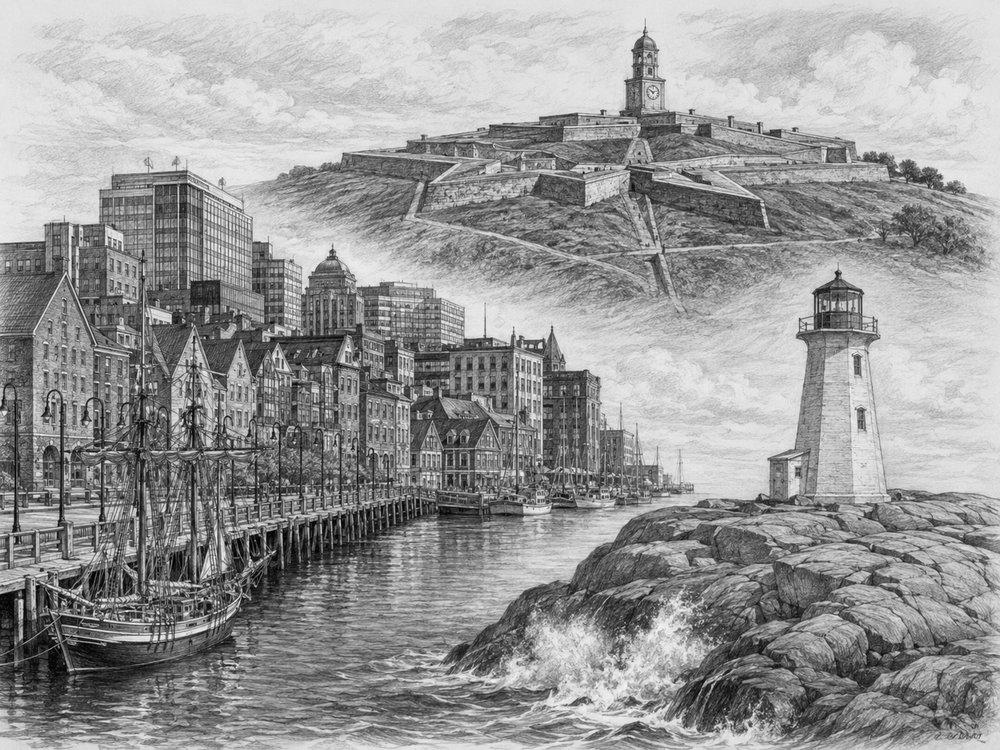
Halifax is one of the easiest cruise ports on the Atlantic coast to enjoy on your own. Your ship ties up right at the walkable waterfront, steps from a long harbor boardwalk, restaurants, and a fortress on the hill above town. This Halifax cruise port guide covers how to spend a port day well: the historic Citadel, the Titanic story that runs through the whole city, the seafood and donairs the region is known for, and the famous lighthouse at Peggy’s Cove about 45 minutes out. Most of the core sights are within walking distance, so you can do a lot without ever booking a tour.
Where your ship docks
Cruise ships dock at the Halifax Seaport, on the south end of the downtown waterfront, right beside the boardwalk. This is one of the best-located cruise berths in the region. You walk off the ship and you are already in the city, with shops, the farmers’ market, and the harbor path just outside the terminal. There is no tender and no long shuttle ride into town.
From the pier, downtown and the boardwalk are an easy stroll. The Citadel sits on the hill above the waterfront, a walk uphill of roughly 15 to 20 minutes, or a short taxi ride. Taxis line up near the terminal, and the compact downtown means most fares are short. Anything beyond the city center, most importantly Peggy’s Cove, is where a taxi or an organized tour becomes worth it. Canada uses the Canadian dollar, though many waterfront spots accept cards, and it is smart to have a little local currency for small purchases.
Top things to do on a port day
The Halifax Citadel
The star-shaped Halifax Citadel crowns the hill in the middle of the city and is the single most recognizable landmark here. It is a well-preserved 19th-century fortress with grass ramparts, a dry moat, and costumed guards in Highland uniforms. Walk the walls for a sweeping view over the harbor and the rooftops down to your ship. If you time it right you can catch the daily noon gun, a cannon fired at midday that you can hear across downtown. Give yourself at least an hour here, more if you want to go through the exhibits inside. The uphill approach is the main effort; take it slow and the reward is the best overview you will get of the whole port.
The waterfront boardwalk and the Maritime Museum of the Atlantic
The Halifax boardwalk runs for a couple of kilometers along the harbor and is the spine of a good port day. It links the cruise terminal to the museums, the market, patios, and small piers where you can watch the working harbor. Right on the boardwalk you will find the Maritime Museum of the Atlantic, and this is where Halifax’s connection to the Titanic becomes real. Halifax was the base for the recovery ships sent out after the sinking, and the museum holds one of the most affecting Titanic collections anywhere, including a deck chair and other artifacts recovered from the water. It is an easy, high-value stop because it is a flat walk from the ship.
Fairview Lawn Cemetery and the Titanic graves
The Titanic story continues at Fairview Lawn Cemetery, where more than a hundred victims of the sinking are buried, their headstones arranged in curving rows that echo the shape of a ship’s hull. Many stones carry only a number and a date; some name the person, including one marked “J. Dawson” that draws visitors familiar with the film. The cemetery is a short taxi ride from the waterfront rather than a walk, so it works well combined with a wider city tour. It is a quiet, moving place, the emotional counterpart to the artifacts in the museum.
The Public Gardens
A few blocks from the Citadel, the Halifax Public Gardens are among the finest Victorian gardens in North America, with formal flower beds, a bandstand, fountains, and winding paths. They are free to enter and make a calm break from the harbor. If you are already walking up to the Citadel, the gardens pair naturally into the same loop. They are at their most colorful in summer and early fall.
Alexander Keith’s brewery, donairs, and seafood
Halifax takes its food and drink seriously. Alexander Keith’s is a historic brewery in the downtown core, one of the oldest in North America, and its tour is a popular way to spend part of an afternoon close to the ship. For eating, two things define the city. The first is the donair, Halifax’s own street-food specialty, a spiced meat wrap with a distinctive sweet garlic sauce that is the official food of the city. The second is the seafood, especially lobster, scallops, and mussels pulled from the surrounding Atlantic waters. A lobster roll on a boardwalk patio is one of the simplest, best things you can do here.
Peggy’s Cove and excursions
The signature excursion out of Halifax is Peggy’s Cove, a tiny fishing village about 45 minutes from the city built around one of the most photographed lighthouses in Canada. The red-and-white lighthouse stands on a dramatic field of wave-smoothed granite boulders at the edge of the open Atlantic, with a working lobster harbor behind it. It is the postcard image of Nova Scotia, and for many cruisers it is the highlight of the whole call.
This is the one place where you should think carefully about ship tour versus independent. The walkable core of Halifax needs no tour at all, but Peggy’s Cove is well outside the city with no simple public transit link, so you will want either the ship’s excursion or a private taxi or van arranged in advance. The ship’s tour has the advantage that the vessel will not leave without it. If you go by taxi, agree on the round-trip and a firm return time, and build in a buffer so a slow drive back never threatens your all-aboard. On the granite, stay well back from the black, wet rocks near the water; rogue waves there are genuinely dangerous.
Halifax also pairs well with the wider itinerary. Many ships that call here also stop at Bar Harbor and Acadia for the coast and national park, or at Boston for its history and harbor. Check your own sailing to see which combination you get and confirm the details in your cruise line’s app.
Fall foliage season
Halifax is a marquee stop on autumn cruises up the Atlantic coast. As the season turns, the maples and birches across Nova Scotia shift into deep reds and golds, and the cool, clear light makes the harbor and the granite coast look their best. Fall calls are popular for exactly this reason, so expect the boardwalk and top sights to be busier when several ships are in on a peak foliage day. Summer sailings trade the color for longer, warmer days and lively patios. Either way, pack a layer; the harbor wind has a bite even when the sun is out.
How much time you need
A standard call gives you enough time to enjoy Halifax without rushing, but you cannot do everything. Roughly speaking, a walkable in-town day of the boardwalk, the Maritime Museum, the Citadel, the Public Gardens, and a seafood lunch fills a comfortable port day with time to spare. Adding Peggy’s Cove effectively becomes your day: the round trip plus time at the lighthouse eats up a large block, so pair it only with a light in-town plan.
Decide before you step off which kind of day you want. If it is your first time and the lighthouse is the dream, commit to Peggy’s Cove and keep the rest simple. If you would rather soak up the city, stay in the walkable core where nothing depends on traffic. Whatever you choose, note your all-aboard time, which is earlier than departure, and give any out-of-town trip a wide margin. Confirm your ship’s exact docking spot and any tour timings in the cruise line’s app before the day begins.
Cruise ships that visit Halifax
Frequently asked questions
Is the Halifax cruise port walkable?
Yes. Ships dock at the Halifax Seaport right on the downtown waterfront, next to the boardwalk. The Maritime Museum, restaurants, and the farmers’ market are a flat walk from the ship, and the Citadel is a manageable uphill stroll or short taxi ride. Only out-of-town sights like Peggy’s Cove need a tour or taxi.
Do I need a ship excursion or can I explore on my own?
For the city itself you do not need a tour; the walkable core is easy to do independently. The exception is Peggy’s Cove, which is about 45 minutes away with no simple transit link. For that, take the ship’s excursion or arrange a private taxi in advance with a firm return time.
What is Halifax’s connection to the Titanic?
Halifax was the base for the ships that recovered victims after the Titanic sank nearby in the North Atlantic. The Maritime Museum of the Atlantic holds a major Titanic collection, including recovered artifacts, and more than a hundred victims are buried at Fairview Lawn Cemetery, where the headstones are laid out in the curve of a ship’s hull.
How do I get to Peggy’s Cove from the cruise port?
The two reliable options are a ship-organized tour or a private taxi or van hired for the round trip. It is roughly 45 minutes each way. If you go independently, agree on the fare and a return time before you set out, and leave a generous buffer so traffic never risks your all-aboard.
What food is Halifax known for?
Two things: fresh Atlantic seafood, especially lobster, scallops, and mussels, and the donair, the city’s own spiced-meat wrap with a sweet garlic sauce. A boardwalk lobster roll is the easy classic, and Alexander Keith’s historic brewery is a popular stop for a tour and a drink close to the ship.
When is the best time to cruise to Halifax?
Both summer and fall are excellent. Summer brings long, warm days and lively patios; fall is the marquee foliage season, when Nova Scotia’s forests turn red and gold and the harbor light is at its best. Fall calls can be busier at the top sights, so start early. Pack a layer for the harbor wind in any season.
How much time do I need in Halifax?
A typical port day is enough for a full walkable itinerary of the boardwalk, museum, Citadel, gardens, and a seafood lunch. If you want Peggy’s Cove, treat it as the main event and keep the rest of the day light, since the round trip takes a large block of time. Always confirm your all-aboard time and plan around it.

Meet Leo: The Heartbeat Behind ‘A Country A Month’
Journeying through the pages of A Country A Month, you might often feel the rhythm of a storyteller’s heartbeat, pulsating through each line, each image, and each adventure shared. That heartbeat belongs to none other than our remarkable website editor, Leo.
With a lens in one hand and a pen in the other, Leo seamlessly marries his passions for photography and writing. His eye captures moments that words can barely describe, yet his eloquence brings those images to life, transcending borders and connecting us all through shared stories. An avid traveler, every country he’s visited has added another chapter to his expansive tale, and through our platform, he generously shares these chapters with us.