Is a Legend of the Seas Mediterranean cruise worth it? For most travelers, yes: you get Royal Caribbean’s largest and newest ship paired with a run of iconic European ports. Legend of the Seas is the third ship of the Icon Class, recently entered service, and she splits her year in a way no other Icon-Class ship does, sailing the Mediterranean in summer and the Caribbean in winter. That summer program is a 7-night Western Mediterranean round-trip that alternates between two home ports, Barcelona and Rome/Civitavecchia, running roughly July through October. You wake up in Spain, Italy, and the south of France while sleeping each night aboard a ship with seven pools, the largest waterpark at sea, and a glass-domed AquaDome.
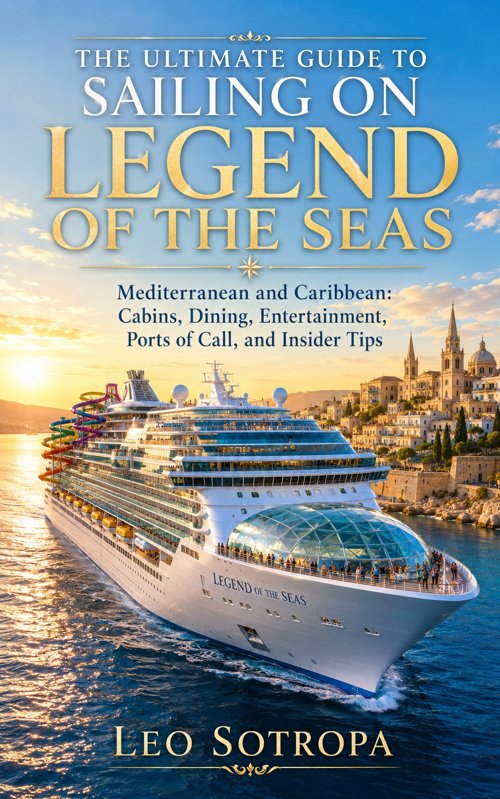
Everything in this article and far more, deck by deck, in The Ultimate Guide to Sailing on Legend of the Seas.
Get the book →This guide covers what the Mediterranean season looks like, what to do in each port, how to run a port day without missing the ship, and how a Mediterranean cruise differs from a Caribbean one. If you are still deciding between the regions, our Legend of the Seas cruise guide lays out the full picture of the ship and both seasons.
Why do the Mediterranean on Legend of the Seas?
The Mediterranean has been cruised for decades, usually on mid-size ships. What makes Legend different is scale. At roughly 250,800 gross tons and about 20 decks, she carries up to around 7,600 guests at full occupancy, which means the ship itself is a destination on the sea days and evenings between ports. You are not choosing between a great ship and great ports here; you get both.
On board, Legend carries eight neighborhoods, from the tree-lined Central Park with real plants to Thrill Island with the Category 6 waterpark and its six record-setting slides, including the tallest drop at sea. There are seven pools, among them Royal Bay, the largest pool at sea, and the adults-only Hideaway. In the evenings the entertainment is first-run: the main theater stages Roald Dahl’s Charlie and the Chocolate Factory in its debut at sea, there is an ice show called Fusion, and America’s Got Talent LIVE at Sea marks the first time that format has been staged on a cruise ship.
Dining leans into the theme of travel. Royal Railway — Legend Station is an immersive train-carriage restaurant themed on the Silk Routes of Marco Polo, serving the cuisines of India, China, Persia, Italy, and Turkey, and it is the only Icon-Class ship with this restaurant. Eating along a fictional Silk Road one night and stepping into a real Italian port the next morning is a fitting rhythm for a Mediterranean sailing.
The verified Mediterranean season
Legend’s Mediterranean program is a 7-night Western Mediterranean itinerary, sailed round-trip and alternating between two home ports: Barcelona in Spain and Rome/Civitavecchia in Italy. The season runs approximately July through October, before the ship repositions across the Atlantic and takes up her winter Caribbean schedule from Fort Lauderdale.
Because the sailings alternate home ports, your embarkation city depends on the week you book. The ports of call across the season include La Spezia (the gateway to Florence, Pisa, and the Cinque Terre), Marseille for Provence, Palma de Mallorca, Naples, and Málaga, along with sea days. The exact ports on any week vary by sailing, so treat the list below as the menu the season draws from rather than a fixed sequence, and confirm your specific itinerary in the Royal Caribbean app before you sail.
| Detail | Mediterranean season |
|---|---|
| Length | 7 nights, round-trip |
| Home ports | Barcelona and Rome/Civitavecchia (alternating) |
| Region | Western Mediterranean |
| Season | Approximately July to October |
| Ports drawn from | La Spezia, Marseille, Palma de Mallorca, Naples, Málaga, plus sea days |
One practical note: a Western Mediterranean week is port-heavy, with likely only one or two proper sea days out of seven. That is part of why the ship’s neighborhoods matter, since those sea days are when you actually ride the slides, sit in Central Park, or catch the shows you missed ashore.
Port-by-port: what to see on a Western Mediterranean week
Here is each Mediterranean stop Legend visits, with the landmarks that anchor a first visit. Excursions and timed-entry tickets for the biggest sights sell out, so book ahead through the Royal Caribbean app or a reputable operator, and confirm opening hours for anything you plan to reach on your own.
Barcelona, Spain
Barcelona is both a home port and one of the great cities of the western Mediterranean, so if it is your embarkation city, arrive early and give it a full day. The signature sight is the Sagrada Família, Antoni Gaudí’s still-unfinished basilica, which requires a timed ticket booked well in advance. Gaudí’s fingerprints are all over the city: Park Güell, on a hillside above town, pairs his mosaic terraces with wide views over the rooftops. In the center, La Rambla is the tree-lined pedestrian spine running toward the harbor, and just off it the medieval Gothic Quarter is a warren of narrow stone lanes. With only a port-day window, prioritize the Sagrada Família with a pre-booked slot and save the Gothic Quarter for whatever time is left.
Palma de Mallorca, Spain
Palma, the capital of Mallorca, is the most relaxed stop of the week. Its landmark is La Seu, the enormous Gothic cathedral that rises above the waterfront, visible as the ship comes in. Around it, the old town is compact and walkable, full of shaded plazas and small shops. Because Palma is an island port, it is also the easiest place to swim rather than sightsee, so a common approach is a short morning in the cathedral and old town, then an afternoon by the water.

La Spezia, Italy (Cinque Terre, Florence, and Pisa)
La Spezia is a working Italian port that serves as a gateway to three very different day trips, and choosing among them is the key decision of this stop. The closest and most scenic is the Cinque Terre, the string of five cliffside villages along the Ligurian coast, reachable by train or boat and best suited to walking, viewpoints, and seafood. The more ambitious option is Florence, a longer transfer inland, where you can stand under the Duomo, see the Uffizi’s collection, and cross the Ponte Vecchio over the Arno. Pisa and its Leaning Tower lie in the same direction and are sometimes combined with Florence on one long excursion.
Be realistic about distance. Florence is a long transfer from La Spezia, so a Florence day is mostly travel bracketing a few hours in the city, and a combined Florence-and-Pisa day is tighter still. If Florence is a bucket-list goal, the drive can be worth it; if not, the Cinque Terre gives you far more time on the ground. This is one port where a ship-organized excursion earns its keep, because the ship will not leave without its own tours and the inland distance leaves little margin if an independent train runs late.
Marseille, France (Provence)
Marseille is your doorway to Provence and the south of France. In the city, the basilica of Notre-Dame de la Garde crowns the highest hill with a sweeping look over the harbor and coast, while the Vieux-Port, the old port, is the historic heart where fishing boats still tie up and cafés line the quays. Marseille is also the jumping-off point for Aix-en-Provence, the elegant university town inland, known for its fountains, plane-tree boulevards, and markets. The day comes down to a choice: stay in Marseille for the basilica and Old Port, or head inland to Aix for a slower Provençal afternoon.
Rome/Civitavecchia, Italy
Civitavecchia is the port that serves Rome, and the most important fact about this stop is the distance: Rome is roughly a 1.5-hour transfer from the cruise port. That is not a stroll into town; it shapes your entire day. Once in the city, the headline sights are the Colosseum and the adjacent Roman Forum, the Vatican with St. Peter’s Basilica, and the Trevi Fountain. The big two, the Colosseum and the Vatican, involve timed entry and long lines, so a self-planned Rome day means booking tickets in advance and building the schedule around that 1.5-hour drive each way.
If Rome/Civitavecchia is your home port rather than a mid-cruise call, do what applies to Barcelona: come a day or two early and see Rome properly before you board, rather than compressing the Colosseum, the Vatican, and the Trevi Fountain into a single rushed transfer day. On a port-call day, pick two sights at most and accept that the round-trip drive eats a large chunk of your hours. Our guide to Legend of the Seas ports and excursions goes further into booking strategy.
Naples, Italy
Naples may offer more famous day trips than any other stop, which is both its appeal and its challenge. From the port you can reach Pompeii, the Roman city buried and preserved by the eruption of Mount Vesuvius, which still looms over the bay. South along the coast is the Amalfi Coast, with its cliff-hugging road and pastel towns, and offshore sits the island of Capri. Naples is also the birthplace of pizza, so a wood-fired Margherita in the city is its own valid excursion.
The catch is that you cannot do all of this in one day. Pompeii and Vesuvius pair naturally, Capri is a boat trip that fills a day on its own, and the Amalfi drive is scenic but slow. Choose one lane: history-minded travelers usually take Pompeii and Vesuvius, those after views lean toward Capri or Amalfi, and anyone content to stay close can wander historic Naples and eat very well. As elsewhere, the drive times reward a booked tour.
Málaga, Spain
Málaga, on Spain’s southern Costa del Sol, is one of the more self-contained ports, with much of what you want walkable from the ship. The Alcazaba is a hilltop Moorish fortress with gardens and ramparts overlooking the city, and below it the cathedral anchors the old center. Málaga is also the birthplace of Pablo Picasso, celebrated in the heart of town, and the city beaches are close enough for an easy afternoon swim. All of which makes it a strong candidate for a do-it-yourself day, away from organized tours.
How to run a Mediterranean port day
Mediterranean port days demand more discipline than Caribbean beach days. The sights are inland, the transfers are long, and the ship leaves on time. A few habits make the difference between seeing a city and watching it from a bus window:
- Start early. Be ready to step off as the ship clears the gangway, especially in La Spezia, Civitavecchia, and Naples where the best sights are an hour or more away.
- Respect the transfer math. Subtract the round-trip drive before you plan anything; a stop with a 1.5-hour transfer each way is really a half-day of sightseeing dressed up as a full day.
- Pick a lane and commit. One major sight done well beats three done in a hurry. Rome, Naples, and La Spezia all tempt you to overreach.
- Weigh the ship excursion against going independent. Ship tours cost more and move in groups, but the ship will not sail without them, which is real insurance on long inland trips. Independent trains give you freedom and often a lower price, but the risk of a late return is yours.
- Book timed-entry tickets ahead. The Sagrada Família, the Colosseum, and the Vatican all use advance slots that sell out. Do not plan to buy at the door.
- Watch the clock on ship time, which may differ from local time ashore. All-aboard is typically 30 minutes before departure and is enforced, so give yourself a cushion.
The last rule matters most. If you miss the all-aboard on an independent excursion, catching up to the ship at the next port is your problem and your expense, a risk that weighs heaviest on the long-transfer ports. More day-of tactics live in our Royal Caribbean Legend of the Seas tips.
How a Mediterranean cruise differs from a Caribbean one
Legend sails both regions, which makes her a useful way to compare them, and the two are genuinely different holidays. Knowing the differences up front helps you pack, plan, and set expectations, particularly if your only prior cruising has been in the Caribbean:
- Port-intensive, not beach-intensive. A Western Mediterranean week is packed with ports and short on sea days. In the Caribbean you often have more days at sea and days built around a single beach or a private island like Perfect Day at CocoCay.
- More walking, and more of it uphill and on cobblestones through historic centers, fortresses, and hillside basilicas. Caribbean days are gentler on the feet.
- Longer transfers. Many Mediterranean marquee sights sit well inland, whereas Caribbean excursions tend to start near the pier.
- Slightly dressier. European cities lean a touch more polished by day, and some sites, especially churches like St. Peter’s, expect covered shoulders and knees. Caribbean days are unapologetically casual.
- Generally pricier once flights, pre-cruise hotels, and excursions are added in. Keep budgeting relative and confirm current fares in the Royal Caribbean app.
- Different rhythm on board. Because Mediterranean days ashore are long and tiring, evenings on the ship become your downtime, and the shows and dining carry more of the entertainment load than on a lazier Caribbean sailing.
None of this makes one region better; they are different tools. If you want culture, history, and a new country almost every morning, the Mediterranean delivers; if you want to decompress on beaches, the Caribbean does that better.
Getting there and booking flights
Both home ports, Barcelona and Rome/Civitavecchia, involve international flights for most travelers, and the single best piece of advice is to arrive in Europe a day or two before your sailing. Transatlantic flights are long and prone to delays, and a missed embarkation is far worse than a spare hotel night. Arriving early also lets jet lag settle so you are not sleepwalking through your first port, and it turns your home-port city into a bonus destination.
Rome’s main airport sits between the city and Civitavecchia, so an early arrival lets you see Rome before you board, which, given the 1.5-hour transfer, is the sensible way to experience the capital. Allow generous connection times, and remember there is no free ship-wide Wi-Fi aboard, so download the Royal Caribbean app, your boarding pass, and offline maps before you leave home. If this is your first sailing, our guide to a first-time cruise on Legend of the Seas walks through boarding, the app, and the SeaPass card.
Packing for the Mediterranean
Packing for a Med summer sailing balances hot, sunny port days against a ship that skews slightly dressier than a Caribbean one in the evenings. Plan for heat during the day and cover the details European sightseeing demands.
- Genuinely comfortable walking shoes. This is the item people most regret skimping on; you will cover miles on cobblestones and hills.
- Modest layers for churches. A light scarf or packable top to cover shoulders and knees gets you into St. Peter’s and other sacred sites without fuss.
- Sun protection. High summer in Spain, Italy, and southern France is strong, so bring a hat, sunglasses, and sunscreen for long, exposed days at ruins and fortresses.
- A small daypack with a refillable water bottle. Long inland tours run hot, and staying hydrated matters more than it sounds.
- Smart-casual evening wear for the ship’s nicer evenings and venues like the Hollywoodland Supper Club.
- Swimwear for the ship and beach ports. Palma and Málaga both put a beach within reach, and Legend’s pools and waterpark are calling on sea days.
- A universal adapter and a portable battery. European outlets differ from North American ones, and a full phone matters when it is your map, ticket, and camera all day.
Get the complete Legend of the Seas playbook
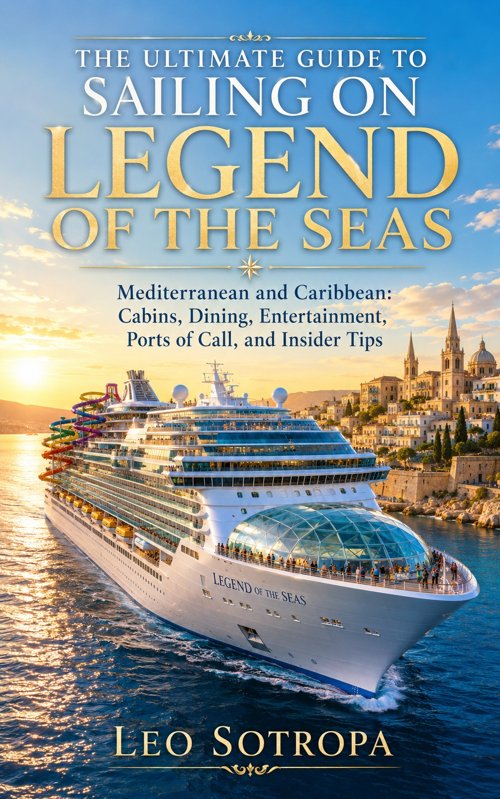
Want the port-by-port plans, cabin picks, and day-of tactics in one place? The complete Legend of the Seas guide is part of the Ultimate Ship Guides series by Leo Sotropa, with clear action steps in every chapter so you spend less time planning and more time in Barcelona, Rome, and everywhere between.
Frequently asked questions
Where does Legend of the Seas sail in the Mediterranean?
She sails a 7-night Western Mediterranean round-trip that alternates between two home ports, Barcelona and Rome/Civitavecchia, roughly July through October. Ports of call across the season include La Spezia, Marseille, Palma de Mallorca, Naples, and Málaga, plus sea days. Exact ports vary by sailing, so confirm your itinerary in the Royal Caribbean app.
How far is Rome from the cruise port?
Rome is roughly a 1.5-hour transfer from the Civitavecchia cruise port in each direction. That distance shapes the whole day, so plan for two major sights at most, book timed-entry tickets for the Colosseum and the Vatican in advance, and if Civitavecchia is your home port, consider arriving a day or two early to see Rome before you board.
Can I visit Florence from Legend of the Seas?
Yes, from the La Spezia port, but it is a long inland transfer, so a Florence day is mostly travel around a few hours in the city to see the Duomo, the Uffizi, and the Ponte Vecchio, sometimes combined with Pisa’s Leaning Tower. If you want more time on the ground, the Cinque Terre villages are much closer. Because of the distance, a ship-organized excursion is the safer choice for reaching Florence.
Should I book ship excursions or explore on my own?
It depends on the port. For long-transfer stops like La Spezia, Civitavecchia (Rome), and Naples, ship excursions add real insurance because the ship will not leave without its own tours. For close-in, walkable ports like Málaga and Palma de Mallorca, going independently is easy and often cheaper. Either way, respect the all-aboard time, typically 30 minutes before departure.
How is a Mediterranean cruise different from a Caribbean one?
A Western Mediterranean week is port-intensive with fewer sea days, more walking on hills and cobblestones, longer inland transfers, and a slightly dressier feel, and it tends to cost more once flights and hotels are added. A Caribbean cruise is more relaxed, with more sea days and beach-focused stops. The ship is the same; the trips are not.
When should I arrive for a Mediterranean sailing?
Arrive in Europe a day or two before departure. Transatlantic flights are long and can be delayed, and missing embarkation is far more costly than an extra hotel night. Arriving early also lets jet lag settle and turns Barcelona or Rome into a bonus destination, which is especially worthwhile in Rome given the 1.5-hour distance between the city and Civitavecchia.
What should I pack for a Med cruise on Legend?
Comfortable walking shoes first, then sun protection for hot summer days, modest layers to cover shoulders and knees for churches like St. Peter’s, a daypack with a water bottle, smart-casual clothes for the ship’s dressier evenings, swimwear for the pools and beach ports, and a European power adapter with a portable battery. Since there is no free ship-wide Wi-Fi, download the Royal Caribbean app and offline maps before you travel.
Ready for the whole ship in one place? It is all in The Ultimate Guide to Sailing on Legend of the Seas.
Get the book →
Meet Leo: The Heartbeat Behind ‘A Country A Month’
Journeying through the pages of A Country A Month, you might often feel the rhythm of a storyteller’s heartbeat, pulsating through each line, each image, and each adventure shared. That heartbeat belongs to none other than our remarkable website editor, Leo.
With a lens in one hand and a pen in the other, Leo seamlessly marries his passions for photography and writing. His eye captures moments that words can barely describe, yet his eloquence brings those images to life, transcending borders and connecting us all through shared stories. An avid traveler, every country he’s visited has added another chapter to his expansive tale, and through our platform, he generously shares these chapters with us.