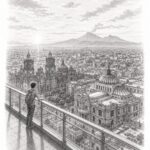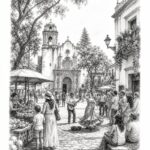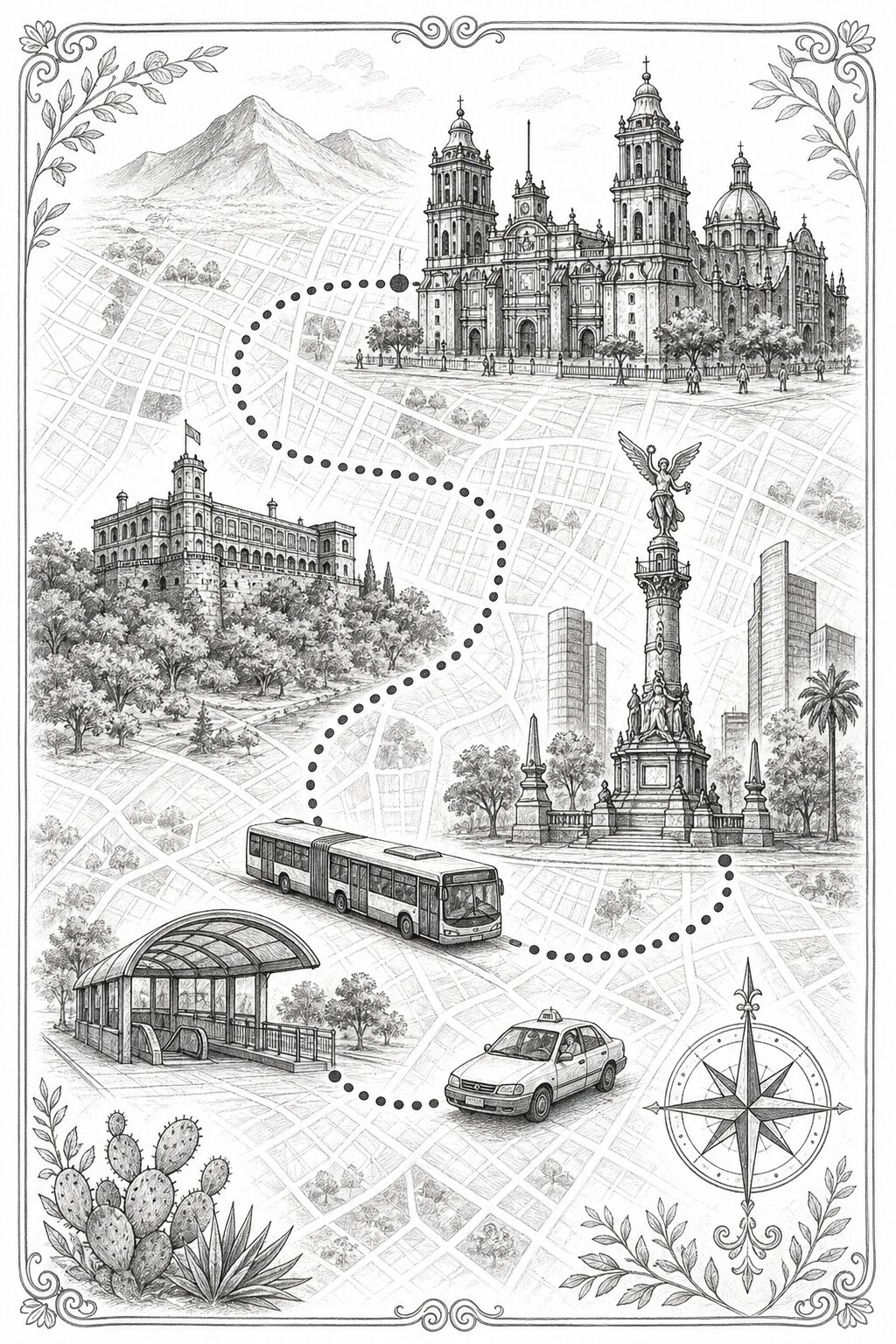
A good Mexico City food plan is not a list of dishes detached from the trip. It accounts for when people eat, which neighborhoods suit different meals, where reservations matter, what prices mean, and how to recognize a place designed only for passing visitors.
Use this article with the complete Mexico City travel guide, the three-day itinerary, and the where-to-stay guide.
This is the longest chapter in the book, and it is the one to dog-ear. Mexico City does not organize itself around one skyline or one river the way some of its peers do; it spreads across a vast high-altitude valley ringed by volcanoes, Popocatepetl and Iztaccihuatl visible on clear mornings, in low-rise grids and leafy colonias that reveal themselves one neighborhood at a time rather than from a single viewpoint. The historic center sits on the drained bed of Lake Texcoco, which is why the ground still shifts and the Cathedral’s bell towers visibly lean; everything you will see in this article grew from that same unstable, extraordinary ground. Each section below is a self-contained half day: a one-line identity, a walkable route with real street names, the food worth stopping for, the right time to go, and a quieter alternative when you want the same flavor without the crowd.
How the city fits together, in one paragraph: the Centro Historico anchors the northeast, 700 years of continuous capital stacked on itself. West of it, Roma Norte and Condesa form the leafy, walkable middle, Art Deco streets built for wandering and eating. Further west, Chapultepec Park and Polanco pair the city’s green lung with its most polished district. South, Coyoacan and San Angel hold the colonial plazas and the Frida Kahlo pilgrimage, with Xochimilco’s floating gardens further south still, a living Aztec-era farming landscape unlike anything else in this book. East of the Centro, La Merced, Tepito, and the markets belt show you the working city other guidebooks skip, best visited by day and with a plan. No single day should try to cover more than one or two of these; each deserves its own half day, and this article is built accordingly.
A few habits make every walk in this article better. Altitude (the city sits at 2,240 meters) means your first day or two of walking may feel more tiring than the distances suggest; pace accordingly, especially on your first morning, and see the complete guide for the fuller picture. Weekday mornings are calmer almost everywhere in this article, since the crowd tide in most of these neighborhoods rises on weekends; know which version of a district you are choosing before you go. And moving between these districts means the Metro, the Metrobus, or a ride-hail car, never a walk, so budget the transit time described in the complete guide into your day.
Centro Historico: seven hundred years, one square
Who will love it: history readers, architecture lovers, and anyone who wants to feel the weight of an entire civilization stacked in one plaza.
The route (about four hours): Start in the Zocalo, one of the largest public squares in the world and the ceremonial heart of the city since before the Spanish arrived. Cross to the Metropolitan Cathedral, free to enter, and look closely at the bell towers as you approach; the visible lean is not an illusion but the same soft lakebed soil that has troubled every building here for five centuries. Walk to the Templo Mayor ruins and museum, the excavated heart of Tenochtitlan, discovered by accident in 1978 when electrical workers hit a buried stone disc; the ruins sit directly beside the colonial Cathedral built partly from the same temple’s stones, two eras on one block. Enter the Palacio Nacional via Calle Moneda with a passport or ID in hand (confirm current entry rules and any Monday closure before you go) for Diego Rivera’s sweeping staircase murals, a visual history of Mexico painted across the walls. Walk Calle Madero past the Torre Latinoamericana and the tiled facade of the Casa de los Azulejos, then reach the Palacio de Bellas Artes for its own Rivera, Orozco, and Siqueiros murals inside a building whose exterior alone justifies a photograph. Finish in the Alameda Central, the city’s oldest public park, and if your evening allows it, walk to Plaza Garibaldi after dark for mariachi bands playing song by song (the complete guide and the complete guide cover the etiquette).
Food and coffee: Sanborns, inside the Casa de los Azulejos, is the classic sit-down stop, a genuine institution rather than a tourist prop. Tacos de canasta carts appear by day throughout the district. El Cardenal is the name to know for a proper Mexican breakfast, and the century-old cantinas Salon Corona and La Opera Bar (the latter with a bullet hole in its ceiling, left by Pancho Villa according to local lore) reward a stop for a drink and the room itself.
Best time: weekday mornings are calmest by far. Weekends and especially the Independence Day weekend in mid-September bring the largest crowds and the heaviest security presence; enjoy the energy on purpose or plan around it.
Quieter alternative: none of the Centro is truly quiet, and that is rather the point of visiting it; if you want a gentler version of the same history, save Coyoacan and San Angel, below, for a calmer colonial fix.
Worth adding if time allows: step off Calle Madero for a few minutes into any of the side streets between the Zocalo and Bellas Artes, where colonial facades hide small courtyards, workshops, and the kind of unglamorous city life that the main tourist axis moves past too quickly to notice. The contrast between the polished plaza and these working blocks a few steps away is, in its own way, the whole story of this article in miniature: Mexico City rewards the visitor willing to turn one more corner than the itinerary strictly requires.
Roma Norte: the city’s best eating, on Art Deco streets
Who will love it: food travelers, café wanderers, and anyone who wants to spend a half day simply walking well.
The route (about two and a half hours): Begin at Plaza Rio de Janeiro, with its bronze replica of Michelangelo’s David presiding over a quiet square. Walk the tree-lined median of Avenida Alvaro Obregon, Roma’s spine, past Art Deco facades that give the neighborhood its architectural identity. Detour into Mercado Roma, an upscale food hall good for a grazing lunch, then continue to Plaza Luis Cabrera for its fountain and benches. Push further to Mercado Medellin, a genuinely local market strong on South American and Caribbean goods rather than curated stalls, a useful contrast to Mercado Roma’s polish. Finish the afternoon or evening in a mezcaleria or on a rooftop bar as the light goes gold over the neighborhood’s low skyline.
Food and coffee: this is covered in full in the complete guide, but two institutions are worth naming here as anchors for your route: Contramar, a long-running seafood restaurant that draws a genuine wait even on a weekday, and Panaderia Rosetta, whose guava concha has become something close to a neighborhood mascot.
Best time: Thursday through Saturday evenings are Roma at full social volume; weekday mornings are calm and café-friendly, ideal if you want the architecture without the crowd.
Quieter alternative: Condesa, immediately west, gives you the same walkable, tree-shaded feel with fewer destination restaurants and more park benches.
Condesa: leafy, park-centered, unhurried
Who will love it: brunch people, dog-watchers, and anyone who wants a neighborhood to sit in rather than sightsee.
The route (about two hours): Start in Parque Mexico, Condesa’s centerpiece, where original Art Deco lampposts line the paths and a small amphitheater hosts informal weekend gatherings. Walk the oval of Avenida Amsterdam, laid out along the curve of a former horse-racing track, a detail that explains the street’s unusual shape to anyone who wonders about it. Continue to Parque Espana, then let yourself drift through the boutique streets surrounding both parks; Condesa rewards wandering more than any fixed itinerary.
Food and coffee: this is a sit-and-wander neighborhood more than a sight-dense one, and its strength is a genuinely strong brunch culture; plan to sit down somewhere for at least an hour rather than treating the neighborhood as a checklist.
Best time: mid-morning through early afternoon, when the parks fill with locals and the brunch spots are at their best. Evenings here are pleasant but quieter than Roma’s.
Quieter alternative: if even Condesa feels busy, the streets just south of Parque Espana carry the same character with a fraction of the foot traffic.
Chapultepec and Polanco: the park and the polish, side by side
Who will love it: museum people, families, and anyone who wants the city’s single best green space paired with its most upscale streets.
Frequently asked questions
How many days are enough for Mexico City?
Three well-planned full days cover a strong first visit, while four or five allow slower neighborhoods, additional museums, or a day trip. Count usable sightseeing days rather than hotel nights.
What should be booked first?
Reserve the experience you would be most disappointed to miss, then secure lodging and any limited-entry sights. Verify current rules and opening information on the official operator’s website shortly before travel.
How do you avoid rushing?
Group each day geographically, allow time for security and transport, and treat extra stops as optional. One demanding reservation plus nearby flexible experiences usually produces a better day than a chain of timed entries.
Continue planning Mexico City
- Complete Mexico City travel guide
- 3 days in Mexico City: first-time itinerary
- Where to stay in Mexico City
- Best things to do in Mexico City
- Mexico City food guide
- Mexico City first-time tips
- Mexico City on a budget
Meet Leo: The Heartbeat Behind ‘A Country A Month’
Journeying through the pages of A Country A Month, you might often feel the rhythm of a storyteller’s heartbeat, pulsating through each line, each image, and each adventure shared. That heartbeat belongs to none other than our remarkable website editor, Leo.
With a lens in one hand and a pen in the other, Leo seamlessly marries his passions for photography and writing. His eye captures moments that words can barely describe, yet his eloquence brings those images to life, transcending borders and connecting us all through shared stories. An avid traveler, every country he’s visited has added another chapter to his expansive tale, and through our platform, he generously shares these chapters with us.