What separates a good MSC World Europa week from a great one? Mostly the decisions you make before you ever step aboard, plus a handful of small habits that regulars repeat every sailing. This ship carries more than 5,000 guests across seven themed districts and runs seven-night Western Mediterranean weeks between some of Europe’s most famous cities. That scale rewards planning. The tips below are the practical ones — how to pick the right Experience, book the cabin and extras that matter, run a long port day without wasting it, eat and drink like a regular, and skip the mistakes newcomers make when they first meet MSC’s booking system.
Everything in this article and far more, deck by deck, in The Ultimate Guide to Sailing on MSC World Europa.
Get the book →Before you sail: the decisions that shape your whole week
The single most important thing to understand about booking MSC World Europa is that you are choosing two things at once: a cabin, and an “Experience.” The Experience is a bundle that sits on top of your cabin and changes what is included, how much flexibility you get, and even which cabins you are allowed to select. Get this right and the rest of the trip falls into place. Get it wrong and you spend the week wishing you had spent a little more or a little less.
Pick the right Experience first
MSC’s Experiences run from most affordable to most exclusive, and each one changes the math of your booking:
- Bella is the entry Experience with the lowest fare. The trade-off is that MSC assigns your cabin’s exact location — you pick a category, not a specific room. Fine if price is everything and you are relaxed about where you sleep.
- Fantastica lets you choose your specific cabin and your dining time, adds room-service breakfast and extra loyalty points, and generally buys you flexibility. For most first-timers this is the sweet spot.
- Aurea is the premium tier: the best-located cabins, priority boarding, thermal spa access, and often a drinks package bundled in. If you were going to buy a drinks package and spa access anyway, do the sums — Aurea can work out cheaper than buying them separately.
- Yacht Club is the private ship-within-a-ship — suites with a 24-hour butler and concierge, a private restaurant, lounge, bar, pool and sun deck, and premium all-inclusive drinks. It is a different holiday, priced accordingly.
Inclusions shift with each sailing and promotion, so confirm exactly what your Experience covers before you pay rather than assuming last season’s bundle still applies. If you want the full breakdown of what each tier gets you, our guide to the MSC World Europa Experiences walks through the trade-offs in detail.
Book dining, spa and excursions early
The specialty restaurants, the spa, and the most popular shore excursions all have finite capacity, and on a ship this full the best slots go early. A few things worth locking in before you sail:
- Specialty dining. The Chef’s Garden Kitchen — the restaurant by a Michelin-starred chef — plus the sushi and teppanyaki venue, the steakhouse, and the taqueria all cost extra and all fill up. If you have your heart set on one, reserve it before boarding, and aim for a port-day evening when the main dining room feels busiest.
- Spa and thermal areas. Day passes and treatment slots are limited. Book the sea day, not the port day, when everyone else is ashore.
- Shore excursions. The headline tours — Pompeii from Naples, the Cinque Terre from Genoa, Taormina from Messina — sell out. If a specific excursion is the reason you chose this itinerary, reserve it rather than gambling on availability once aboard.
Download the MSC for Me app before you leave home
The MSC for Me app runs your day on board — deck plans, the daily schedule, dining reservations, show times, your account balance, and messaging within your travel party. Download it, log in, and get familiar with it before you sail, because the terminal and the first hour aboard are not the moment to learn a new app. Onboard Wi-Fi is a paid plan, so buy the package if you want your own phone working at sea, and remember that the app itself typically runs on the ship’s network without eating into a data plan. Confirm the current schedule and your exact ports in the app too — itineraries and embarkation ports can vary by sailing.
Choosing and booking your cabin
Once you have settled on an Experience, the cabin is the next lever. MSC World Europa offers Interior, Ocean View, Balcony, the smart-value Infinite Ocean View, premium Aurea cabins, and Yacht Club suites in interior, deluxe, grand and owner’s layouts. The category you can pick freely depends on your Experience — remember Bella means MSC picks the exact spot for you.
- Best value: an Interior or Infinite Ocean View booked on a Fantastica fare, so you get to choose the location instead of leaving it to chance. The Infinite Ocean View in particular gives you light and a sense of the sea without paying full balcony money.
- Best all-round: a midship Balcony on the mid-decks. You get space, natural light, and the steadiest ride when the Mediterranean turns lumpy.
- Cabins to approach with caution (always check the deck plan first): rooms directly under the pool deck or aquapark, where deck chairs scrape early in the morning; rooms over or under the theater and the World Promenade nightlife, where late music carries; forward high-deck cabins, which feel motion first; and any obstructed-view or unintended connecting rooms.
The pattern here is simple: pay the small premium for a Fantastica fare so you can place yourself midship and mid-deck, then cross-check your assigned room against the deck plan for anything noisy directly above or below. For a deeper look at specific rooms and locations, see our rundown of the best cabins on MSC World Europa.
Running a Mediterranean port day well
This is where casual cruisers lose the most and regulars gain the most. Western Mediterranean port days are long, and the ship generally sits in port from morning until early evening. That is a gift — but only if you are off the gangway early. The single best habit on this itinerary is to be dressed, fed, and standing near the exit when the ship clears, not queuing for the buffet at mid-morning.
Start early and plan the transfer
Several of these ports drop you some distance from the sights you actually came for, and the transfer eats time you did not budget:
- Naples is the classic example. Pompeii and Mount Vesuvius, the Amalfi Coast, and the island of Capri all take real travel time from the pier — you cannot do them all in one day, so choose one and commit.
- Genoa is a gateway as much as a destination: the historic old town and aquarium are close, but the Cinque Terre and Portofino are a journey.
- Messina is the port; clifftop Taormina with its ancient Greek theatre, and Mount Etna, are the reasons to be there — both need transport.
- Marseille puts Notre-Dame de la Garde and the Vieux-Port within reach, and doubles as the gateway to Aix-en-Provence if you want to go further.
- Barcelona and Valletta are kinder — the Sagrada Família, Park Güell, La Rambla and the Gothic Quarter in one, and St. John’s Co-Cathedral, the Grand Harbour and nearby Mdina in the other — but even here, early beats the afternoon crowds.
The ship excursion versus independent call
There is no universal right answer, only a trade-off you should make deliberately rather than by accident:
- Book the ship’s excursion when the destination is far from the pier, when timing is tight, or when you simply do not want to worry about getting back. The ship waits for its own tours; it does not wait for you. For a far-flung stop like Pompeii or the Cinque Terre, that guarantee is worth the premium.
- Go independent when the port is walkable or the destination is easy to reach — Barcelona, Valletta, Marseille’s Old Port — and you would rather move at your own pace for less money. Just build in a generous buffer to get back aboard before all-aboard time, which is typically well before departure.
A reliable middle path: take the ship’s tour for the one long, complicated port on your itinerary, and go independent on the easy ones. Carry a little local cash for cafes and taxis even in card-friendly ports, and keep a photo of the ship’s all-aboard time on your phone. Our guide to MSC World Europa ports and excursions breaks down each stop and which approach tends to work best.
Dining like a regular
The food on MSC World Europa spans included main dining rooms and a large buffet through to the specialty venues, and the people who eat best are the ones who work out early which meals they will spend money on and which they will not.
- Treat the specialty venues as occasions, not defaults. Pick one or two nights for the steakhouse, the sushi and teppanyaki spot, the taqueria, or the Chef’s Garden Kitchen — ideally on port evenings when the main dining room is at its busiest — and let the included restaurants carry the rest of the week.
- Learn the buffet’s rhythm. It is busiest right when everyone comes back aboard from a port and right before shows. Eat slightly off-peak and it transforms from a scrum into a pleasant meal.
- Use the main dining room for the experience. With a Fantastica fare you choose your dining time; a fixed early or late seating with the same waiters most nights builds the kind of service where the staff learn how you like things.
- Breakfast strategy on port days. If you have room-service breakfast included, use it to eat in the cabin and get ashore before the buffet crowd. It buys you the most valuable thing on a port day — an early start.
If you want a fuller picture of the venues and what is included versus extra, our overview of what to expect on MSC World Europa covers the dining scene district by district.
Saving money without cutting the fun
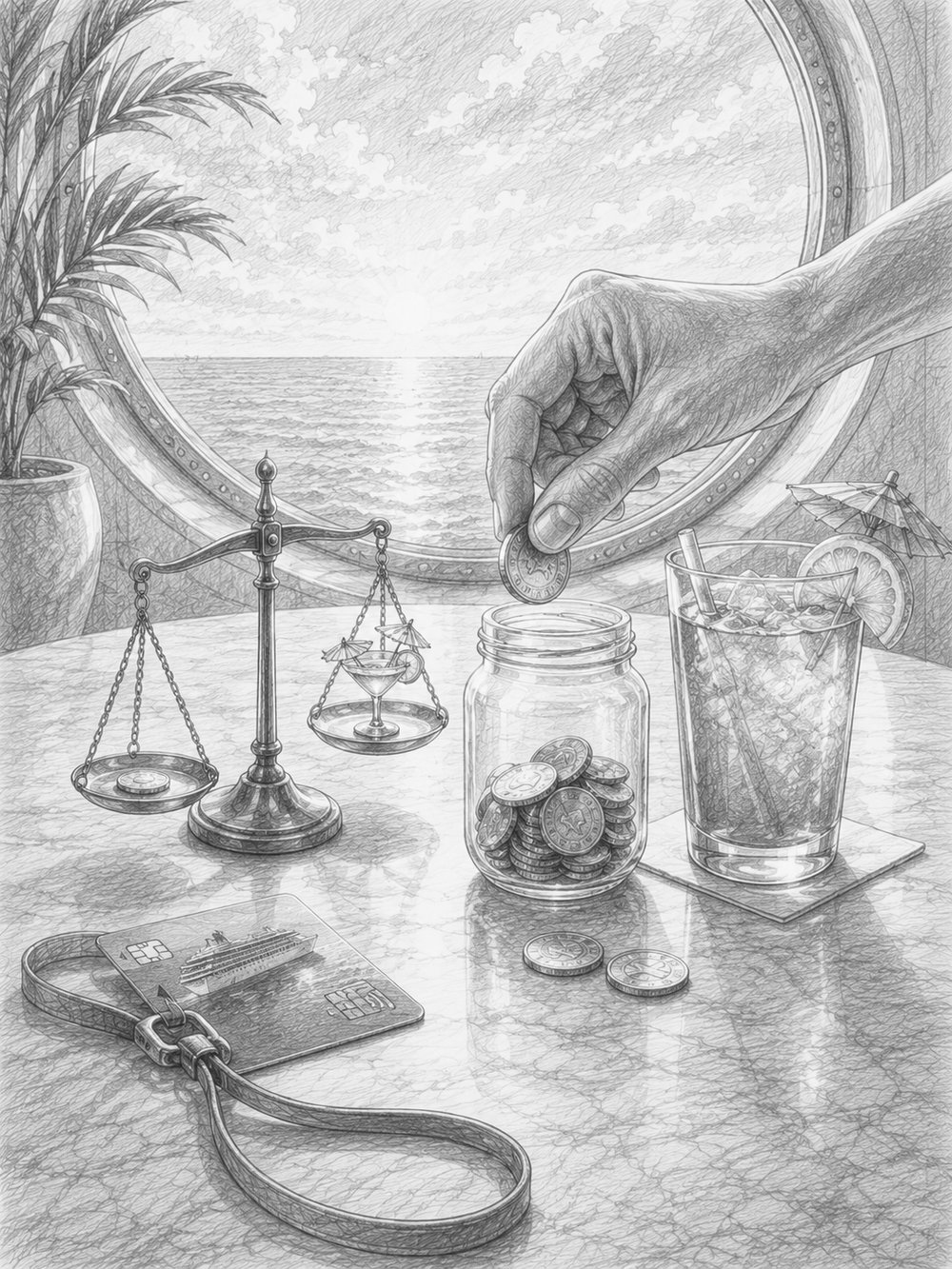
The fare is only part of what you pay for a cruise. The extras — drinks, gratuities, Wi-Fi, specialty dining, excursions — are where budgets quietly balloon. A little arithmetic before you sail keeps them in check.
Do the drinks-package math
A drinks package is worth it for some guests and a waste for others, and the only way to know which you are is to count honestly:
- Tally what you actually drink in a normal day — coffees, sodas, a glass of wine with dinner, a cocktail or two by the pool. Be honest, not aspirational.
- Compare that daily total against the package price per day. If you would need to drink more than you comfortably would just to break even, skip it and pay as you go.
- Remember that on a port-heavy Mediterranean itinerary you are often ashore for the best drinking hours, which lowers the value of an all-day package.
- If you were leaning toward Aurea anyway, factor in that a drinks package is often bundled into that Experience — which can make the premium tier the cheaper route to the same drinks.
Understand gratuities and the other extras
Daily gratuities are added to your onboard account automatically — budget for them from the start rather than treating them as a surprise at the end. Onboard Wi-Fi is a separate paid plan, so decide before you sail if you want to be connected or genuinely offline for the week. And because specialty dining and premium excursions add up fast, the cleanest way to control spending is to set a rough extras budget before boarding and check your account balance in the app every couple of days.
Beating the lines: the Venom Drop and the shows
The best free thrills on board are also the most popular, which means timing is everything. Two in particular reward a bit of strategy.
- The Venom Drop — the record-setting multi-deck dry slide on the World Promenade — draws the longest queues in the middle of sea-day afternoons. Ride it early in the morning, during a port stop when most guests are ashore, or in the evening after dinner, and you may walk straight on instead of waiting.
- The aquapark and waterslides follow the same pattern: quietest first thing and during port calls.
- Theater productions can fill for the popular slots. Arrive early for a good seat, or where the app lets you reserve, book ahead. The show schedule usually runs around dinner, so plan your meal and your show together rather than colliding with the rush.
- The Zen area’s cantilevered whirlpools, which hang out over the sea, are best enjoyed at off-peak hours in the adults-only calm rather than the midday scramble.
A few more habits regulars swear by
- Explore the ship on the first afternoon. Walk the World Promenade, find the Galleria atrium with its glass elevators, and locate your nearest lifts, and you will navigate confidently all week.
- Pack a small day bag for ports. Water, sunscreen, a layer, local cash and your cruise card. The Mediterranean sun is strong and many sights involve a lot of walking.
- Keep the cruise card and a photo ID handy ashore. You need the card to re-board, and photo ID for certain excursions and purchases.
- Watch the daily programme in the app each evening for the next day. Show times, port timings and schedule changes live there, and reading it the night before saves you scrambling.
- Book your next dining or spa slot as soon as one opens up. Availability is a moving target on a full ship.
Common mistakes newcomers make on MSC
MSC works a little differently from some other lines, and most first-timer frustrations come from a few predictable missteps. Avoid these and you skip most of the learning curve:
- Booking Bella and then being disappointed by the cabin location. If where you sleep matters to you, pay the small step up to Fantastica so you can choose. Bella is only a bargain if you genuinely do not mind.
- Assuming inclusions carry over from a previous cruise or a friend’s sailing. Experience bundles and promotions change constantly. Read what your specific booking includes.
- Treating a long port day as a lie-in. These itineraries are built around the ports. Sleeping until mid-morning wastes the most valuable hours of the trip.
- Cutting it fine on independent port days. The ship leaves on time and does not wait for guests on their own arrangements. Build a real buffer.
- Ignoring the drinks-package math and buying it “to be safe.” Count your real consumption first — on a port-heavy Mediterranean week, many guests never break even.
- Not budgeting for gratuities and Wi-Fi. Both are predictable costs. Factor them in from the start so the final bill holds no surprises.
- Waiting until you are aboard to book specialty dining, spa and headline excursions. On a ship of more than 5,000 guests, the best slots are already gone.
None of this is complicated — it is mostly a matter of deciding on purpose instead of by default. If you are sailing MSC for the first time, our guide to a first-time cruise on MSC World Europa covers the wider basics.
Get the complete MSC World Europa playbook
Want every one of these tips expanded into step-by-step chapters? “The Ultimate Guide to Sailing on MSC World Europa,” part of the Ultimate Ship Guides series by Leo Sotropa, turns each decision — Experience, cabin, port day, dining and budget — into clear action steps you can follow before and during your cruise.
Frequently asked questions
Which MSC Experience should I book on MSC World Europa?
For most guests, Fantastica is the sweet spot because it lets you choose your specific cabin and dining time and adds useful flexibility. Bella is cheapest but MSC assigns your exact cabin location. Aurea is worth pricing out if you want spa access and a drinks package, since bundling can beat buying them separately. Yacht Club is a premium ship-within-a-ship for those who want suites, a butler and private spaces. Confirm current inclusions before you book, as they change by sailing.
What is the best cabin on MSC World Europa?
For value, an Interior or Infinite Ocean View booked on a Fantastica fare so you can choose the location. For the best all-round experience, a midship Balcony on the mid-decks, which gives you space, light and the steadiest ride. Check the deck plan and avoid rooms directly under the pool deck or aquapark, above or below the theater and World Promenade nightlife, and forward high-deck cabins if you are prone to motion.
Should I book ship excursions or explore the Mediterranean ports independently?
It depends on the port. Book the ship’s excursion for far-flung or time-sensitive stops like Pompeii from Naples or the Cinque Terre from Genoa, because the ship waits for its own tours. Go independent in walkable, easy ports like Barcelona, Valletta or Marseille to save money and move at your own pace — just leave a generous buffer to get back before all-aboard time.
Is the drinks package worth it on MSC World Europa?
Only if you drink enough to beat the daily price. Tally what you honestly consume in a normal day and compare it to the package cost per day. On a port-heavy Mediterranean itinerary you are often ashore during prime drinking hours, which lowers the value. If you are already considering the Aurea Experience, check whether a package is bundled in, since that can make the premium tier the cheaper route to the same drinks.
How do I avoid the lines for the Venom Drop and the shows?
Ride the Venom Drop dry slide early in the morning, during a port stop when most guests are ashore, or in the evening after dinner, rather than mid-afternoon on a sea day. For theater productions, arrive early for a good seat or reserve in the app where possible, and plan your dinner seating around the show schedule so you are not caught in the rush.
Do I need the MSC for Me app, and does it cost anything?
Yes — the MSC for Me app runs your day on board, with deck plans, the daily schedule, dining and show information, your account balance and in-party messaging. Download it and log in before you leave home. The app generally works on the ship’s network, but full internet access for your other apps requires a paid Wi-Fi plan.
What extra costs should I budget for beyond the fare?
Plan for daily gratuities, which are added to your onboard account automatically, plus any paid Wi-Fi plan, specialty dining, drinks or drinks package, and shore excursions. The simplest way to stay in control is to set a rough extras budget before you sail and check your account balance in the app every couple of days, so you can adjust as you go rather than facing a surprise on disembarkation morning.
Ready for the whole ship in one place? It is all in The Ultimate Guide to Sailing on MSC World Europa.
Get the book →
Meet Leo: The Heartbeat Behind ‘A Country A Month’
Journeying through the pages of A Country A Month, you might often feel the rhythm of a storyteller’s heartbeat, pulsating through each line, each image, and each adventure shared. That heartbeat belongs to none other than our remarkable website editor, Leo.
With a lens in one hand and a pen in the other, Leo seamlessly marries his passions for photography and writing. His eye captures moments that words can barely describe, yet his eloquence brings those images to life, transcending borders and connecting us all through shared stories. An avid traveler, every country he’s visited has added another chapter to his expansive tale, and through our platform, he generously shares these chapters with us.