What makes a Norwegian fjords cruise on the Nieuw Statendam worth planning around? The short answer: the scenery is the itinerary. Unlike a sun-and-sand sailing where the ship is the destination, a fjords voyage puts the coastline in the leading role — the Geirangerfjord unspooling past your verandah, Bergen’s wooden Bryggen quarter, the quiet oil-and-fishing prosperity of Stavanger, art-nouveau Ålesund, and little Flåm at the head of a long green arm of water. Holland America’s second Pinnacle-class ship is built for exactly this kind of slow, windows-first cruising, and this guide walks through what to do at each port, which days are for watching rather than going ashore, and the small decisions — a verandah, a jacket, a spot in the Crow’s Nest — that decide how much of Norway you actually see.
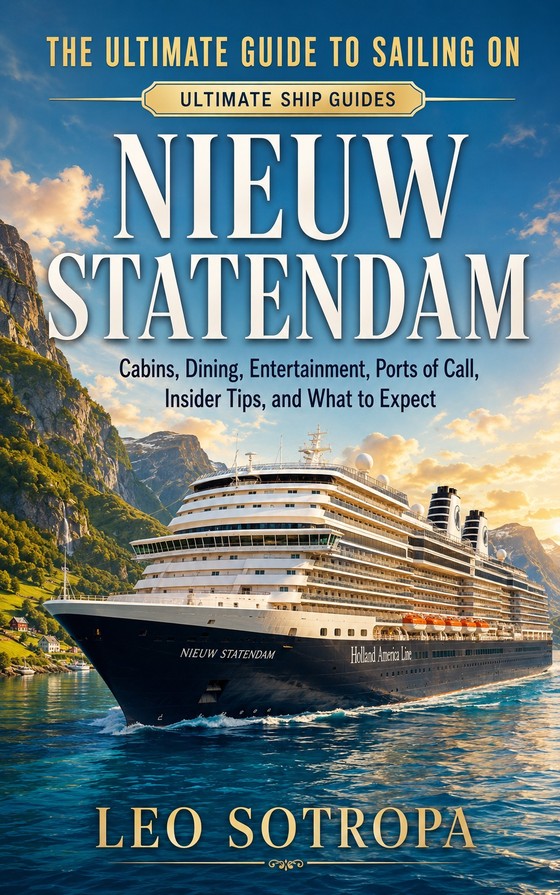
Everything in this article and far more, deck by deck, in The Ultimate Guide to Sailing on Nieuw Statendam.
Get the book →Two ships, one purpose: why the Nieuw Statendam suits the fjords
The Nieuw Statendam is the second Pinnacle-class ship in the Holland America fleet, sister to the Koningsdam and the Rotterdam. At around 99,900 gross tons with about twelve guest decks and roughly 2,666 guests at double occupancy, she is large enough to feel substantial and small enough to slip into the tighter Norwegian ports and reach the head of a fjord where the true giants have to turn around. The line was founded in Rotterdam in 1873, and for decades its ships carried cargo and emigrants from that quay to New York; the fjords sit squarely in the company’s home waters, and it shows in how routinely the crew handle these narrow, weather-changeable runs.
What matters for a fjords cruise specifically is that the ship was designed around looking outward. The interiors by Adam D. Tihany and Bjørn Storbråten run on a music theme, but the room that earns its keep here is the Crow’s Nest, a forward observation lounge with floor-to-ceiling windows. On a Caribbean sailing it is a pleasant lounge. On the approach to the Geirangerfjord it becomes the single most valuable space aboard. If you want the full picture of the ship before you go, the broader Nieuw Statendam cruise guide covers her decks, dining, and layout in detail, and this article assumes you already know roughly what you booked.
Know which voyage you booked
Holland America runs two quite different Northern Europe itineraries out of these home waters, and it is worth being certain which one is on your booking. The Baltic capitals voyage visits Copenhagen, Oslo, Stockholm, Helsinki, Tallinn, and Visby, among others — a cities-and-history trip. The Norwegian fjords voyage is the scenery trip: Stavanger, Ålesund, Olden, Bergen, and the Geirangerfjord, with some sailings making longer runs toward the Arctic Circle and the North Cape. The two share a home port but almost nothing else in feel. If you are weighing the alternative, the Baltic capitals guide lays out that side of the fleet’s program.
Most fjords sailings are based in Rotterdam, though some depart from Dover or Amsterdam — confirm your embarkation port in the Navigator app before you book flights, because the three cities are not interchangeable for logistics. The season runs roughly May to September, and the exact ports vary by sailing. Longer “Collector’s Voyages” of up to about four weeks also run, sometimes stitching the fjords together with the Baltic capitals into a single long trip. Whatever the brochure says, treat the Navigator app as the source of truth for your actual ports and scenic-cruising days, because these itineraries shift with weather and berth availability.
The scenic-cruising days are the main event
On a fjords cruise, some of the best hours are spent nowhere near a gangway. Scenic-cruising days — most famously the run into and out of the Geirangerfjord — are days where the ship itself becomes the excursion, threading between cliff walls with waterfalls coming off the rock. There is no port to book, no shore excursion to line up. The “activity” is being awake, dressed warmly, and positioned well when the ship enters the fjord.
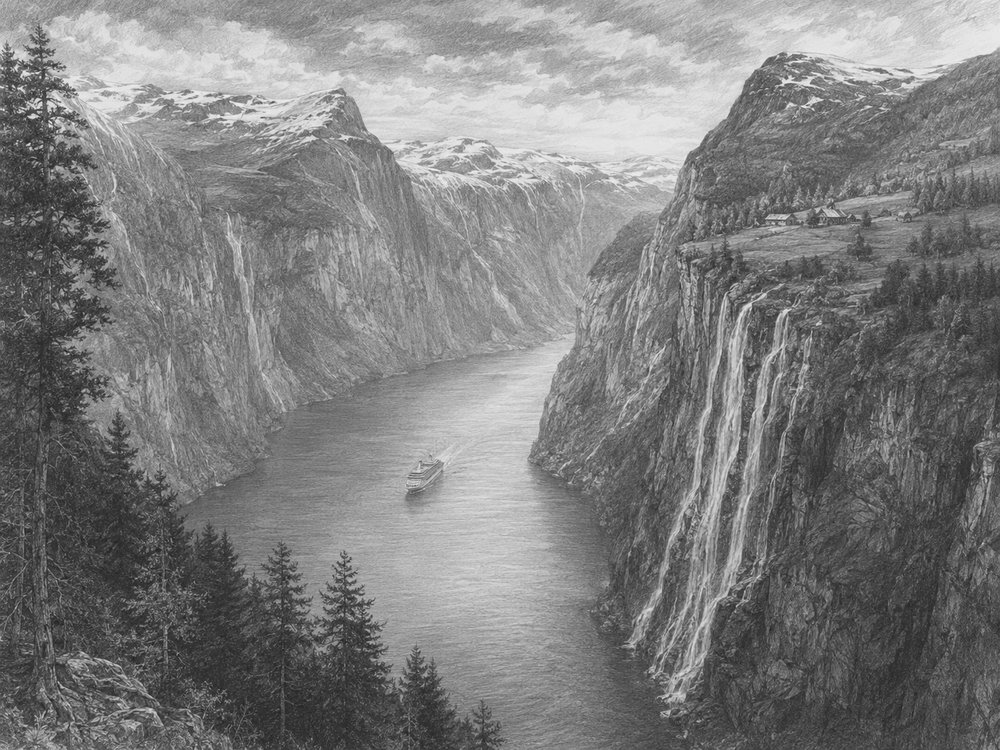
The Geirangerfjord is the one most people come for. It is a narrow, deep, UNESCO-listed arm of water with near-vertical sides, and the ship moves through it slowly enough that you can watch the famous waterfalls — the Seven Sisters among them — slide past. The captain and the Explorations Central team usually narrate the approach, pointing out the abandoned mountain farms clinging to ledges high on the cliffs. This is where a plan matters: the good viewing hours can fall early in the morning, and the fjord is often at its most dramatic when the light is low and the cloud is sitting halfway down the walls.
Where you watch from is a real choice. The Crow’s Nest gives you warmth, coffee, big windows, and narration, but it faces forward and fills up fast on a marquee morning. An open deck — high up, or out on your own verandah — gives you the cold air, the sound of the waterfalls, and the ability to look straight up the cliff face, which glass never quite delivers. Many regulars do both: the Crow’s Nest for the long approach and the wide forward view, then out onto a deck or their verandah for the tightest, most vertical stretch. Get a hot drink first, put on more layers than you think you need, and claim your spot before the fjord narrows.
The ports, and what to actually do at each
Bergen and the Bryggen
Bergen is the gateway to the fjord country and usually the most walkable major stop. The Bryggen — the old Hanseatic wharf, a run of leaning wooden merchant houses along the harbour — is a short walk from most berths and is the thing to see even if you do nothing else. Wander the narrow lanes behind the facades where the timber buildings crowd together, then head to the fish market for a sense of the working port. The funicular up Mount Fløyen is the classic add-on for a view back over the city and out toward the islands; go up early if the ship is in port only for the day. Bergen is famously the rainy city of Norway, so this is the port where a waterproof layer pays for itself.
Stavanger
Stavanger is compact and easy to do on foot. Gamle Stavanger, the old town, is a tidy district of white wooden cottages that you can walk in under an hour, and the harbourfront is right where the ship docks. Stavanger is also the base for the region’s oil industry, which funds a prosperous, low-key city that rewards simply walking. The big-ticket excursion here is the hike to Preikestolen — the Pulpit Rock — a serious day out that requires booking ahead and a good level of fitness; it is not a stroll, and if that is your goal, treat the whole port day as committed to it. If you would rather keep the day gentle, the town centre and its cafés are enough.
Ålesund
Ålesund is the prettiest town of the itinerary for many people — rebuilt in art-nouveau style after a fire more than a century ago, so the whole centre shares one turn-of-the-century architectural language, spread across islands linked by bridges. The set-piece view is from the Aksla viewpoint at the top of the Fjellstua steps: several hundred steps up from the town park, delivering a postcard of the coloured facades, the harbour, and the surrounding islands and peaks. If the steps are not for you, a road goes up too. Otherwise, this is a wandering port — the streets themselves are the attraction.
Flåm and Olden
Flåm sits at the head of a long fjord arm and is tiny — a village that exists largely for the scenery and the railway. The Flåm Railway is the reason most people go: a steep, dramatic mountain line that climbs through waterfalls and switchbacks to Myrdal, one of the more spectacular train rides in Europe and worth booking early because seats are finite. Olden, on the fjords sailings that include it, is the jumping-off point for the Briksdal glacier and the lake valleys of the Jostedalsbreen area — green water, glacier arms, and easy valley walks. Both are small ports where the excursion, not the town, is the point.
Toward the Arctic Circle
Some fjords sailings extend north, making longer runs toward the Arctic Circle and the North Cape. These are more sea-days-heavy itineraries, with fewer, further-apart ports and long stretches of open coastline. If you have one of these, the ship’s own program matters more — the Crow’s Nest, the enrichment talks, the Music Walk in the evenings — because you will spend real time aboard between stops. In high summer this far north the light barely leaves; the sky stays bright late, which changes how you plan your days and, honestly, how you sleep, so pack for a cabin that never goes fully dark on deck.
Cool, changeable weather: pack in layers
The single most useful piece of practical advice for a fjords cruise is to dress in layers and carry a waterproof shell every day, even a bright one. Norwegian coastal weather changes fast: a clear morning in Ålesund can turn to drizzle by the time you are on the viewpoint, and the temperature on an open deck during the Geirangerfjord run is noticeably colder than the still air in port, because the ship is generating its own wind. The reliable kit is a base layer, a warm mid-layer like a fleece, and a windproof, waterproof outer, plus a hat and gloves for the deck on scenic mornings. Comfortable, grippy walking shoes matter too — Bergen’s wharf and Ålesund’s steps are not places for smooth soles.
Do not over-plan around forecasts. Fjord weather is local and quick to shift, and a “rainy” day often clears for exactly the hour the ship is in the best part of the fjord. The move is to be ready to go outside the moment it does, which comes back to layers you can add and shed without a trip back to the cabin.
Why a verandah earns its keep in a fjord
On a warm-weather cruise you can talk yourself out of a balcony. On a fjords cruise the maths changes. The scenery arrives on both sides and often when you least expect it — a waterfall, a cliff farm, a shaft of light on the water — and having your own private, sheltered vantage means you catch the moments that happen while the public decks are crowded or while you are mid-coffee. In a fjord or on a scenic approach, a verandah earns its keep in a way it simply does not on an open ocean crossing.
Holland America’s cabin categories run from Interior and Ocean View up through Verandah, Spa staterooms, Signature Suites, Neptune Suites — which add the Neptune Lounge and a concierge — and the single Pinnacle Suite. For the fjords, the sweet spot is a midship Verandah on the mid-decks: enough outdoor space to sit through a scenic morning, a steadier position for anyone sensitive to motion on the more open northern runs, and quicker access to the ship’s public spaces. An Interior or Ocean View remains the best value if the budget is tight, and you will still have the Crow’s Nest and the open decks for the big scenery; a Neptune Suite is the top of the range. When you look at the deck plan, steer away from rooms under the Lido pool deck or the buffet, cabins under the World Stage or near the Music Walk, forward high-deck rooms if you are prone to motion, and any verandah marked obstructed — an obstructed balcony is a poor trade on the one itinerary where the view is the entire point.
| Cabin choice | Best for the fjords |
|---|---|
| Interior / Ocean View | Best value; rely on the Crow’s Nest and open decks for scenery |
| Midship Verandah, mid-decks | Best all-round; private vantage on scenic days, steadier ride |
| Neptune Suite | Top of the range; Neptune Lounge and concierge |
| Obstructed verandah | Avoid on this itinerary — the view is the point |
Life aboard on the days at sea and in the evenings
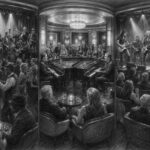
Between ports and after the scenic mornings, the ship carries the day. The Music Walk is the heart of Holland America’s evenings — a run of connected, all-included live-music venues: B.B. King’s Blues Club, Billboard Onboard with its duelling pianists, and the Rolling Stone Rock Room, a five-piece rock band that is a Pinnacle-class exclusive. One thing to set expectations on: Lincoln Center Stage, the classical troupe, is not a fixed venue aboard; it rotates between ships and appears on select sailings only, so do not count on it being there for your fjords voyage — check the Navigator app once you are aboard. For a fuller rundown of the nightly music, the Music Walk and entertainment guide goes venue by venue.
The World Stage, the 270-degree LED theatre, runs the “BBC Earth in Concert” productions, which sit well with a nature-led itinerary. The complimentary Grand Dutch Café — bitterballen and Dutch beer — is a fitting spot to end a cold day ashore, and the Explorations Central enrichment program tends to lean into the region’s history and geology, which is more interesting here than usual because you can watch the subject slide past the window. There is also the casino and the Greenhouse Spa for the longer sea stretches north.
On dining, the included venues cover most needs: the Dining Room, the Lido Market buffet, Dive-In for burgers, the New York Deli & Pizza, and the Grand Dutch Café. For a charge there is the Pinnacle Grill steakhouse, Tamarind for pan-Asian, Rudi’s Sel de Mer for French seafood, and Canaletto for Italian. Club Orange is a paid upgrade that bundles an exclusive restaurant, expanded menus, priority embarkation and tender access, and a cabin upgrade — and the tender-priority piece is genuinely useful on a fjords cruise, since some of these ports are tender ports where getting ashore promptly buys you more of a short day. Have It All, the line’s bundled fare, wraps a drinks package, Wi-Fi, a shore-excursion credit, and specialty dining into a set daily amount, with the number of included specialty nights scaling to the length of the voyage. If this is your first Holland America sailing, the first-timer’s guide to the Nieuw Statendam is worth a read before you decide which add-ons are worth it.
Get the complete Nieuw Statendam playbook
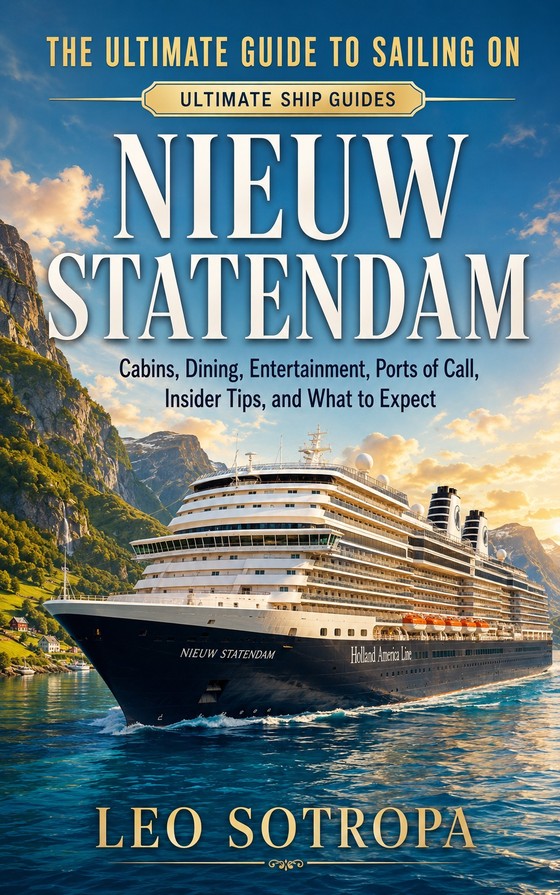
If you want every scenic-cruising day, cabin call, and port plan mapped out in one place, “The Ultimate Guide to Sailing on Nieuw Statendam” turns all of this into a step-by-step trip plan. It is part of the Ultimate Ship Guides series by Leo Sotropa, with clear action steps in every chapter so you board knowing exactly where to stand when the Geirangerfjord opens up.
Frequently asked questions
Do I need a verandah for a Norwegian fjords cruise?
You do not strictly need one — the Crow’s Nest and the open decks give everyone the big scenery — but a verandah earns its keep on this itinerary more than on any other. The scenery arrives on both sides and often unexpectedly, and a private, sheltered vantage means you catch the moments that happen while the public decks are crowded. A midship Verandah on the mid-decks is the best all-round choice; if the budget is tight, an Interior or Ocean View is the best value and you still see everything from the ship’s public spaces.
What is the best place on the ship to watch the Geirangerfjord?
The Crow’s Nest, a forward observation lounge with floor-to-ceiling windows, is the single most valuable room aboard on this itinerary — it gives you warmth, coffee, narration, and a wide forward view for the long approach. For the tightest, most vertical stretch, an open deck or your own verandah lets you feel the cold air and look straight up the cliff face, which glass cannot fully deliver. Many regulars use both: the Crow’s Nest for the approach, then outside for the narrowest part.
What should I pack for the fjords weather?
Layers and a waterproof shell, every day. Coastal Norwegian weather is cool and changeable, and an open deck during the Geirangerfjord run is noticeably colder than the still air in port. A base layer, a warm mid-layer, a windproof and waterproof outer, plus a hat and gloves for scenic mornings, will cover almost everything. Bring grippy walking shoes for Bergen’s wharf and Ålesund’s steps, and do not over-plan around forecasts — fjord weather is local and often clears for the best hour.
Which ports does the Nieuw Statendam visit on a fjords cruise?
Typical Norwegian fjords sailings include Stavanger, Ålesund, Olden, Bergen, and the Geirangerfjord, with some voyages making longer runs toward the Arctic Circle and the North Cape. Flåm features on many itineraries too. Ports vary by sailing and the season runs roughly May to September, so always confirm your exact ports and scenic-cruising days in the Navigator app.
Where does the Nieuw Statendam sail these fjords cruises from?
Most fjords sailings are based in Rotterdam, Holland America’s home city since the line was founded there in 1873, though some depart from Dover or Amsterdam. The three are not interchangeable for flights and transfers, so confirm your embarkation port in the Navigator app before booking travel. If you are sailing from the home port, arriving a day early to see Rotterdam itself is well worth it.
Are the fjords ports tender ports?
Some are. On a scenic-cruising day like the Geirangerfjord run there is no going ashore at all — the ship itself is the excursion. At certain small ports you come ashore by tender, which is where Club Orange’s priority tender access becomes genuinely useful, since getting off promptly buys you more of a short day. Check your specific ports in the Navigator app, as tender arrangements vary by sailing and berth availability.
Is a fjords cruise different from the Baltic capitals itinerary?
Very. Both sail from the same home waters, but the fjords voyage is a scenery trip built around Stavanger, Ålesund, Olden, Bergen, and the Geirangerfjord, while the Baltic capitals voyage is a cities-and-history trip through Copenhagen, Oslo, Stockholm, Helsinki, Tallinn, and Visby. They feel almost nothing alike, so be sure which one is on your booking. Longer Collector’s Voyages sometimes combine both into a single trip of up to about four weeks.
Ready for the whole ship in one place? It is all in The Ultimate Guide to Sailing on Nieuw Statendam.
Get the book →
Meet Leo: The Heartbeat Behind ‘A Country A Month’
Journeying through the pages of A Country A Month, you might often feel the rhythm of a storyteller’s heartbeat, pulsating through each line, each image, and each adventure shared. That heartbeat belongs to none other than our remarkable website editor, Leo.
With a lens in one hand and a pen in the other, Leo seamlessly marries his passions for photography and writing. His eye captures moments that words can barely describe, yet his eloquence brings those images to life, transcending borders and connecting us all through shared stories. An avid traveler, every country he’s visited has added another chapter to his expansive tale, and through our platform, he generously shares these chapters with us.