Spain appears in thousands of retirement daydreams: a table on a sunny plaza, a walkable neighborhood, fresh food, excellent trains, and healthcare that does not provoke panic every time an envelope arrives. The dream is attractive because much of it is real.
The difficult part is determining whether your income, health, family situation, and tolerance for bureaucracy can support that life over an entire retirement.
No-Nonsense Guide to Retiring in Spain: Without a Millionaire’s Budget by Leo Sotropa is a practical planning guide for Americans who are considering Spain on Social Security, a pension, or a modest nest egg. It replaces the question “Is Spain cheap?” with the questions that actually decide whether the move works:
- Can you qualify for legal residence?
- Which Spanish locations fit your real budget?
- How will Spain tax your particular income?
- What will you do for healthcare before and after arrival?
- Can you afford housing in the town you actually want?
- How will you manage dollars, euros, emergencies, and trips home?
- What happens if your health, marriage, or finances change?
The book does not promise a luxury Mediterranean life on any Social Security check. It shows how ordinary retirees can test Spain carefully, choose the right location, and build a plan with room for bad surprises.
What this book actually is
This is not a glossy catalog of beaches and white villages. It is a decision manual.
The guide begins with the reader’s constraints, not Spain’s attractions. It asks you to write down reliable monthly income, liquid savings, housing requirements, health needs, climate preferences, language tolerance, and the amount you must preserve for emergencies or a return to the United States.
Only then does it compare places.
That order matters. Spain contains very different retirement markets. Central Madrid, central Barcelona, a fashionable Costa del Sol address, a working neighborhood in Granada, and a smaller inland city do not belong in one national cost-of-living average. A retiree can be priced out of one Spain and comfortable in another.
The book therefore treats location as a financial instrument. Choosing a walkable regional city can reduce rent and eliminate much of the cost of owning a car. Choosing a tourist market can raise housing costs and make long-term rentals scarce. Choosing a small inland town can save money while increasing language demands and distance from specialist care.
There is no universally best place. There is a best fit for a particular household.
Why Spain attracts budget-conscious retirees
Spain combines several qualities that are difficult to find in one country:
- Walkable cities and towns
- Extensive public transportation
- A strong food culture
- Long coastlines and varied climates
- Public and private healthcare
- A slower daily rhythm
- Established international communities
- Direct connections to the rest of Europe
- A residence route commonly used by financially self-sufficient retirees
Daily life can feel abundant without being built around expensive consumption. A coffee on a plaza, a municipal market, an evening paseo, a public beach, a neighborhood festival, and a long conversation with friends can form the center of the week.
That lifestyle can suit a fixed income because many of its pleasures are inexpensive. But Spain’s popularity has also changed the numbers. Housing pressure is real in the most promoted cities, islands, and coastal markets. Yesterday’s “cheap Spain” article is not a lease offer.
The guide helps readers distinguish Spain’s enduring advantages from outdated price claims.
Three retirees, three budgets
The book uses three composite retirees to show how the planning method works.
The first is a solo retiree in Granada living primarily on Social Security. Her plan depends on keeping rent controlled, choosing a practical neighborhood rather than a tourist postcard, walking and using public transportation, and maintaining separate savings for immigration and emergencies.
The second is a couple on the Costa Blanca. Two benefits allow them to share rent, utilities, and internet, but they still have to manage a tightening coastal rental market. Their lesson is that a seemingly comfortable household income can be undermined by housing, seasonal demand, or a car.
The third is a single retiree in Valencia who has more financial breathing room and prioritizes healthcare, culture, and big-city services. She demonstrates that a larger budget should buy resilience—not automatically a more expensive address.
The examples are not testimonials or promises. They are worked models. Each shows:
- Reliable monthly income
- Housing
- Utilities and communications
- Food and household spending
- Transportation
- Healthcare
- Social life
- Travel
- Emergency reserves
- The separate financial test imposed by the residence process
This separation is essential. A retiree may be able to afford an ordinary life in Granada yet fail to satisfy the current financial evidence required for the non-lucrative visa. Conversely, someone may clear the immigration threshold while choosing a lifestyle that consumes savings too quickly.
Affordability and visa eligibility are related, but they are not the same test.
The cost-of-living truth
The book refuses to reduce Spain to one monthly number.
Housing normally creates the largest difference between retirement plans. A rent that fits comfortably in a regional neighborhood may be impossible in central Barcelona or a prime coastal zone. Even inside one city, proximity to tourism, a beach, transit, elevators, air conditioning, and modern insulation can change the price.
A credible Spain budget includes:
- Long-term rent
- Deposits, agent costs where applicable, and temporary lodging
- Electricity, water, gas, and internet
- Heating and cooling
- Groceries and household supplies
- Restaurants and entertainment
- Public transport or car ownership
- Private insurance and medical costs
- Dental, vision, and prescriptions
- Tax preparation and administrative assistance
- Flights to the United States
- Currency conversion
- Home maintenance or furnishing
- Emergency travel
- A reserve for moving again
The guide also explains why a “normal month” is not enough. A retirement plan must survive the expensive months: a rent increase, a dental procedure, a weak dollar, family travel, a legal consultation, or a temporary move.
Readers are encouraged to build three budgets:
- A normal month
- A difficult year
- A later-life scenario
The third budget is the one most retirement articles omit. It asks what happens if you can no longer climb stairs, drive, manage documents, or travel alone. A charming bargain on a steep hill may be a poor long-term choice.
Where the book helps you look
The guide compares several kinds of Spanish destinations rather than declaring one winner.
Alicante and the Costa Blanca
The Alicante area offers a warm climate, an established international community, beaches, transportation, and access to healthcare. It can provide an easier landing for newcomers, especially those nervous about language.
Its weaknesses are popularity and housing pressure. Retirees need to compare ordinary residential neighborhoods and year-round rental supply, not vacation prices.
Valencia
Valencia combines city services, culture, transportation, beaches, and specialist healthcare. It appeals to retirees who want a substantial city without defaulting to Madrid or Barcelona.
Its success has raised demand. A realistic Valencia plan may require choosing neighborhoods outside the most fashionable center and accepting that its old bargain reputation is fading.
Granada
Granada can offer strong cultural life, university energy, walkability, and comparatively manageable costs. Free tapas traditions can make social life feel generous even on a modest budget.
The city is not a year-round beach resort. Winters can be cold, hills affect mobility, and daily Spanish becomes more important outside international circles.
Seville
Seville offers architecture, music, food, neighborhoods, transport, and a powerful sense of place. It may suit retirees who value culture over the coast.
Summer heat is not a footnote. The cost of cooling, the shape of the daily schedule, and a retiree’s medical tolerance for extreme heat must be evaluated honestly.
Málaga and the Costa del Sol
Málaga offers excellent connections, healthcare, a major airport, mild winters, and a large international community. Those advantages have a price.
The area may fit a comfortable budget better than a lean one. Retirees should distinguish the provincial city, resort towns, inland communities, and luxury markets instead of treating the Costa del Sol as one price zone.
Smaller inland cities
Smaller cities can improve affordability and immersion. They may also offer quieter streets and a stronger sense of ordinary Spanish life.
The trade-offs can include fewer English-speaking professionals, less frequent transport, smaller rental inventories, hotter summers or colder winters, and greater distance from specialist hospitals and airports.
The book’s comparison framework scores locations across budget, climate, healthcare, transport, language, social fit, airport access, and long-term livability.
The non-lucrative visa, without shortcuts
For many American retirees, Spain’s non-lucrative visa is the central immigration route. The name contains an important limitation: the route is designed for residents who can support themselves without working.
The book explains the application as a connected financial and documentary file rather than a checklist collected at random. Applicants generally need to plan for:
- Current income or qualifying financial resources
- Additional resources for accompanying family members
- Private health insurance meeting the applicable requirements
- Criminal-record documentation
- Medical documentation
- Proof of accommodation or a credible housing plan
- Apostilles and translations where required
- Consulate-specific forms and procedures
- Post-arrival registration and residence-card steps
Thresholds, interpretations, and consular procedures can change. The book teaches readers how to verify the responsible consulate’s current requirements rather than memorizing a number from an old blog.
It also addresses a common conflict: Spanish landlords often want a resident profile, while a visa file may need housing evidence before the applicant has established residence. A scouting trip, professional assistance, temporary accommodation, and careful timing may be needed.
The non-lucrative route is also not a casual part-time-residence solution. Readers need to understand renewal, presence, tax residence, and the consequences of building their lives in Spain.
Healthcare: strong care, but no automatic bridge
Spain’s healthcare reputation is one of its major attractions. Retirees can encounter public services, private insurance, private clinics, pharmacies, emergency care, and later-life options.
The planning problem is access and timing.
Medicare generally does not pay for routine treatment in Spain. A Medicare card is therefore not a Spanish healthcare plan. Applicants may need qualifying private insurance for the visa, then later consider available public-system routes depending on residence status and regional procedures.
The guide treats healthcare in phases:
- Coverage required for the visa
- Care during the first year
- Public eligibility or contribution-based access where available
- Private care as a supplement
- Dental, vision, prescriptions, and long-term care
- A contingency for treatment or relocation
It also separates the decision to keep Medicare from the question of Spanish coverage. Maintaining certain U.S. coverage may support a future return, but it does not replace insurance or access in Spain. Dropping coverage can reduce expenses now while creating later enrollment complications.
Readers with chronic or complex conditions are urged to investigate actual providers, medication availability, exclusions, waiting periods, language support, and proximity to appropriate hospitals before moving.
Taxes: the chapter that protects the plan
Spain is not a tax-free retirement jurisdiction.
American citizens generally continue to have U.S. filing obligations. Spanish tax residence can also bring reporting and taxation of worldwide income, subject to domestic law and treaty rules. Different sources—Social Security, government pensions, private pensions, retirement-account withdrawals, dividends, capital gains, and rental income—may receive different treatment.
The guide introduces the questions readers must take to a qualified U.S.–Spain tax professional:
- When will Spanish tax residence begin?
- How is each income source classified?
- Which country taxes it first?
- What credits or treaty provisions may apply?
- What foreign-account reporting is required?
- Could Spanish asset reporting apply?
- Could wealth-related taxes apply nationally or regionally?
- How should withdrawals be timed before and after the move?
- What happens to a spouse or survivor?
The point is not to turn the reader into a cross-border tax specialist. It is to prevent a move based on gross income when taxes can materially change spendable income.
The book also covers wills, succession planning, beneficiary coordination, and the importance of professional advice when U.S. and Spanish systems overlap.
Housing: rent first and learn the market
The guide strongly favors renting before buying.
A first-year rental preserves flexibility while retirees learn:
- Which neighborhoods function year-round
- How noise travels through buildings
- Whether stairs and hills are manageable
- How heating and cooling perform
- Whether transportation is sufficient
- How far healthcare actually feels
- What winter and summer are like
- Whether tourism affects daily life
- How much Spanish the location requires
Buying immediately concentrates risk in an unfamiliar market. Shipping an entire household can create the same problem in a different form. The guide recommends a lighter move, a test period, and a deliberate decision after the first year.
It also covers rental scams, deposits, inventory, documentation, inspection, and the danger of sending money before the property and counterparty have been verified.
Money logistics and currency risk
Retirees may receive income in dollars while paying expenses in euros. That creates a moving budget.
The book discusses maintaining appropriate U.S. accounts, opening a Spanish account, transferring funds, protecting access to two-factor authentication, and reducing unnecessary conversion fees.
Readers are encouraged to test their budgets at several exchange rates. If the plan works only when the dollar is unusually strong, it is not yet durable.
A useful structure separates:
- Monthly spending money
- Visa and relocation funds
- Emergency reserves
- Long-term retirement assets
- Return-home funds
The same savings should never be assigned simultaneously to the visa, the emergency fund, and the return plan.
Moving, settling in, and adapting
The practical move does not end when the visa is approved.
The guide walks through the first sequence in Spain: temporary accommodation, local registration, identity and residence documents, banking, phone service, utilities, healthcare, transportation, and the eventual long-term lease.
It also deals with the emotional transition. Spain’s schedule, meal times, bureaucracy, language, and social habits can feel charming on vacation and exhausting during a move.
Integration requires repeated contact. Language classes, neighborhood routines, volunteer work, walking groups, cultural organizations, and becoming a regular somewhere all help turn a location into a life.
English-speaking communities can soften the landing. They should be a bridge, not necessarily the whole structure. The more modest the budget and the less international the town, the more useful Spanish becomes.
Planning for change
A mature retirement plan includes an exit.
The book asks readers to consider what happens if:
- One spouse dies
- A chronic condition worsens
- A family member in America needs help
- Rent rises sharply
- The dollar weakens
- Driving is no longer possible
- The visa route or tax treatment changes
- Spain simply does not feel like home
Possible responses include moving to a more accessible neighborhood, choosing a larger city, downsizing, returning to the United States, or using a part-year strategy that stays within immigration and tax rules.
Returning home is not failure. It is one of the outcomes a responsible plan funds from the beginning.
Who this book is for
The guide is designed for:
- Americans living mainly on Social Security
- Retirees with a modest pension or nest egg
- Couples who want to compare shared-income scenarios
- Solo retirees who need a conservative housing plan
- Readers interested in Spain’s non-lucrative visa
- People willing to rent before buying
- Retirees who want walkability and public transportation
- Readers prepared to learn some Spanish
- Anyone who wants practical trade-offs rather than sales language
It may not suit someone who must continue working under a route that prohibits employment, needs immediate access to a specific U.S. treatment team, refuses to navigate cross-border taxes, or expects central Madrid, central Barcelona, and prime coastal markets to fit every modest budget.
What makes the guide no-nonsense
The book follows several rules.
It does not treat national averages as personal budgets. It does not present an immigration minimum as a recommended income. It does not imply Medicare travels with you. It does not hide taxes behind sunshine. It does not invent testimonials or claim that one city fits everyone.
Instead, it provides:
- Composite budget scenarios
- Location comparisons
- Worksheets and action steps
- Visa-document planning
- Healthcare decision points
- Tax questions for a professional
- Housing and scam precautions
- Banking and currency planning
- Arrival sequences
- Later-life and return-home contingencies
That is the difference between admiring Spain and preparing to live there.
About Leo Sotropa and the series
Leo Sotropa writes practical guides for readers who want to retire abroad without pretending they have a millionaire’s budget. Each book in the series combines affordability, residency, healthcare, taxes, housing, culture, and long-term resilience.
The goal is not to tell every reader to move. It is to help each reader reach a better decision—yes, no, not yet, or somewhere else—with fewer costly surprises.
Get No-Nonsense Guide to Retiring in Spain
If Spain remains on your shortlist, the complete book provides the budgets, worksheets, city comparisons, visa sequence, healthcare planning, tax questions, housing guidance, and contingency framework in one place.
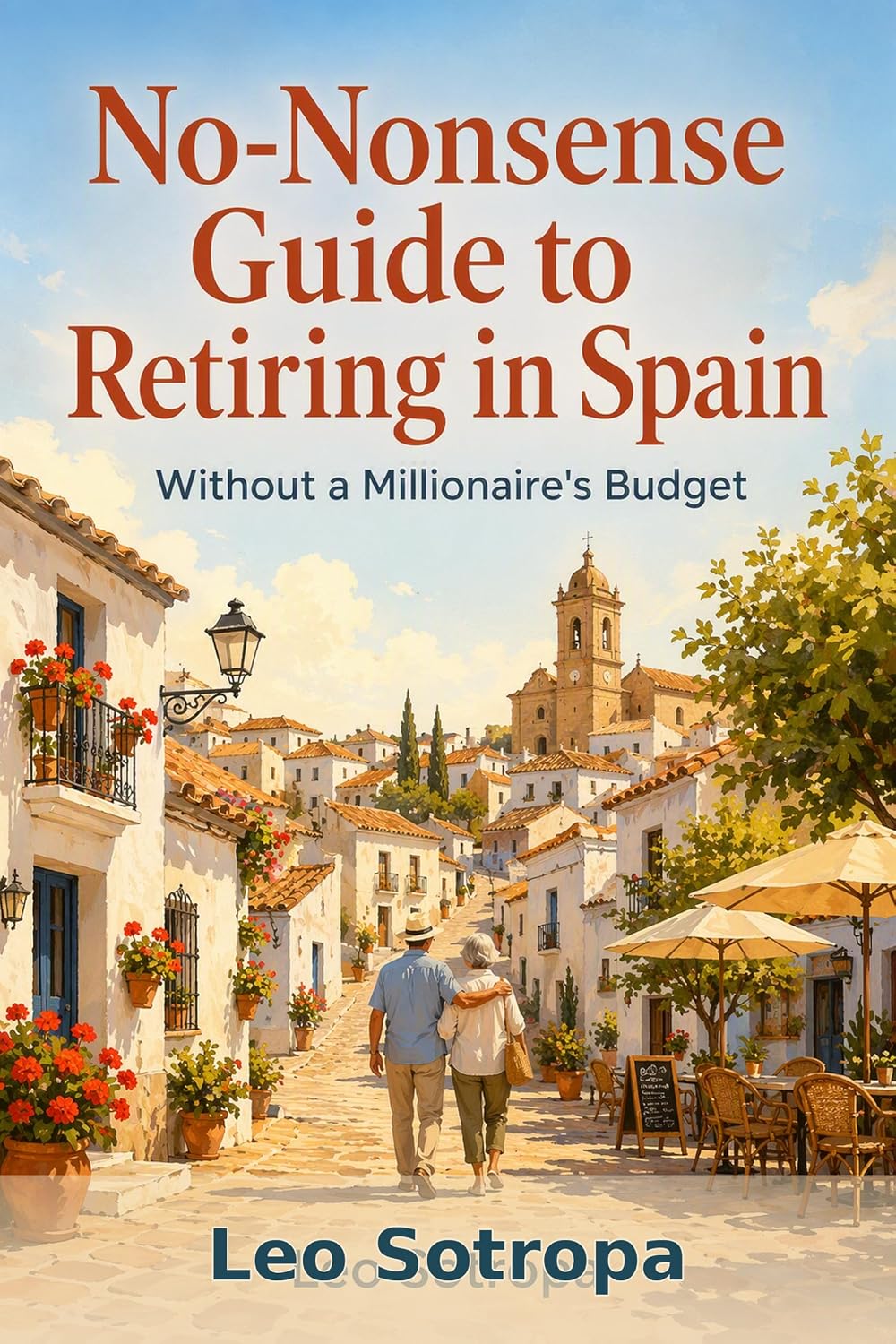
No-Nonsense Guide to Retiring in Spain by Leo Sotropa is available on Amazon.
Continue online with the guide to retiring in Spain on Social Security, the Spain non-lucrative visa guide, and the Spain retirement cost-of-living framework.
Frequently asked questions
Can an American retire in Spain?
Yes, if the retiree qualifies under an appropriate residence route and satisfies the current financial, insurance, documentation, and procedural requirements. The non-lucrative visa is commonly considered by retirees who will not work.
Can you retire in Spain on Social Security alone?
Some retirees can fund daily life primarily with Social Security, especially outside the most expensive markets. However, the income or resources required by the visa must be tested separately, and savings are needed for relocation, emergencies, healthcare, and currency risk.
Is Spain cheaper than Portugal?
Neither country has one price. The answer depends on the city, neighborhood, housing market, taxes, healthcare, and lifestyle. Compare specific destinations and complete household budgets.
Does Medicare cover retirees in Spain?
Medicare generally does not cover routine care in Spain. Retirees need a Spanish healthcare plan and should make a separate decision about maintaining U.S. coverage.
Is Spanish necessary?
It is possible to begin in some international areas using English, but Spanish improves housing options, healthcare navigation, administration, friendships, and independence. It becomes more important in less expensive and less tourist-oriented locations.
Should retirees buy property immediately?
Usually not. Renting first allows the retiree to test the neighborhood, climate, healthcare access, noise, transportation, and true year-round lifestyle before making a large commitment.

Meet Leo: The Heartbeat Behind ‘A Country A Month’
Journeying through the pages of A Country A Month, you might often feel the rhythm of a storyteller’s heartbeat, pulsating through each line, each image, and each adventure shared. That heartbeat belongs to none other than our remarkable website editor, Leo.
With a lens in one hand and a pen in the other, Leo seamlessly marries his passions for photography and writing. His eye captures moments that words can barely describe, yet his eloquence brings those images to life, transcending borders and connecting us all through shared stories. An avid traveler, every country he’s visited has added another chapter to his expansive tale, and through our platform, he generously shares these chapters with us.