 To Romania, with Love: Notes from a country I never really left is a literary travel memoir in twenty chapters. It is not a guidebook. It does not try to tell you where the best Wi-Fi is, or which hostel takes American Express. It is a slower book than that — a book about reading a country the way one reads a long, beloved sentence, patiently, more than once, and with attention to what isn’t said.
It moves between Bucharest’s two-century boulevards and the painted monasteries of Bucovina, between communist television and a New York Stock Exchange bell, between a 1979 soup invented in a small Moldavian town and the morning of January 1, 2007, when a passport gained a stamp that meant everything. The chapters are short on their own and a little longer when read together. Each one is one place, one object, one hour — and a country looked at from there.
The book has its own home at ToromaniawithLove.com, where you can read about the project, follow the translations into Romanian, Italian, German, French, and Spanish, and find the table of contents in full. What follows is a chapter-by-chapter walkthrough — twenty short windows into the country I have been trying, for a long time now, to describe.
Chapter 1 — Bucharest, Two Cities at Once
 Bucharest is two cities standing on the same street, and most days it does not bother to pretend otherwise. On one side of Calea Victoriei a Belle Époque arcade leans against a hotel that has been there since the time of trains and gloves; on the other, a brutalist block from the 1970s stares back without apology. The chapter starts at Casa Capșa — a confectionery turned café turned restaurant turned cultural address — and walks the few hundred meters that contain a hundred and fifty years of Romanian decisions. Capșa is where writers met to argue about whether Romania was Eastern or Western; the question, like the coffee, has never really gone cold.
What the chapter is really about is layering. Bucharest is not a city that replaces; it accumulates. The communist boulevards did not erase the interwar streets, only built on top of them. The post-1990 advertising hoardings did not erase the boulevards, only covered them. Each generation has added a layer without removing the one below, and so the city reads like a palimpsest: scratch the surface and another text appears. To walk Bucharest well is to learn to read more than one century at the same time.
Chapter 2 — Mititei, the Public Meat
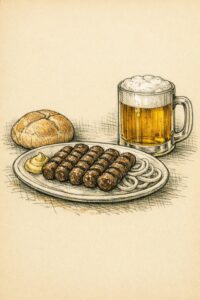 Sometime in the 1860s, in a restaurant on a side street of old Bucharest, the kitchen ran out of sausage casings. What came off the grill that night was the sausage filling alone, shaped by hand, seasoned harder than usual to make up for the absence of skin. The customers, the story goes, asked for them again the next week. That improvised solution became mititei — “the little ones” — and a century and a half later they are still grilled at every street fair, summer terrace, and football crowd in the country, eaten standing up, with mustard, and a roll, and a beer that is colder than it needs to be.
The chapter is partly about a recipe and partly about a habit. Mititei are a Romanian way of being in public — a food that requires charcoal smoke and other people, that does not survive being eaten alone at a desk. They show up at weddings and funerals, at protest squares and parking lots, at every gathering where the country wants to be reminded that it is gathered. To eat a mic is to do something Romanian in a way that almost nothing else quite is: to share, in public, a meat that was first served when one thing ran out and another thing began.
Chapter 3 — Palatul Parlamentului
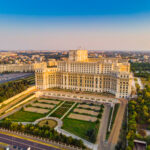
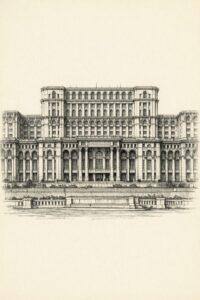 It is the second-largest administrative building in the world, and it should not exist. Ceaușescu ordered its construction in 1984, and to make room for it a fifth of historic Bucharest was bulldozed — churches, neighborhoods, the addresses of tens of thousands of people. Marble was taken from one mountain, crystal from another; a country that did not have enough flour was spending itself on a single building. When the regime fell in 1989, the building was not yet finished. The new Romania inherited a stone whale it had not asked for and did not know how to feed.
What this chapter examines is what a country does with something that big, that wrong, and that real. Romania has, over time, learned to live inside its inherited monster. The Parliament moved in. A museum of contemporary art took a wing. Tourists climb to the balcony and look out over a Bucharest that the building itself created the view of. The Palace is still too big, still too much marble, still a monument to a man who is no longer here — but it is also, now, simply a building where people go to work, eat lunch, and argue about the budget. That, perhaps, is the most Romanian thing that could have happened to it.
Chapter 4 — Caru’ cu bere, the Building That Stayed
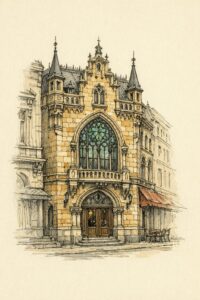 Caru’ cu bere — “the Beer Cart” — opened in 1879 on a small Bucharest street and has been serving more or less the same menu ever since. The building is a neo-Gothic confection of stained glass and painted vaults, with a wooden balcony that runs the length of the dining hall and a staircase that has been climbed by every Bucharest generation since the Belle Époque. Wars came; the building stayed. Communism came; the building stayed, rebranded for a while, but the frescoes were never quite painted over. After 1990 a careful restoration brought back the colors. The waiters still wear vests.
This chapter is about persistence as a form of memory. Bucharest has lost a great deal — to bombs, to earthquakes, to one regime’s enthusiasm for demolition — and the buildings that remain do a kind of quiet work simply by being there. Caru’ cu bere is not a museum; it is a working restaurant that happens to be a hundred and fifty years old. People go for the sarmale and the beer, and incidentally walk through a room their great-grandparents also walked through. There are not many cities where that is still possible, and Bucharest knows what it has.
Chapter 5 — Brașov, the Bend in the Mountain
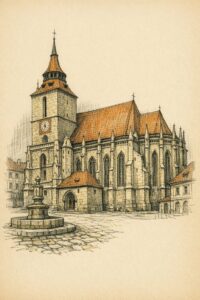 Brașov sits in a fold of the Southern Carpathians the way a coin settles into a palm. The Saxons built it in the thirteenth century with stone walls, a Gothic church (later blackened by fire and renamed for it), and the kind of central square that opens like a lung when you walk into it. The mountain — Tâmpa — rises directly behind, and a cable car climbs to a viewpoint where the city below resolves into red roofs and right angles. In a country where geography is mostly horizontal, Brașov is where the country tilts.
The chapter is about that tilt. For centuries Brașov was a frontier town between three kingdoms; the merchants who lived there had to speak three languages before breakfast. Today the city is a weekend destination, a tech hub, a ski base, a place where people from Bucharest come to remember that Romania has weather. But the older Brașov is still there — in the German signage above some doorways, in the shape of the squares, in the way the streets bend away from the mountain rather than fighting it. The Carpathians have shaped this city the way a long marriage shapes both people in it.
Chapter 6 — The Two Hours, and What People Watched Anyway
 In the 1980s, Romanian state television broadcast for two hours a day. Two hours. The rest of the schedule was a blank carrier wave, or a test pattern, or — if you were lucky — a static frame of the national emblem. What aired in those two hours was a managed reality: the leader greeting workers, the workers greeting the leader, a folk troupe, a weather forecast for tomorrow that bore no relation to today. And yet families gathered at 8 p.m. and watched. Not because they believed what they were seeing, but because watching was itself the act — a small, daily insistence that there was still, somewhere, a “we.”
This chapter is about what people did with what little they were given. They learned to read between the frames. A song meant something. A face that wasn’t on this week meant something else. Hungarian television, picked up illegally from across the border, became a second education; so did the rare smuggled VHS tape. The chapter argues that the post-1990 generation, far from being naïve, is the most media-literate generation Romania has ever produced — because it grew up trained, by scarcity, to interrogate every image it was shown. Two hours of television, watched closely, can teach a person more than twenty.
Chapter 7 — Sibiu and the Saxon Question
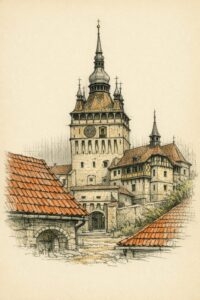 Sibiu is the city with eyes. Its rooftops have small, almond-shaped dormer windows — narrow slits cut into the tile — and from below they look, unmistakably, like a city watching back. The Saxons who built Sibiu in the twelfth century built it carefully: cobbled squares fitted to within a centimeter, defensive walls with their own logic, churches that doubled as fortresses. For eight hundred years German-speaking Transylvanians lived here, ran the guilds, kept the books, and gave the city a Mitteleuropean spine that you can still feel in the way the streets meet.
And then, in 1990, almost all of them left. After Ceaușescu fell, Germany opened a quiet door for the ethnic Germans of Romania, and within a few years nearly a quarter of a million Saxons had gone. The villages they left behind are still there, with their fortified churches and their tidy graveyards, but the people are not. Sibiu, for its part, refused to fade. It was European Capital of Culture in 2007; it has a Saxon-descended mayor and now a Saxon-descended president; it has reinvented itself as a city where the German past is no longer a population but a memory, lovingly maintained. The eyes on the rooftops have a different gaze now, but they are still open.
Chapter 8 — Dedeman, the Quietest Empire
 If you have not heard of Dedeman, that is more or less the point. Founded in 1992 by two brothers in Bacău — a city most foreigners cannot place on a map — Dedeman is a do-it-yourself chain that has, over the last thirty years, become the largest privately held Romanian company in the country. It did not list on a stock exchange. It did not take foreign investment. It did not expand into other markets. It simply opened more stores, sold more drywall, hired more cashiers, paid more taxes, and got quietly, enormously rich. The Pavăl brothers rarely give interviews. The empire keeps its lights on and its head down.
This chapter is about a Romanian style of success that goes against the celebrity grain. The story Romania tells about itself, in 2026, is often about its star exports — UiPath, the tennis stars, the Olympic gymnasts. Dedeman is the counter-story: an unflashy, family-held, locally owned business that has out-earned almost every flashier rival by simply staying patient. The chapter argues that this kind of quiet capital is, in fact, the Romanian model — not the unicorn, but the durable, hyper-local company that compounds for thirty years without anyone in Bucharest noticing.
Chapter 9 — Maramureș, Where the Wood Remembers
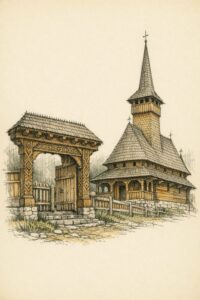 Maramureș is the part of Romania that did not let the twentieth century in. It sits up against the Ukrainian border in a tangle of valleys, and its villages still build the way they built five hundred years ago: tall wooden gates carved with the sun and the rope, churches with shingled steeples so steep they look like they are praying, families that speak a Romanian inflected with words no one in Bucharest uses anymore. UNESCO lists eight of the wooden churches as world heritage; the locals list them as where they go on Sunday.
The chapter spends time in the Merry Cemetery of Săpânța, where each grave is marked by a blue wooden cross hand-painted with a portrait of the deceased and a rhymed couplet about their life — often funny, sometimes biting, occasionally tender. It is a cemetery where mourning has been allowed to laugh, and that, the chapter argues, is the Maramureș worldview in miniature: a place that has had every reason to be heavy and has chosen, instead, to be light. The wood remembers what the country has forgotten, but it remembers it with a smile.
Chapter 10 — Țiriac, the Capital That Came Back
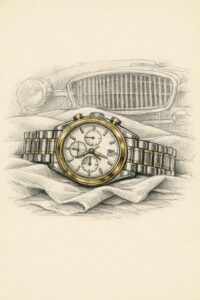 Ion Țiriac was born in Brașov in 1939, picked up a tennis racket because his father gave him one, and by the 1970s was one of the most recognizable Romanians in the world — first as a Davis Cup player, then as the manager who shepherded Boris Becker, Goran Ivanišević, and Marat Safin through the top of the men’s tour. After 1990 he came home with a fortune earned abroad and proceeded to do something almost no other Romanian of his generation did: he reinvested all of it. Bank. Insurance company. Air charter. Tennis tournament. Car collection.
The chapter looks at the Țiriac Collection — a private museum at Otopeni airport that houses several hundred cars from a century of automotive history, including a Bugatti, a Rolls-Royce that belonged to a sultan, and a Romanian-built Dacia 1300 from the year of the moon landing. The museum is, on its surface, one man’s hobby. But the chapter reads it as something more: a portrait of a Romanian capital that left, learned how the world worked, and came back. Many Romanians have made fortunes abroad. Țiriac is one of the few who brought his home.
Chapter 11 — Voroneț and the Painted North
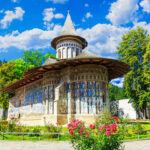
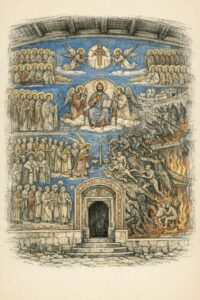 Voroneț Monastery was built in 1488 on Stephen the Great’s orders, in three months and three weeks, as a vow paid for a battle won. Half a century later, an unknown master covered every external wall in fresco — a Last Judgment on the west façade so vivid that the blue paint behind the figures has its own name in the international color literature: “Voroneț blue.” Five centuries of Carpathian winters have not faded it. The pigment recipe is lost. Restorers can clean the wall, but they cannot remake the color.
This chapter is about a particular kind of medieval ambition. The painted monasteries of northern Moldavia — Voroneț, Sucevița, Moldovița, Humor — were built in a generation, painted in another, and intended to teach a population that could not read. They are a Bible in pigment, addressed to peasants in their own language. The chapter argues that they are also, more quietly, an early experiment in public design — a willingness to put art outdoors, where everyone could see it, where the rain could touch it, where it would have to earn its place. Five hundred years later, it is still earning.
Chapter 12 — Bucovina, a Way of Thinking
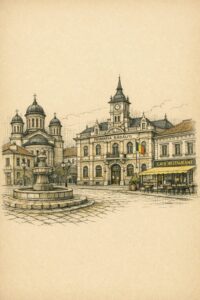 If Maramureș is the country that did not let the twentieth century in, Bucovina is the country that lets the twentieth century in and then politely closes the door behind it. The pace is slower here. The fields are smaller. The Sunday Mass is longer. A wedding takes three days. A funeral takes seven. The painted monasteries are part of it, but they are only the surface of something older: a region that has decided, over a long time, that patience is not the opposite of progress but a form of it.
The chapter takes its title from a remark the author’s mother made once, that Bucovinans don’t have a religion so much as a way of thinking. The way of thinking is built on small repetitions — the morning bread, the Saturday soup, the same prayer at the same hour, the same path to the well — and it produces a kind of person who does not, in general, hurry. The chapter does not romanticize this. It notes the costs: the brain drain, the abandoned villages, the children working in Italian factories. But it also insists that there is something here that the rest of the country could stand to learn from, and the country, slowly, is starting to.
Chapter 13 — Ciorbă Rădăuțeană, the 1979 Soup
 In 1979, in the kitchen of the Hotel Nordic in the small Bucovinan town of Rădăuți, a cook named Cornelia Dumitrescu invented a soup. It was a riff on an older Transylvanian dish, but lighter — chicken instead of mutton, garlic crushed in at the last moment, an egg yolk beaten with sour cream, a final acid kick from vinegar. She served it to hotel guests. Truck drivers asked for the recipe. By the late 1980s, ciorbă rădăuțeană was on menus in Constanța, Cluj, and Timișoara. By 2000 it had crossed into household cooking nationally. The cook is, in 2026, in her eighties. She is still alive, and she invented Romania’s most beloved soup.
The chapter is partly a recipe and partly a meditation on how things travel. Ciorbă rădăuțeană did not move because a marketing department pushed it; it moved because it was good, and because Romanians on the road tasted it, and because they took it home. The chapter argues that this is the truer Romanian commerce — slow, lateral, mouth to mouth, recipe to recipe — and that the country’s best exports often look like this: a thing invented in a small town in 1979 that, a generation later, the whole country thinks of as theirs.
Chapter 14 — Iași, the Other Capital
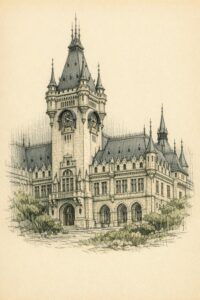 Before Bucharest was a capital, Iași was. The seat of Moldavia for three hundred years, the city where the 1859 union of the two principalities was negotiated, the home of Romania’s first university and its first national theater. To walk Iași is to walk a city that has spent two centuries trying to remember that it once mattered more than it does now, and that has, in the trying, become something better than nostalgia: a working intellectual city, with bookshops on every other corner and the air of a place that takes its own arguments seriously.
The chapter spends time in the cafés where the Junimea literary society met in the 1860s and 1870s — the conversation that, more than any single document, shaped modern Romanian literary culture. It spends time at the Metropolitan Cathedral, where the relics of Saint Parascheva draw two million pilgrims a year. And it spends time in the university quarter, which has the densest concentration of students in the country and the highest density of arguments per square meter that the author has ever encountered. Iași is not Bucharest’s rival. It is Bucharest’s older sibling: quieter, less wealthy, slightly affronted, and not entirely wrong about any of it.
Chapter 15 — Luca Covrigi and the Morning Country
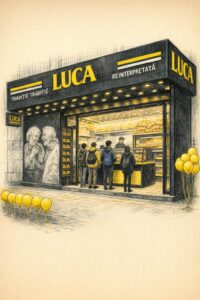 Luca Covrigi is a pretzel chain. It sells pretzels — covrigi — out of small windowed shops, hot, by the kilogram, before sunrise. It does not advertise. It does not have a celebrity founder. It does not appear on lists of the country’s most innovative companies. And yet, every morning in dozens of Romanian cities, a queue forms outside the Luca window, and a country eats. The chapter starts there, at six in the morning in November, with breath visible in the air, and tries to understand what is actually being sold.
What is being sold, the chapter argues, is a small daily contract — that someone has been up since four, that the dough has been mixed, that the oven is hot, that the pretzels will be ready when you arrive, that the price will be the price it was yesterday. In a country where, for most of recent memory, daily contracts have been the first thing to break, this is not a small thing. The chapter is about the morning country, the unflashy infrastructure of trust that makes the rest of the day possible, and about a pretzel chain that, without meaning to, has become an instrument of it.
Chapter 16 — NATO, Twenty-Nine March 2004
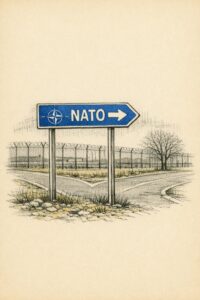 On the morning of 29 March 2004, the Romanian flag was raised at NATO headquarters in Brussels and at Cotroceni Palace in Bucharest. The country had, that day, formally joined the alliance. Romanians watched the ceremony on television and went back to work. There were no parades. There was no national day off. There was, the author remembers, a strange quiet — as if the country, after fourteen years of post-1989 uncertainty, had finally been told which side of the map it sat on, and was not quite sure what to do with the news.
The chapter is about that quiet. NATO accession was not a destination; it was a hinge. The Mihail Kogălniceanu airbase, near Constanța on the Black Sea coast, has since become one of the alliance’s most important Eastern European installations. American troops train there. Aircraft from a dozen countries refuel there. After 2022, when the war in Ukraine made the question of which side of the map Romania sits on suddenly urgent, that hinge has carried the weight the country needed it to carry. The chapter ends in 2024, twenty years after the flag went up, at an airbase that has finally become what it was always going to be.
Chapter 17 — Târgu Jiu, the Endless Column
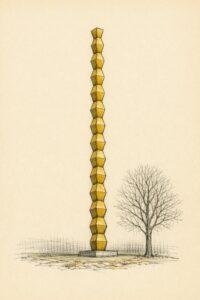 In 1937 and 1938, Constantin Brâncuși installed three sculptures in a small park in Târgu Jiu, his home county’s market town, as a memorial to the Romanian soldiers who had died in the First World War. The first is the Table of Silence — a round stone table surrounded by twelve hourglass-shaped stools, where, the artist imagined, the dead might still confer. The second is the Gate of the Kiss, a stone arch carved with paired ovals. The third, at the end of a long axis through the town, is the Endless Column — a vertical stack of cast-iron modules, twenty-nine meters tall, that appears, the closer one looks, to keep going past where the eye can follow.
The chapter argues that these three works are, together, the most important public artwork in twentieth-century Europe. They are also the most Romanian. The Column does not represent infinity; it performs it. The Table does not represent silence; it imposes it. The Gate does not represent love; it offers it. Brâncuși left Paris for two years to install them, and then he went back. Târgu Jiu does not advertise the sculptures. It does not have to. They are there, in the park, as they have been for nearly ninety years, and the country has not yet finished looking at them.
Chapter 18 — UiPath, the Floreasca Anomaly
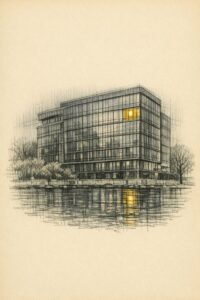 UiPath was founded in 2005 in a small apartment in the Floreasca neighborhood of Bucharest by a software engineer named Daniel Dines. For most of its first decade it was a consultancy, then a small software company, then a slightly larger software company. In 2017 it raised thirty million dollars and the world started to notice. In April 2021 it listed on the New York Stock Exchange at a valuation of more than thirty-five billion dollars. The Bucharest apartment is still there. The company’s headquarters now spans two continents. Romania, briefly, had a unicorn — and then it had a public company.
The chapter is interested in why UiPath happened where it did. The short answer is that Romania, for thirty years, had been a country with a strong technical education system and a weak technical job market. Programmers were trained, then left. UiPath was the first Romanian company to be ambitious enough, and global enough, to keep them home. The chapter argues that the company’s most important export is not its software; it is the proof of concept. Floreasca, an unremarkable Bucharest neighborhood, has now produced a public American company. There is no reason it could not produce another.
Chapter 19 — One January 2007
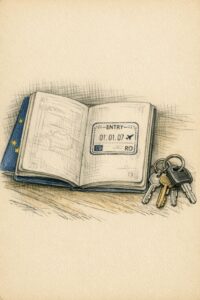 On 1 January 2007, Romania joined the European Union. The author was in Bucharest that morning. There were small fireworks the night before; there were television specials; the prime minister gave a speech. And then January 1 came, and it was a Monday, and most things were closed for the holiday, and Bucharest looked exactly as it had the day before. The chapter is about that flat morning — about a country that had, for sixteen years, organized its entire political life around joining a club it could not yet enter, and that had, finally, been let in, and now had to figure out what to do on a Monday.
What it did, over the next two decades, was both more and less than anyone had hoped. The borders opened, and three and a half million Romanians left for the West — the largest peacetime emigration in Romanian history. The funds came, and motorways were built, slowly. The chapter is honest about the disappointments. But it ends with the passport — the small object that, after that morning, no longer needed a visa to cross most of the continent — and argues that this is what changed, in the end: not the politics, not the economy, but the door. A door that had been closed for two generations was, on a Monday in January, open.
Chapter 20 — The Delta, the Country at Its Edge
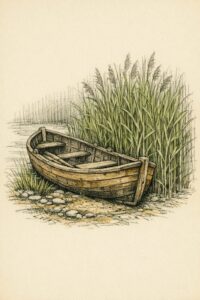 The Danube has come two thousand eight hundred kilometers by the time it reaches Tulcea, and at Tulcea it gives up the idea of being a river. It fans into three arms — Chilia, Sulina, Sfântu Gheorghe — and the three arms fan into hundreds of smaller channels, and the channels fan into a landscape that is neither land nor water but a long, slow argument between the two. The Danube Delta is the second-largest in Europe, a UNESCO biosphere reserve, the home of more than three hundred bird species, and the place where Romania, geographically, ends.
The chapter goes there last, deliberately. After Bucharest, after the monasteries, after the airbase, after the IPO, the book ends at a place where the country becomes water and waits. The villages of the Delta — Mila 23, Sfântu Gheorghe, Crișan — are reached only by boat. The people there fish, and watch the birds, and speak a Romanian inflected by Russian and Lipovan and the slow patience of a river that has stopped hurrying. The chapter is about endings that are also beginnings, about the country at its edge, and about a writer who, after twenty chapters of looking, is finally willing to stop and let the landscape look back.
About the book
To Romania, with Love: Notes from a country I never really left is published by Eleodor Sotropa. The book’s home is ToromaniawithLove.com, where you can find the table of contents, news on the Romanian, Italian, German, French, and Spanish editions, and information on how to order. Thank you for reading.

Are you tired of traveling to the same old European destinations like France, Italy, or Spain? If you’re looking for a unique and diverse travel experience, consider the hidden gems of the A Country A Month series, waiting to be explored. The author is an avid photographer and traveler. His favorite travel companion is his vintage leather-bound journal, in which he sketches and writes about his adventures.