A good Amsterdam food plan is not a list of dishes detached from the trip. It accounts for when people eat, which neighborhoods suit different meals, where reservations matter, what prices mean, and how to recognize a place designed only for passing visitors.
Use this article with the complete Amsterdam travel guide, the three-day itinerary, and the where-to-stay guide.
This is the longest chapter in the book, and it is the one to fold down at the corner. Amsterdam is small enough to think you have seen it in an afternoon and rich enough to reward a proper visit to each of its distinct quarters, from the postcard hush of the Jordaan’s inner canals to the industrial nerve of Amsterdam Noord across the water. Each section below is built as a self-contained half day: a one-line identity and who will love it, a walkable route by real street name, where to eat and drink along the way, the anchor sights, the best time to go, and a quieter alternative for when you want the same character without the crowd.
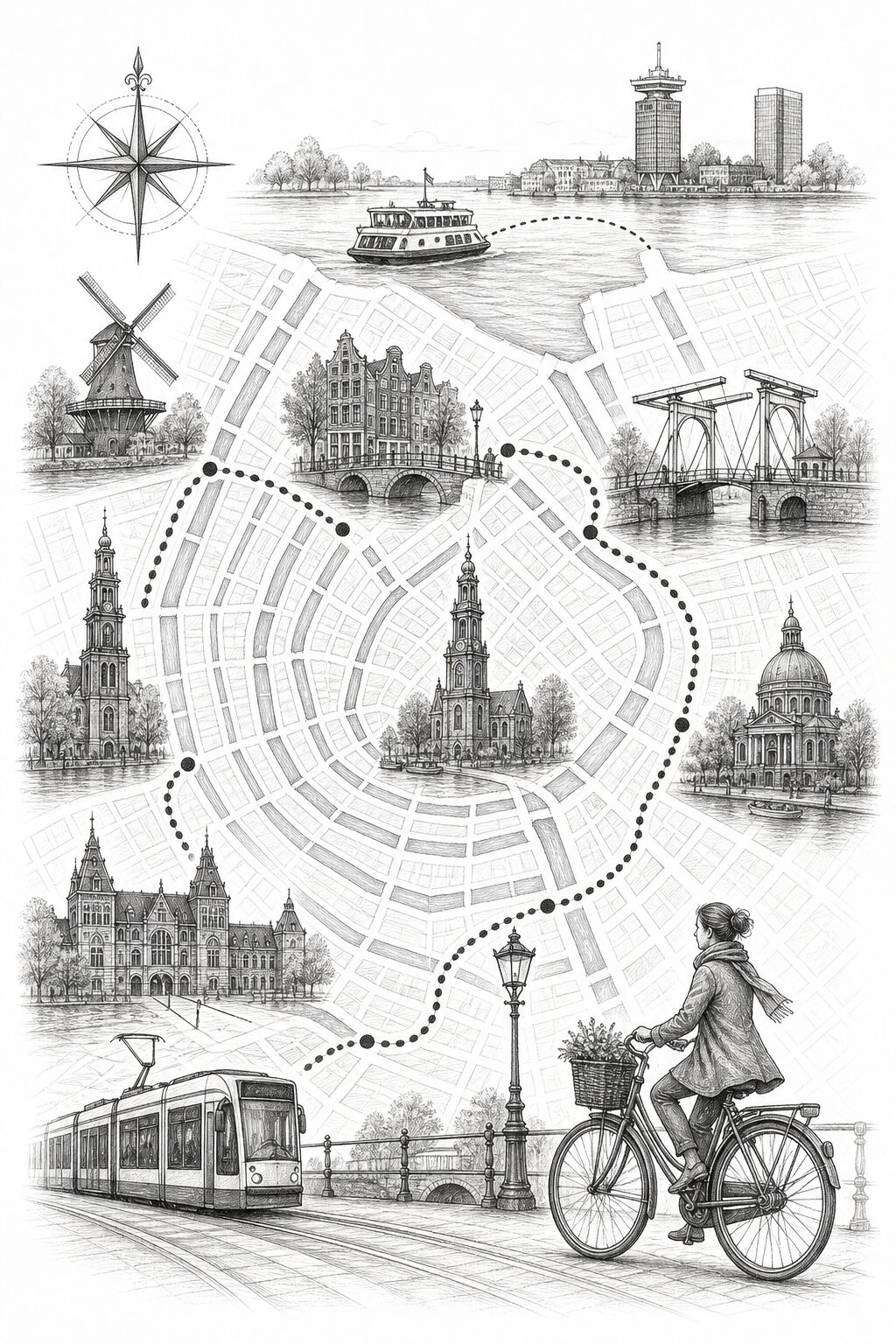
How the city fits together, in one paragraph: four concentric canals, the Singel, Herengracht, Keizersgracht, and Prinsengracht, wrap the medieval core in horseshoe rings, with Centraal Station sitting at the open mouth of the horseshoe on the IJ waterway. Inside the rings and just west of Centraal sits the Jordaan, quiet and villagey; the historic Centrum, radiating from Dam Square, holds the Nine Streets shopping grid and, in its oldest eastern lanes, the Red Light District. South of the ring, Museumplein and Vondelpark form the cultural and green spine, with De Pijp just beyond them for food and market energy. East of the center, the old Jewish Quarter and the Plantage carry the city’s most layered history. And across the IJ, reached only by ferry, Amsterdam Noord is the fastest-changing, least touristy district in the book, with Oud-West offering a quieter, more local counterpoint just west of Vondelpark.
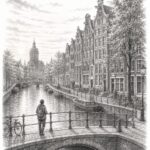
A visitor pauses on a Jordaan bridge just after eight one September morning, coffee in hand, and understands the whole chapter in thirty seconds: the water is glass-still, a baker across the canal is stacking bread in the window, a single cyclist rings her bell twice and glides past without slowing, and nobody else is awake yet to see any of it. By eleven the same bridge will hold forty tour groups and a queue for pancakes. The lesson repeats at every stop in this article: Amsterdam rewards whoever arrives first.
Before the first route, a few habits that make every walk in this article better. Download an offline map before you leave your hotel’s Wi-Fi, since data coverage is fine but the streets curve in ways that punish a distracted glance at a phone, especially near a bike lane. Time your walks against the crowd tide: the historic center is a genuinely different city at 9am than at 1pm, and every route below rewards an early start. Treat coffee and a bathroom stop as one errand, not two, since a EUR 3.50 to 4 coffee at almost any cafe buys you both. And walk with the assumption that the narrow cross-street you did not plan for is worth ten minutes; Amsterdam’s dwarsstraten, the little streets that cross the main canals, are where most of the city’s independent shops and galleries actually live, and no route below accounts for the detour that will inevitably pull you off it.
The Jordaan: the postcard neighborhood
Who will love it: canal romantics, market browsers, anyone who wants Amsterdam to feel like a village.
The route (about two to two and a half hours): start at Noordermarkt, home to a Monday flea market from around 9am to 1pm and a Saturday organic farmers’ market from about 9am to 3pm as of this writing. Walk Westerstraat, the neighborhood’s main artery, to Westerkerk, the parish church where Anne Frank’s family worshipped before going into hiding nearby; its tower is climbable on a booked, guided tour and offers one of the best rooftop views in the city on a clear morning. Continue along Prinsengracht past the Anne Frank House itself (book weeks ahead per the complete guide), then cut inland into Egelantiersgracht and Bloemgracht, generally agreed to be the Jordaan’s prettiest inner canals and far quieter than Prinsengracht. Wander the dwarsstraten, the narrow cross-streets threaded with galleries and independent shops, and finish at Cafe ‘t Smalle, a canal-side cafe on a distillery site dating to 1786, or at Johnny Jordaanplein, a small square named for the neighborhood’s beloved mid-century folk singer.
Food and coffee: Winkel 43, by Noordermarkt, is celebrated for its Dutch apple pie and worth the wait on a Saturday market morning. Cafe Papeneiland, on Prinsengracht at the corner with Brouwersgracht, is a brown cafe dating to 1642. Cafe Chris, founded in 1624, claims the title of the city’s oldest bar and still pours in the same low-ceilinged room.
When to go: early morning for the quiet canals, Saturday for the market at full swing, and June’s Open Tuinen Dagen, or open garden days, for a rare look behind the facades into the private courtyard gardens most visitors never see.
Quieter alternative: the far northern edge of the Jordaan, beyond Westerstraat toward Brouwersgracht, carries the same architecture with a fraction of the foot traffic, especially on a weekday afternoon.
Worth knowing: many of the Jordaan’s tranquil courtyards, called hofjes, were built centuries ago as almshouses for the elderly poor and remain residential to this day, tucked behind unmarked doors along the main streets; most are private, but a handful open their gates during the day, and stumbling on one uninvited feels like finding a secret the rest of the crowd missed.
The Canal Ring, Centrum, and the Nine Streets: the UNESCO heart
Who will love it: first-time visitors who want the greatest hits in one loop, and anyone who likes to shop with intention.
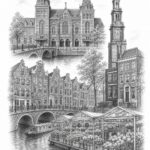
The route (about two and a half to three hours): begin at Dam Square, the literal site of the original 13th-century dam on the Amstel River, flanked by the Royal Palace and the National Monument. Walk Kalverstraat, the city’s main shopping street, to the Begijnhof, a quiet, still-inhabited courtyard just off Spui that asks visitors for respectful silence. From there, enter the Nine Streets, or Negen Straatjes, a grid of boutique cross-streets threaded between the main canals and the best half hour of window shopping in the city. Walk a stretch of Herengracht or Keizersgracht, the grandest of the merchant-house canals, to admire the facades that funded the Dutch Golden Age (the complete guide), then finish at the Bloemenmarkt, the floating flower market on the Singel, before ending the loop at Muntplein beneath the Munttoren tower.
Food and coffee: the Nine Streets are dense with cafes, specialty cheese shops, chocolatiers, and vintage stores; treat any of them as a valid lunch stop rather than saving the neighborhood for browsing alone.
When to go: weekday mornings are the calmest version of this walk by a wide margin; Kalverstraat and the approach to Dam Square form the single most crowded corridor in the city on most afternoons, so if your schedule allows only one pass through this district, make it before noon.
Quieter alternative: walk the same Nine Streets grid at dusk, after the shops have closed but the cafes are still lit, for a version of the neighborhood almost nobody photographs.
Worth knowing: look up as you walk Herengracht and Keizersgracht, and the canal houses tell their own story in their rooflines, the stepped gables of the earlier Golden Age houses giving way to the grander bell and neck gables merchants favored as their fortunes grew. A hoisting beam still juts from many gables, a working reminder that these houses were warehouses as much as homes, with goods winched straight up the front rather than carried up the impossibly narrow, steep stairs inside (the complete guide).
De Pijp: the city’s food and market heart
Who will love it: eaters, market people, and the adventurous duo from the complete guide.
The route (about two hours, best from midday into evening): start at the Albert Cuyp Market, the city’s largest and most famous street market, running roughly 9am to 5pm most days except Sunday; confirm current days and hours before you go, since markets adjust their schedules more often than museums do. Walk into Sarphatipark, De Pijp’s green heart and a genuinely quieter alternative to Vondelpark on a warm afternoon. Continue along Ferdinand Bolstraat and Gerard Doustraat, the district’s restaurant-dense main streets, and finish at the Heineken Experience on De Pijp’s northern edge if a brewery tour appeals to your group (the complete guide).
Frequently asked questions
How many days are enough for Amsterdam?
Three well-planned full days cover a strong first visit, while four or five allow slower neighborhoods, additional museums, or a day trip. Count usable sightseeing days rather than hotel nights.
What should be booked first?
Reserve the experience you would be most disappointed to miss, then secure lodging and any limited-entry sights. Verify current rules and opening information on the official operator’s website shortly before travel.
How do you avoid rushing?
Group each day geographically, allow time for security and transport, and treat extra stops as optional. One demanding reservation plus nearby flexible experiences usually produces a better day than a chain of timed entries.
Continue planning Amsterdam
- Complete Amsterdam travel guide
- 3 days in Amsterdam: first-time itinerary
- Where to stay in Amsterdam
- Best things to do in Amsterdam
- Amsterdam food guide
- Amsterdam first-time tips
- Amsterdam on a budget

Meet Leo: The Heartbeat Behind ‘A Country A Month’
Journeying through the pages of A Country A Month, you might often feel the rhythm of a storyteller’s heartbeat, pulsating through each line, each image, and each adventure shared. That heartbeat belongs to none other than our remarkable website editor, Leo.
With a lens in one hand and a pen in the other, Leo seamlessly marries his passions for photography and writing. His eye captures moments that words can barely describe, yet his eloquence brings those images to life, transcending borders and connecting us all through shared stories. An avid traveler, every country he’s visited has added another chapter to his expansive tale, and through our platform, he generously shares these chapters with us.