Planning a trip to Amsterdam is easier when the city is treated as a set of connected neighborhoods and decisions, not a checklist of famous names. This complete guide brings together the essential sights, the right time to visit, transport, places to stay, food, realistic costs, and the choices that most affect a first trip.
Use this article with the complete Amsterdam travel guide, the three-day itinerary, and the where-to-stay guide.
Here is a number worth sitting with before you pack a bag: Amsterdam logged 23.7 million overnight stays last year, a record, in a city where barely 920,000 people actually live. Add roughly 21.9 million day visitors and you get a strange arithmetic: on a busy summer afternoon, the historic center holds more travelers than residents. And yet the thing almost every first-time visitor says afterward is not “it was crowded.” It is “I did not expect to fall for it this hard.”
That is what this book is for. Amsterdam is not a city you conquer with a checklist. It is a fishing village on a dam that got rich enough, fast enough, in the 1600s to lay out three concentric canals by design and then never really stopped being that ambitious, quiet, water-logged place at heart. It is a city where a seventeenth-century merchant’s house leans gently against its neighbor, where a bicycle bell means business, and where some of the world’s greatest paintings sit within a ten-minute walk of each other on one green square. It is also, in the ways that matter most to you as a traveler, a remarkably easy great city: small enough to cross on foot in under an hour, flat enough to bike without training, and fluent enough in English that language never becomes the obstacle you feared.
But Amsterdam has learned, the hard way, that being loved by 23.7 million people a year comes at a cost, and the city is now openly managing its own popularity: a self-imposed cap on overnight stays it keeps missing, a rising tourist tax, and a running civic argument about how much charm a place can sell before it stops being itself. None of that should stop you from coming. It should make you the kind of visitor this book is built to produce: one who books the Anne Frank House the moment the six-week window opens, who never sets a foot in the red-paved bike lane, who eats two streets back from Dam Square instead of on it, and who leaves the city a little better than a purely extractive tourist would.
This guide is built the way a longtime local friend would build it. First the city itself, the complete guide, the feel of arriving and standing in it for the first time, its short arc of history, its shape on the water, and who it genuinely suits. Then the complete guide, the signature sights, the short list you would regret skipping, each with an honest worth-it verdict. Then the planning layer: when to come, how to get around on two wheels or a tram, and where to sleep. Then the city up close, neighborhood by neighborhood, each one built as a walkable half-day you could follow this afternoon. Then the eating and drinking, the museums, the day trips, and ready-made itineraries for one, two, and five days. And at the end, the deeper story: how a dam on the Amstel became a Golden Age superpower and then a byword for tolerance, and the market traders, guides, diamond cutters, and brown-cafe keepers who keep it running today.
A word on what this book is not. It is not a directory. Amsterdam has apps and websites for exhaustive listings, and they are better at being databases than any book can be. What a book can still do better than a feed is judge, sequence, and tell you the truth at length: which timed-entry slot to fight for and which is quietly skippable, what order turns a scattered wish list into one unhurried day, and why the city looks the way it does, so that what you see means something once you see it. Where a restaurant, cafe, or shop appears by name in these pages, it has earned that durability, an institution that has outlasted decades of trends, not a hot opening that might be gone by the time you land.
Two promises about how this book works. Every price, hour, and booking rule here was accurate when it was checked, and where things move often, the tourist tax, the transit fares, the museum ticket prices, you will see the phrase “as of this writing” and a pointer to the official site to confirm, because Amsterdam revises these more often than most cities its size. And nothing in here is padding. If a famous thing is honestly optional for you, this book says so and tells you what to do instead.
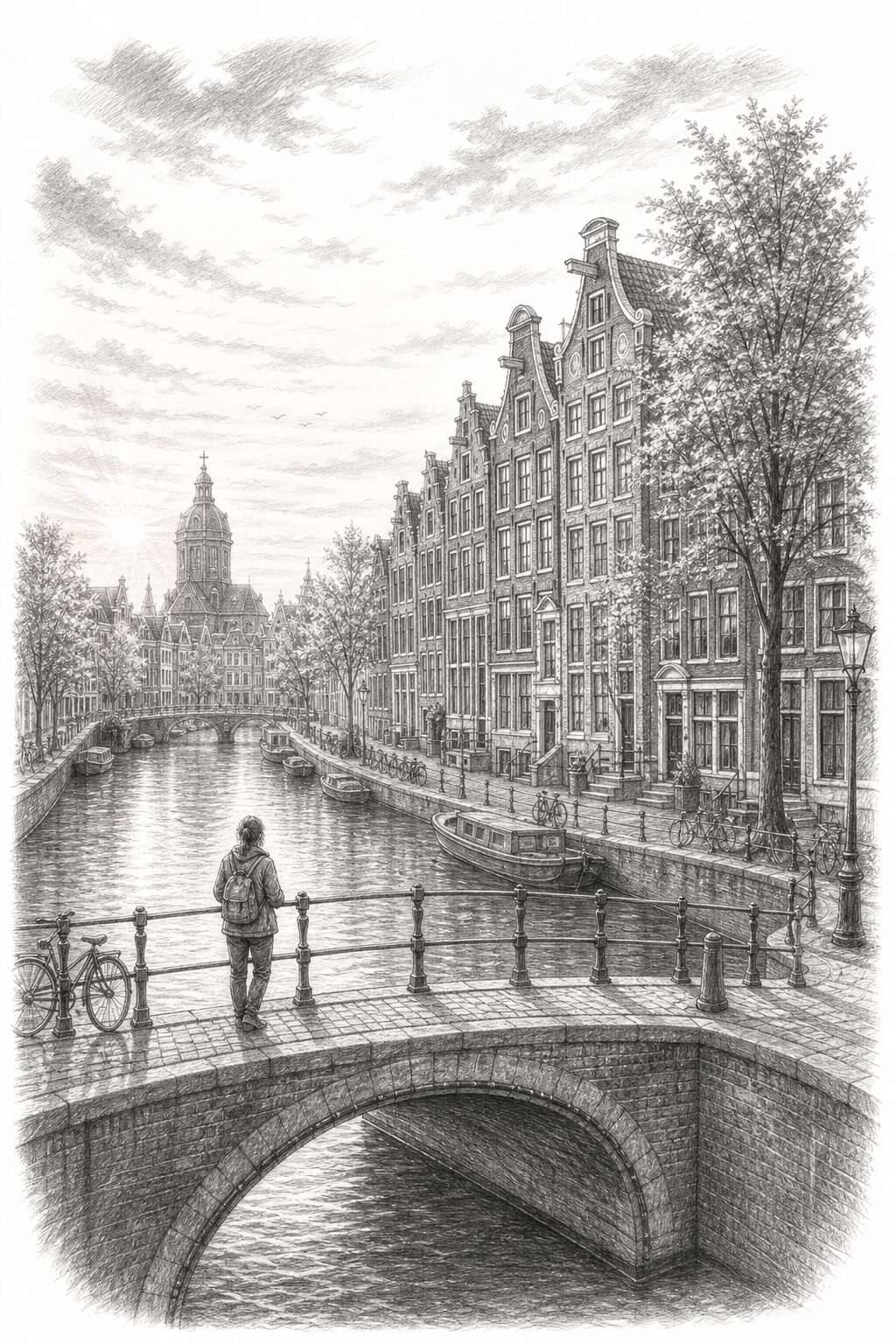
One friendly warning before the complete guide: keep your eyes open at every street corner, not for the views, wonderful as they are, but for the bikes. You have been told. Now go stand on a bridge and watch the light change on the water.
Action Steps
- Decide your trip length now; three to four days covers Amsterdam’s essentials well, and the itineraries in the complete guide are built for one, two, and five days.
- Before booking anything else, read the complete guide for the sights that require advance tickets, especially the Anne Frank House, and the complete guide for the month-by-month reality and the 2026 WorldPride window.
- Set a reminder for the Anne Frank House ticket release (Tuesdays at 10:00 CEST, six weeks ahead) the day your dates are fixed; it is the single tightest booking in the city.
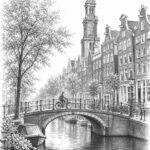
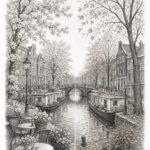
Step off the train at Centraal Station, walk out under its grand nineteenth-century facade, and turn around once. Water everywhere: a harbor basin dotted with ferries, a taxi rank of actual boats, and beyond it the first fingers of the canal ring reaching into the city like veins. Bicycles lean four deep against every railing, more of them than you can quite process on your first morning. A tram glides past close enough to touch, silent except for its bell. Narrow gabled houses lean companionably into one another along the nearest quay, the way old friends lean when they have stood shoulder to shoulder for four hundred years. You have been in Amsterdam for about ninety seconds, and you already understand something about it that no photograph quite delivers: this is a city built almost entirely around water, at a scale a human being can actually hold in their head.
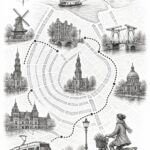
That is the thing that makes Amsterdam Amsterdam. It does not sprawl. It coils. Four concentric horseshoe canals, laid out with startling deliberateness in the seventeenth century, wrap the medieval core like growth rings on a tree, and roughly 1,200 bridges stitch the whole system back together. You can walk from the busiest square in the center to a quiet, birdsong canal in the Jordaan in fifteen minutes. You can cross the entire historic core, start to finish, in under an hour on foot. Amsterdam reads less like a capital city and more like an oversized, very orderly village that happens to run some of the finest museums on earth, and once you feel that scale in your legs, the whole trip gets easier to plan.
A dam, a fortune, and three canals
Amsterdam’s story starts small and specific: a community of fishermen and traders living around a dam on the Amstel River, first documented in 1275, when Count Floris V granted them exemption from a regional toll. The settlement, “Amestelledamme,” received formal city rights in 1306. Dam Square, the buzzing plaza at the heart of the center today, sits on the literal site of that original dam. For two centuries Amsterdam grew steadily on Baltic grain and North Sea herring, respectable but unremarkable, a trading town like a dozen others on the Dutch coast.
Then came the seventeenth century, and everything changed at once. The Dutch East India Company, the VOC, founded in Amsterdam in 1602, became the world’s first major joint-stock corporation, and the Amsterdam Stock Exchange, founded the same year, was the world’s first as well. Money poured in from a global trading network, and the city’s population swelled toward roughly 200,000 people by mid-century, making it one of the largest cities in Europe. This is the Dutch Golden Age, and Amsterdam spent its fortune on infrastructure with a confidence that still shapes your walk today: starting in 1613, the city laid out three great concentric canals, Herengracht, Keizersgracht, and Prinsengracht, as a deliberate, planned expansion, the Grachtengordel. It is still the skeleton of the map you will navigate this week. Merchants built grand houses along Herengracht, the “Gentlemen’s Canal,” and that same merchant wealth funded the era’s art, including Rembrandt van Rijn, who lived and worked in the city and painted The Night Watch, now the single painting most visitors cross the Rijksmuseum to see. It is worth saying plainly, because Amsterdam itself now says it plainly in its own museums: this golden fortune was inseparable from a global trading system that included colonialism and the slave trade, a history the city has moved toward confronting openly rather than airbrushing out of its own story.
The following two centuries were quieter. Amsterdam lost ground to European rivals, became the official capital of the newly formed Kingdom of the Netherlands in 1814 (though the government has long sat in The Hague instead), and modernized through the nineteenth century, including the opening of the grand Centraal Station itself in 1889, built on land reclaimed from the harbor you just walked out of.
Then came the darkest chapter. Nazi Germany occupied the Netherlands from May 1940, and Amsterdam’s large, historically significant Jewish community, concentrated around what is now the old Jewish Quarter, was devastated; more than half of the city’s tens of thousands of Jewish residents were deported and murdered in the Holocaust. Anne Frank and her family hid in a concealed annex above her father’s business on Prinsengracht from 1942 until their arrest in August 1944. The house, opened as a museum in 1960, makes that history viscerally present in a way few historic sites anywhere manage, and it remains one of the most visited, and most emotionally significant, addresses in the city.
Postwar Amsterdam rebuilt, expanded into new districts, and by the 1960s and 70s had become a global symbol of counterculture and, later, of genuinely progressive social policy: the Netherlands performed the world’s first legal same-sex marriages here in 2001. That same open, tolerant civic culture, legal cannabis coffeeshops, regulated sex work, a live-and-let-live streak that still surprises first-timers, is part of what has made the city such a magnet for visitors ever since. Which brings the story to today, where success has become its own complication: a city that fell in love with the world and is now working out, in public and in real time, how much of itself it can keep sharing.
The shape of the city
Everything in Amsterdam organizes around water and, more specifically, around the horseshoe of canals. The Singel is the innermost ring; Herengracht, Keizersgracht, and Prinsengracht follow outward from it, and the Singelgracht marks the historic edge of the center. Almost everything a first-time visitor wants, the museums, the canal houses, the markets, the Anne Frank House, sits inside or just beyond that horseshoe, which is why the city rewards walking and cycling so completely and why you will rarely need a car or even much transit inside the center.
The Jordaan, once a working-class quarter and now the postcard neighborhood of quiet inner canals and boutique shopfronts, sits to the west of the historic core. The Museum Quarter, anchored by the Museumplein, sits to the south, where the Rijksmuseum, Van Gogh Museum, and Stedelijk face each other across a lawn that turns into a picnic and a photo op the moment the sun appears, with Vondelpark, the city’s green lung, opening up right behind it. De Pijp, dense and multicultural, sits further south still, the city’s best food-and-market energy packed into a compact grid. To the east, the old Jewish Quarter and the leafy Plantage district hold the city’s most contemplative history. The medieval center itself, including the Red Light District, occupies the oldest ground, narrow lanes that predate the planned canal ring entirely. And across the IJ waterway, reached only by free ferry, Amsterdam Noord is the city’s fastest-changing district, a former shipyard turned street-art and creative quarter with a skyline view worth the short crossing. the complete guide walks each of these in detail; for now, hold the shape: a horseshoe of water with the oldest, densest ground at its buckle, and the newer, quieter, and more experimental Amsterdam spreading outward and, increasingly, across the river.
The numbers, briefly
Amsterdam’s municipality holds about 920,000 residents, with the wider metropolitan region closer to 1.5 million, small by the standards of Paris or London but enormous in cultural weight for its size. Around 165 canals wind through roughly 100 kilometers of waterway, and the seventeenth-century canal ring itself, the Grachtengordel, has been a UNESCO World Heritage Site since 2010. The city logged that record 23.7 million overnight stays last year, and the Anne Frank House alone draws over a million visitors most years despite being capped by timed entry, while the Van Gogh Museum and the Rijksmuseum each pull in well over two million. The municipality has set itself an official cap of 20 million overnight stays a year and has missed it every year the target has existed, a tension you will feel, gently, in the tourist tax and in the crowd management on the ground.
What genuinely makes it special
Plenty of cities have canals. Amsterdam has a canal ring you can read like a history book, because it was built on purpose, all at once, by a city rich and confident enough to plan four rings of waterfront real estate in advance of needing them. Plenty of cities have great museums. Amsterdam has three world-class collections, the Rijksmuseum, the Van Gogh Museum, and the Stedelijk, within a ten-minute walk of one another on a single square, so a museum day never becomes a transit day. And plenty of cities call themselves bicycle-friendly. Amsterdam is the rare place where that is not marketing: the infrastructure is real, protected, and complete enough that a nervous first-time renter can be moving like a local within an hour.
Then there is the civic character, which travelers underrate until they feel it directly: a genuinely liberal, live-and-let-live culture, legal cannabis coffeeshops, regulated and licensed sex work, marriage equality since 2001, that still catches first-timers off guard in a pleasant way, alongside a level of English fluency among locals that makes language a non-issue almost everywhere you go.
And the honest cons, because this book deals straight with you. Overtourism pressure is now openly part of the city’s own public conversation, and the historic core, especially the Damrak-to-Dam Square corridor at midday, can feel like a theme park rather than a living city. The weather is genuinely gray and wet for a large share of the year, with little air conditioning to rescue the occasional hot week. The tourist tax is among the highest in Europe and climbing. Hotel prices spike hard around major events, and 2026 brings a significant one: WorldPride Amsterdam runs from late July into early August, with a Canal Parade that will pull large international crowds and push both prices and availability hard for that window, so plan around it deliberately if your dates are flexible. And cyclists are fast, silent, and entirely unforgiving of a pedestrian who wanders into the bike lane without looking, which trips up more first-time visitors than any other single hazard in the city. None of these should keep you away. All of them are easier to handle when someone tells you in advance, which is the entire point of this book.
Who this city is best for
Amsterdam is close to an ideal city break for art and design lovers, architecture and canal-house obsessives, cyclists of any confidence level, couples and friend groups wanting a compact and walkable trip, and history travelers drawn to the Golden Age and to the Second World War. It is genuinely good with children, flat, stroller-friendly, full of hands-on museums and parks, in a way that surprises families expecting a purely adult, cafe-culture city. And it rewards repeat visits unusually well, because the second or third trip is where Amsterdam Noord, a slow Oud-West afternoon, and an unhurried brown-cafe evening in the Jordaan really live.
Who might prefer another city? Travelers chasing reliable warm-weather beach time will not find it here. Anyone who finds a lingering party-town reputation, or the presence of legal cannabis tourism, genuinely off-putting should know that reputation, while real in certain corridors after dark, is not the whole city and can mostly be avoided by choice of neighborhood and hour. And travelers who want a big-metropolis skyline and scale, the kind of city where you spend an hour on transit just to cross town, should look elsewhere; Amsterdam’s entire appeal is its human size. If your dream is sitting still in reliable sun, Amsterdam will frustrate you. If your dream is a city small enough to love completely in three days and rich enough to reward a lifetime of return trips, there are few better addresses in Europe.
Action Steps
- Fix the shape in your head: a horseshoe of canals around a dense medieval core, with the Museum Quarter and Vondelpark to the south and Amsterdam Noord across the water; most of your trip happens inside or just beyond that horseshoe.
- Accept the scale in your favor: plan on foot and by bike first, transit second, and never assume a “far” neighborhood is more than twenty minutes away.
- Note the 2026 WorldPride dates, late July into early August, now, even if you are not attending; they will affect hotel prices and availability city-wide.
- If it is your first visit, give Amsterdam three to four unhurried days; it is the difference between the postcard and the actual place.
Every city has a short list of things you would regret missing, and Amsterdam’s is a genuinely manageable one. This article is that list: the sights people cross oceans for, each with the practical truth attached, what it costs, how far ahead to book, when to go, and, where it matters, an honest verdict on whether it earns its place in your limited days. If you see nothing else, see these; and if one of these is quietly skippable for you, this article says so.
One note that will save you both money and queuing all week: Amsterdam’s paid landmarks are not cheap, but several of its best experiences, Vondelpark, the Bloemenmarkt, the free ferries across the IJ, cost nothing at all. Spend your euros and your booking energy where they count.
Anne Frank House
The single most important booking of your entire trip. This is the preserved hiding place on Prinsengracht where Anne Frank and her family sheltered from 1942 until their arrest in 1944, and the museum built around it in 1960 tells that story with a quiet, devastating power that photographs cannot prepare you for. As of this writing, adult tickets run about EUR 16.50, including a EUR 1 booking fee, with children aged 0 to 9 admitted for EUR 1. New slots release online every Tuesday at 10:00 CEST for the six weeks ahead, and they sell out within minutes. Set an alarm. This is not a sight you can decide to see once you land.
Allow one to one and a half hours, and take either the first slot of the day or the last; both avoid the thickest midday crush. Because entry is entirely dependent on the ticket release, and not on how far in advance you land in the city, this is the one Amsterdam sight where turning up flexible does you no good at all. Book it the moment your travel dates are fixed, confirm the current price and release rules on annefrank.org before you fly.
Rijksmuseum
The national museum of the Netherlands and the anchor of the Museumplein, home to Rembrandt’s The Night Watch, an extraordinary run of Vermeer, and the deepest collection of Dutch Golden Age painting anywhere on earth. As of this writing, adult entry runs about EUR 25, with visitors under 18 admitted free though still required to book a ticket. Timed entry is required and booking is online only; the museum has gone cashless on site.
Go at the 9:00 opening or after 15:00, and allow two and a half to three hours if you want more than a highlights sprint. This is the Rijksmuseum’s real advantage over the Van Gogh Museum next door: it holds substantial Van Gogh works of its own, so a traveler who cannot get a Van Gogh Museum slot, or who simply does not want to manage two museum bookings in one trip, loses remarkably little by choosing this one museum well.
Frequently asked questions
How many days are enough for Amsterdam?
Three well-planned full days cover a strong first visit, while four or five allow slower neighborhoods, additional museums, or a day trip. Count usable sightseeing days rather than hotel nights.
What should be booked first?
Reserve the experience you would be most disappointed to miss, then secure lodging and any limited-entry sights. Verify current rules and opening information on the official operator’s website shortly before travel.
How do you avoid rushing?
Group each day geographically, allow time for security and transport, and treat extra stops as optional. One demanding reservation plus nearby flexible experiences usually produces a better day than a chain of timed entries.
Continue planning Amsterdam
- Complete Amsterdam travel guide
- 3 days in Amsterdam: first-time itinerary
- Where to stay in Amsterdam
- Best things to do in Amsterdam
- Amsterdam food guide
- Amsterdam first-time tips
- Amsterdam on a budget

Meet Leo: The Heartbeat Behind ‘A Country A Month’
Journeying through the pages of A Country A Month, you might often feel the rhythm of a storyteller’s heartbeat, pulsating through each line, each image, and each adventure shared. That heartbeat belongs to none other than our remarkable website editor, Leo.
With a lens in one hand and a pen in the other, Leo seamlessly marries his passions for photography and writing. His eye captures moments that words can barely describe, yet his eloquence brings those images to life, transcending borders and connecting us all through shared stories. An avid traveler, every country he’s visited has added another chapter to his expansive tale, and through our platform, he generously shares these chapters with us.