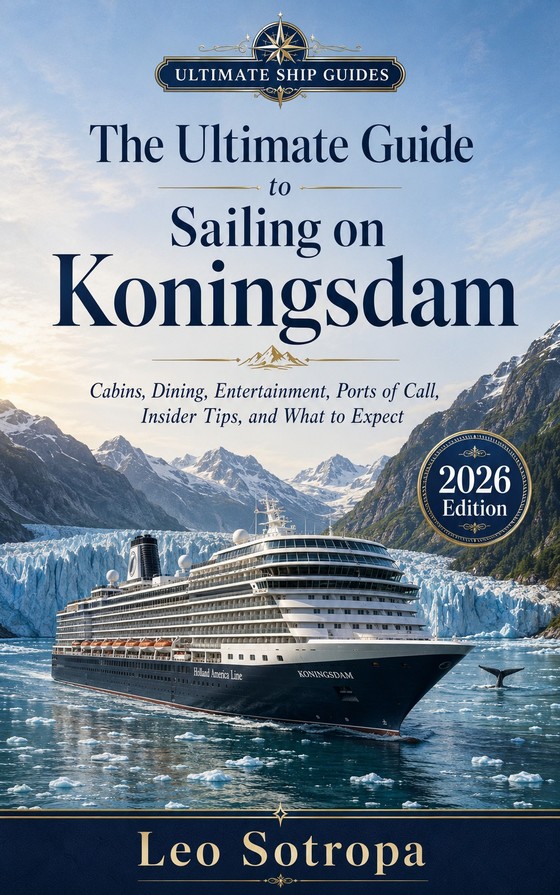
What exactly is the Koningsdam book, and will it make your Alaska sailing easier? In short: The Ultimate Guide to Sailing on Koningsdam by Leo Sotropa is an independent, ship-specific handbook for one particular Holland America Line ship, written for people who have booked or are thinking about booking a voyage aboard her. It is not a glossy brochure and it is not a general cruise primer. It walks you through this exact ship, deck by deck and venue by venue, and it centers on the two things that make Koningsdam worth choosing for Alaska: the Music Walk run of included live-music rooms, and Holland America’s coveted Glacier Bay permits, which put a National Park ranger on your ship for a full narrated day up the bay. If you want to know what you are getting into before you sail from Vancouver, this is the guide written to answer that.
Below is an honest look at what the book covers, who it helps, and why a guide built around one ship tends to be more useful than a broad cruise guide that treats every vessel the same.
What the Koningsdam book actually is
This is a single-ship handbook, part of the Ultimate Ship Guides series by Leo Sotropa. Each title in the series takes one ship and covers it in depth rather than spreading a few pages across a whole fleet. The Koningsdam edition is independent and unofficial, which means it is free to tell you which cabins to avoid, where the value really is in the fare structure, and which rooms are worth your evenings and which you can skip. It is available on Kindle and as a 6×9 illustrated paperback, and every chapter closes with a short set of practical Action Steps so you can turn what you have just read into decisions and bookings.
The ship itself is worth understanding, because the book’s advice flows from her character. Koningsdam is the first Pinnacle-Class ship of Holland America Line, with sisters Nieuw Statendam and Rotterdam. Holland America was founded in 1873 and is one of the oldest travel companies on earth, and that long, quiet pedigree shows in the way the ship is run. She measures about 99,800 gross tons and carries roughly 2,650 guests at double occupancy, which makes her mid-size by today’s standards: large enough for real variety in dining and music, small enough to feel refined rather than frantic. Her interiors were designed by Adam D. Tihany and Bjørn Storbraten around a music theme that runs through the whole ship. The book explains, plainly, who this ship suits and who will be bored by it, so you can decide before you pay rather than after you board.
The hook: Music Walk and Holland America’s Glacier Bay access
Two features do most of the work in explaining why people choose Koningsdam for Alaska, and the book gives each its due.
Music Walk, and the room you can only get on these ships
Music Walk is the line’s signature run of connected live-music venues, and all of it is included in your fare. The guide takes you through each room so you know how to plan your nights. B.B. King’s Blues Club hosts a Memphis blues and soul band and is the most popular room most evenings, so the book tells you when to arrive if you want a seat. Billboard Onboard is the duelling-pianists room, loud and social and request-driven. And the Rolling Stone Rock Room is the one that genuinely sets these ships apart: a five-piece rock band in a purpose-built room that exists only on Pinnacle Class. If live music is part of why you cruise, that room is a real reason to choose Koningsdam over other ships, and the book says so directly.
The guide is also careful about one point that trips people up. Lincoln Center Stage is not a fixed venue on Koningsdam. A Lincoln Center-vetted classical troupe now rotates between ships and appears on select sailings only, so it may or may not be aboard your voyage. Rather than promise something that might not be there, the book tells you plainly to check, and points you to confirm the current line-up in the Navigator app before you build your evenings around it.
Glacier Bay, and why the permits matter
The centerpiece of an Alaska sailing on Koningsdam is a full day in Glacier Bay National Park. This is where Holland America’s history pays off in a way you can see. The line holds the permits for Glacier Bay, and many Alaska itineraries on other lines never enter the bay at all. On a Koningsdam sailing, a National Park ranger comes aboard at dawn and narrates all day as the ship sails about 65 miles up the bay toward the Margerie and Grand Pacific glaciers. It is included in the fare, and the book treats it as the single strongest reason to choose this line for Alaska. The guide explains how to make the most of the day: where to stand, why a verandah earns its keep here more than on any other kind of cruise, and how the ranger program shapes the rhythm of that day from early morning onward.
What’s inside the book
The book is organized the way you would actually use it, from choosing a cabin to reading a menu to stepping ashore. Here is what the chapters cover.
The layout and the neighborhoods
You get a working map of the ship: where Music Walk sits, how the two-deck Dining Room flows, where the World Stage and the Grand Dutch Café fall in the day, and how to move between them without wasting time. The World Stage is the main theatre, encircled by a 270-degree LED screen, and the book explains what it is best used for. Its standout is the BBC Earth in Concert films, where a live orchestra plays alongside nature footage, along with destination programming that ties into the ports you are sailing through. The Grand Dutch Café gets its own attention because it deserves it: a complimentary Dutch coffee-and-snack bar serving croquettes, poffertjes, and Dutch beer. It is small, it is one of the most-loved rooms aboard, and for now it is a Pinnacle-Class feature. The guide tells you when it is quiet and why regulars keep drifting back to it.
The cabin guide
This is the part first-timers tell you they wish they had read sooner. The book gives a full cabin guide covering the categories aboard, which ones to book and which to avoid, and the trade-offs that are easy to miss on a deck plan. It makes a specific case that on an Alaska sailing a verandah matters more than anywhere else, because so much of the scenery, including the Glacier Bay day, happens from the ship rather than ashore. The point is not to upsell you into the most expensive room; it is to help you spend where it counts and skip where it does not.
The dining guide
The dining chapter separates what is included from what carries a charge, and tells you which of the paid venues are worth it. Included with your fare are the two-deck Dining Room, the Lido Market buffet, Dive-In (the burger stand), New York Deli and Pizza, and the Grand Dutch Café. For a charge you can book the Pinnacle Grill, the steakhouse flagship; Tamarind, a pan-Asian room the book rates highly; Rudi’s Sel de Mer, French seafood created by Master Chef Rudi Sodamin; and Canaletto for Italian. The guide gives you a clear read on which specialty nights earn their surcharge and which included venues already do the job, so you plan your reservations rather than guessing at the last minute.
Club Orange and priority tender access
Club Orange is a paid upgrade, and the book gives it a fair, specific hearing. It bundles an exclusive restaurant, expanded menus, priority embarkation and tender access, and a cabin upgrade. The guide’s argument is that the priority tender access is a stronger reason to consider it than the brochure lets on, especially on a busy Alaska sailing where tendering into port can eat into your day. Whether that adds up for you depends on your itinerary and your patience, and the book helps you make that call instead of making it for you.
The money and value chapter: how Have It All really adds up
This is where the book earns its keep for a lot of readers. Have It All is Holland America’s bundled fare, charged at a set amount per person per day, that covers a drinks package, Wi-Fi, a shore-excursion credit, and specialty dining, with the number of specialty nights scaling to the length of your voyage: one night on 6 to 9-night sailings, two on 10 to 20, and three on 21 or more. Understanding the tiers is central to whether you get value, and the book walks through the arithmetic rather than just describing the bundle. It also names the rule that usually breaks the maths, the assumption people make that quietly turns a good deal into a mediocre one. Prices change, so the guide keeps its advice about the reasoning and tells you to confirm the current numbers in the Navigator app, but the logic for deciding whether the bundle is worth it holds up regardless of the figure.
Eight destination chapters
The heart of the ports coverage is eight in-depth destination chapters, one each for Vancouver, Juneau, Skagway, Glacier Bay, Ketchikan, Sitka, Icy Strait Point, and Victoria. These are the ports and scenic-cruising highlights of the seven-day round-trip Alaska Inside Passage voyages from Vancouver, and the book treats each as its own subject rather than a bullet list. You get a sense of what each stop is actually like, what is worth your limited hours ashore, and how to match excursions to your interests and mobility. For travelers who want to go further inland, the guide also explains Holland America’s Alaska Cruisetours, which use the line’s own rail cars and wilderness lodges to extend a trip toward Denali and the Yukon. Exact ports vary by sailing, so the book tells you to confirm your specific itinerary before you plan around it.
Action Steps at the end of every chapter
Every chapter closes with practical Action Steps. This is what keeps the book from being just interesting reading. Instead of finishing a section and wondering what to do with it, you get a short, concrete list: the booking to make, the reservation to lock in, the thing to check in the app, the decision to settle now rather than at the port. It turns a good read into a plan, which is the whole point of buying a guide before you sail.
Who the book is for
The Koningsdam book is aimed at travelers who want a refined, music-rich, less-crowded ship and Holland America’s Glacier Bay access. In practice that means it fits several kinds of reader.
- First-timers who have never sailed this line and want to walk aboard already knowing how Music Walk, the dining rooms, and embarkation work, so their first day is not spent decoding the ship.
- Couples and mature cruisers, who are the natural fit for Koningsdam’s calmer, music-led style and will appreciate the honest read on which venues and cabins match that pace.
- Seasoned cruisers who know how to cruise in general but not this specific ship, and want the ship-specific detail that a broad guide cannot give.
- Families who want to understand the ship’s rhythm and how the included venues, dining, and ports work for them.
- Anyone buying it as a gift for someone who has a Koningsdam Alaska sailing booked, since it reads as a thoughtful, useful present rather than a generic travel book.
Just as usefully, the book is honest about who will not enjoy this ship. If you want nonstop action, waterslides, and a crowd, the guide says so up front, which saves the wrong reader from booking the wrong cruise.
Why a ship-specific guide beats a general cruise book
A general cruise primer has to hedge. It cannot tell you which room fills up first on Koningsdam, because that answer is different on every ship. It cannot tell you that a verandah matters more here because of the Glacier Bay day, or which specialty restaurant is worth the surcharge on this particular vessel, or how the Have It All tiers land against this itinerary’s length. A single-ship handbook can, because it only has one ship to get right.
The practical payoff is less pre-cruise stress. Most of the anxiety before a first sailing comes from unknowns: whether you booked the right cabin, whether you should add the bundle, what to do on a port day, how embarkation will go. The book answers those questions specifically for Koningsdam, so you arrive at the pier having already made the decisions that would otherwise nag at you. That is the honest promise here. It will not sail the ship for you, but it will mean fewer surprises and a better first day.
About the author and the series
The book is written by Leo Sotropa as part of the Ultimate Ship Guides series, published through acountryamonth.com. The idea behind the series is simple: one ship, covered properly, by a writer who is willing to be candid about the trade-offs. Because the guides are independent and unofficial, they can point out the weak cabins and the overrated add-ons alongside the genuinely good rooms and the features worth paying for. The Koningsdam title follows that pattern, with the Action Steps at the end of each chapter turning the reading into a plan you can act on.
One thing the book is clear about: it complements the cruise line’s own tools rather than replacing them. Venues, itineraries, and prices do change, so the guide repeatedly sends you to the Navigator app to confirm the current details for your sailing. What the book gives you is the judgment layer the app does not: which choices are worth making, and why.
Get The Ultimate Guide to Sailing on Koningsdam
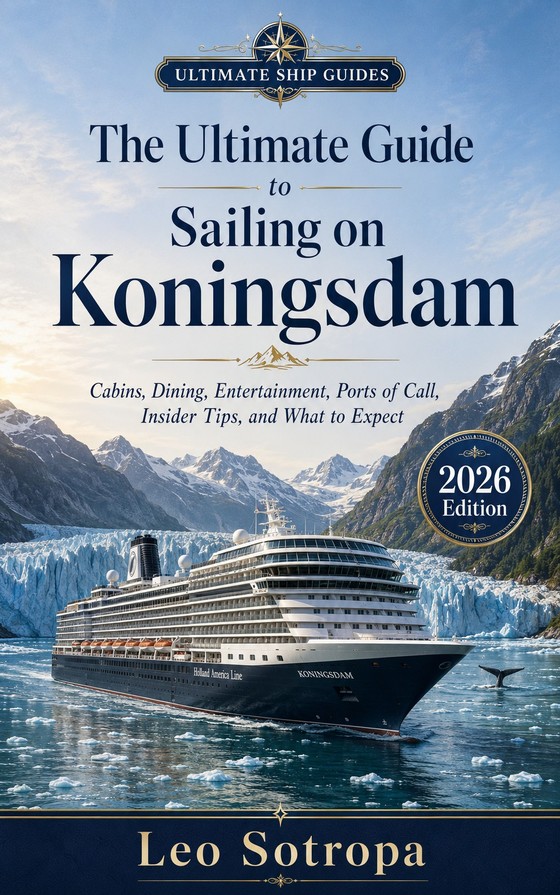
The Ultimate Guide to Sailing on Koningsdam by Leo Sotropa, part of the Ultimate Ship Guides series, is an independent, ship-specific handbook to Holland America’s first Pinnacle-Class ship and her Alaska Inside Passage sailings from Vancouver. Available on Kindle and paperback, with clear Action Steps in every chapter to turn the reading into a plan.
Frequently asked questions
Is this an official Holland America book?
No. It is an independent, unofficial guide written by Leo Sotropa as part of the Ultimate Ship Guides series. That independence is the point: because it is not produced by the cruise line, it can tell you which cabins to avoid, which paid extras are worth it, and where the real value sits in the fare, without a sales angle.
Should I get the Kindle or the paperback?
Both editions carry the same content, so it comes down to how you like to read. The Kindle version is easy to search and to carry on your phone while you are aboard, which is handy for checking a chapter at the pier. The 6×9 illustrated paperback is nice to flip through while you plan at home and makes a better gift. Many readers use the ebook on the ship and keep the paperback for planning.
Is the book up to date?
The guide reflects the latest edition and focuses on the parts of the ship that stay consistent: the layout, the Music Walk venues, the dining structure, the cabin trade-offs, and the ports. Details like specific venues, itineraries, and prices can change, so the book deliberately keeps its price advice relative and tells you to confirm current details in the Navigator app before you sail.
Does it cover Koningsdam’s specific Alaska ports?
Yes. It includes eight in-depth destination chapters for Vancouver, Juneau, Skagway, Glacier Bay, Ketchikan, Sitka, Icy Strait Point, and Victoria, the ports and scenic-cruising highlights of the seven-day Inside Passage voyages from Vancouver. The Glacier Bay chapter gives special attention to the ranger-narrated day that Holland America’s permits make possible. Exact ports vary by sailing, so the book tells you to confirm your own itinerary.
Is it good for first-time cruisers?
It is written with first-timers in mind. It explains embarkation, how the included and paid dining works, how Music Walk and the World Stage fit into an evening, and how to choose a cabin, so you board already understanding the ship. The Action Steps at the end of each chapter give newcomers a clear checklist rather than a pile of information to sort out alone.
Would it make a good gift?
Yes, especially for someone who already has a Koningsdam Alaska cruise booked. The illustrated paperback reads as a considered, practical present, and because it is tied to their actual ship and sailing it is far more useful than a generic travel book. Pairing it with their booking confirmation makes a genuinely thoughtful gift.
Does it replace the Navigator app?
No, and it does not try to. The Navigator app is where you confirm live details like current venues, schedules, and prices for your sailing. The book supplies the judgment the app does not: which choices are worth making, where the value is, and how to plan your days. Used together, the guide helps you decide and the app keeps you current.

Meet Leo: The Heartbeat Behind ‘A Country A Month’
Journeying through the pages of A Country A Month, you might often feel the rhythm of a storyteller’s heartbeat, pulsating through each line, each image, and each adventure shared. That heartbeat belongs to none other than our remarkable website editor, Leo.
With a lens in one hand and a pen in the other, Leo seamlessly marries his passions for photography and writing. His eye captures moments that words can barely describe, yet his eloquence brings those images to life, transcending borders and connecting us all through shared stories. An avid traveler, every country he’s visited has added another chapter to his expansive tale, and through our platform, he generously shares these chapters with us.