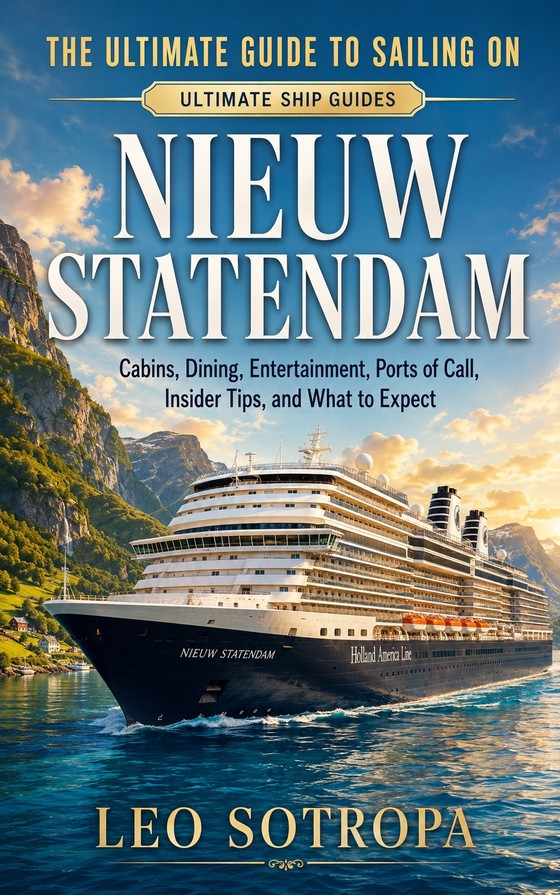
Is The Ultimate Guide to Sailing on Nieuw Statendam by Leo Sotropa worth reading before you sail, and will it actually make your cruise easier? Yes. It is an independent, ship-specific handbook written for one vessel and one part of the world: Holland America Line’s Nieuw Statendam, sailing the company’s home waters out of Rotterdam on two very different Northern Europe voyages. If you have booked a Baltic capitals cruise or a Norwegian fjords cruise on this ship and you want to arrive knowing which cabin to choose, which restaurants are worth a charge, how the Have It All bundle really adds up, and what to do in each port, this is the book that answers those questions in plain language.
This page explains what the book covers, who it is for, and why a guide built around a single ship beats a general cruise primer. It is a description of the book, not the guide itself. The short version: this is a practical companion you read at the kitchen table before you pack, and again on the plane, so that your first hours aboard feel familiar instead of overwhelming.
What this book is
The Ultimate Guide to Sailing on Nieuw Statendam is part of the Ultimate Ship Guides series by Leo Sotropa. Each title in the series takes one ship and covers it properly, rather than trying to summarize an entire fleet in a few thin pages. This one is devoted to Nieuw Statendam, the second Pinnacle-Class ship of Holland America Line, sister to Koningsdam and Rotterdam. It is independent and unofficial, which matters more than it sounds: the book is free to tell you which cabins to avoid, where the bundled extras stop paying for themselves, and which venues are genuinely worth your evening, without a marketing department leaning on the copy.
It comes as a Kindle edition and a 6×9 illustrated paperback, so you can carry it on your phone or keep a printed copy in your day bag. Every chapter ends with a short set of Action Steps: concrete things to do now, this week, or the moment you board. That structure is the difference between reading a guide and using one. You finish a chapter, you do the two or three things it tells you to do, and you move on knowing that part of your trip is handled.
A word on why the ship deserves its own book. Nieuw Statendam is a mid-size ship of about 99,900 gross tons carrying roughly 2,666 guests at double occupancy. That scale sits between the megaships that dominate the Caribbean and the small expedition vessels that thread the fjords. The interiors, designed by Adam D. Tihany and Bjørn Storbråten around a music theme, give her a distinct character, and she was christened by Oprah Winfrey. Knowing how a ship of this size and personality actually works, where the quiet corners are, where the crowds gather, how the music venues connect, is exactly the kind of knowledge that a single-ship guide can deliver and a fleet-wide overview cannot.
Sailing from Rotterdam, where the line began
The heart of this book is a sailing hook that most cruise coverage misses. Nieuw Statendam is based in Rotterdam, with some departures from Dover and Amsterdam, and that is not an accident of scheduling. Holland America Line was founded in Rotterdam in 1873 as the Netherlands-America Steamship Company. For decades it carried cargo and emigrants from that same quay to New York. When you board here, you are leaving from the port where the company started, sailing its home waters. The book leans into that sense of place, and it treats Rotterdam not as an airport with a pier attached but as a genuine highlight of the trip.
From that home port, the ship runs two distinct Northern Europe voyages, and the guide is built around a simple, important idea: you should know which one you booked, because they are different holidays. The Baltic capitals voyage and the Norwegian fjords voyage share a ship but little else. One is a run of great cities and museums and grand harbours; the other is a slow drift past waterfalls and mountain walls where the scenery is the entire point. Pack, plan, and choose your cabin according to the voyage you actually have, not a generic idea of a European cruise.
The Baltic capitals voyage
The Baltic itinerary is a tour of Northern Europe’s capital cities and their nearby treasures: Copenhagen, Oslo, Stockholm, Helsinki, Tallinn, Visby on the island of Gotland, and more, depending on the sailing. These are dense, walkable, museum-rich ports where your time ashore is precious and easily wasted if you arrive without a plan. There are also long-form 28-day Baltic Capitals Collector’s Voyages, a genuine differentiator for travelers who want to settle in and let the region unfold over weeks rather than days. The book treats each capital as a chapter of its own, so you are not flipping between a single crowded page and a map at the gangway.
The Norwegian fjords voyage
The fjords itinerary is a different animal. It calls at Stavanger, Ålesund, Olden, Bergen, and sails into the Geirangerfjord, with longer runs pushing toward the Arctic Circle. Here the ship itself becomes a viewing platform, and the guide is honest about what that changes. A verandah earns its keep in a fjord in a way it never quite does on a city-hopping cruise, because the view arrives at your own railing and stays there for hours. Where you sleep, and which side of the ship you face, becomes a real decision rather than a matter of taste. The book walks you through that choice instead of leaving you to guess.
The season for both voyages runs roughly from May to September, and exact ports vary by sailing, so the guide is careful to send you to Holland America’s Navigator app to confirm current itineraries, venues, and times. That is the timeless approach the book takes throughout: it teaches you how the ship and the region work, then points you to the app for the details that change.
What’s inside
The book is organized the way you actually experience a cruise: the ship first, then the practical decisions, then the ports, then the money. Here is what each part gives you.
The ship, neighborhood by neighborhood
Nieuw Statendam is designed around music, and the guide maps the ship so that its layout stops being a puzzle. The centerpiece is Music Walk, a run of connected live-music venues that are all included in your fare: B.B. King’s Blues Club, Billboard Onboard with its duelling pianists, and the Rolling Stone Rock Room, where a five-piece band plays classic rock. That last venue is a Pinnacle-Class feature, so it is part of what makes this ship worth choosing. The book explains how these rooms flow into one another and how to plan an evening that moves between them without missing the sets you care about.
It is also honest about one thing many marketing pages blur: Lincoln Center Stage is not a fixed venue on this ship. The classical troupe rotates between vessels and appears on select sailings only. If chamber music is part of why you are booking, the guide tells you plainly to check whether it will be aboard your particular voyage rather than assuming it.
Beyond Music Walk, the guide covers the rooms that define the ship. The World Stage is the main theatre, a 270-degree LED space that hosts productions such as BBC Earth in Concert, and it works best when you know how to get a good seat. The Crow’s Nest is a forward observation lounge built for watching a coastline arrive, and the book calls it the most valuable room aboard on this itinerary, which is exactly right on a fjords sailing. There is also the complimentary Grand Dutch Café, where bitterballen and Dutch beer give you a taste of the line’s heritage without a surcharge. Knowing these spaces in advance means you spend your first sea day enjoying the ship instead of decoding it.
The cabin guide
Choosing a cabin is the decision that shapes your whole trip, and it is the one most people get wrong by booking blind. The book includes a full cabin guide that goes through the categories, explains which staterooms tend to reward the price and which to approach with caution, and connects the choice to the voyage you booked. The verandah question is the clearest example: on the Norwegian fjords voyage, a private balcony changes what the cruise is, because the scenery comes to you. On a Baltic capitals run, where you spend your days in cities, the calculation is different. The guide lays out both cases so you can spend your money where it actually improves your holiday.
The dining guide
Dining aboard Nieuw Statendam splits into what is included and what carries a charge, and the book makes the map clear. Included in your fare are the Dining Room, the Lido Market buffet, the Dive-In grill, and the Grand Dutch Café. For an extra charge there are the specialty restaurants: the Pinnacle Grill steakhouse, Tamarind for pan-Asian, Rudi’s Sel de Mer for French seafood, and Canaletto for Italian. The guide gives you a straight read on which of these are worth booking and when, so you are not paying for a night out that the main Dining Room would have matched.
It also explains Club Orange, a paid upgrade that bundles an exclusive restaurant, expanded menus, priority embarkation and tender access, and a cabin upgrade. Whether that package makes sense depends on how you cruise, and the book helps you decide rather than selling it to you.
The money and value chapter
This is where the guide earns its price several times over. Have It All is Holland America’s bundle, packaging a drinks package, Wi-Fi, a shore-excursion credit, and specialty dining, with the number of included specialty nights scaling to the length of your voyage: one night on 6 to 9-night sailings, two on 10 to 20-night sailings, and three on voyages of 21 nights and up. The book works through the arithmetic, shows you the rule that usually breaks the maths, and tells you when the bundle is a genuine saving and when it quietly is not. It also gives frank advice on Nordic prices ashore, which come as a shock to first-time visitors, so you can budget your days in Oslo or Bergen without a nasty surprise. All prices in the book are kept relative, because numbers date; what stays true is the reasoning.
Eight destination chapters
The ports get the depth they deserve. There are eight in-depth destination chapters covering Rotterdam, Copenhagen, Oslo, Stockholm, Helsinki, Tallinn, Visby, and the Norwegian Fjords. Rotterdam alone is treated as a highlight rather than a departure formality, with the Markthal, the Cube Houses, the Erasmusbrug, the windmills at Kinderdijk, and the original ss Rotterdam moored nearby as a hotel. Each chapter helps you decide what to prioritize in a limited window ashore, so your day in a new city has a shape before you step off the gangway.
An honest account of who the ship suits
Not every ship is right for every traveler, and the book says so. It gives an honest account of who Nieuw Statendam suits and who will find her too quiet. This is a refined, music-rich, less-crowded ship, and that is a feature for some and a drawback for others. If you want water slides and a nonstop party, the guide tells you kindly that this may not be your ship. If you want scenery, culture, live music, and space to breathe, it confirms you have chosen well. That honesty is the whole point of an independent guide.
Who it’s for
This book is written for the traveler who wants a refined, less-crowded ship for a scenery- and culture-rich Northern Europe voyage. In practice that means couples and mature cruisers, though it serves a wider range than that suggests.
- First-timers get a calm walk through everything that usually causes pre-cruise anxiety: how embarkation works, what is included, how to read the daily schedule, and where to be for the moments that matter, like sailing into the Geirangerfjord.
- Seasoned cruisers get the specifics that generic advice never reaches: which cabins on this ship reward the fare, how Have It All actually pencils out for their voyage length, and which specialty restaurant is worth the night.
- Couples and mature travelers get a guide tuned to the kind of trip they came for, with the Crow’s Nest, Music Walk, and the ports treated as the core of the experience rather than an afterthought.
- Gift-givers get an easy, thoughtful present for anyone who has just booked this ship. It reads as care, and the Action Steps mean the recipient will genuinely use it.
Why a ship-specific guide beats a generic cruise primer
A general cruise book has to hedge. It cannot tell you which restaurant on your ship to skip, because it does not know your ship. It cannot tell you which side of the vessel to face in the Geirangerfjord, or that the Rolling Stone Rock Room is a Pinnacle-Class feature, or that the Crow’s Nest is the room to claim on a fjords morning. It deals in averages, and averages are exactly what let you down when you are standing at a gangway in Tallinn with a few hours and no plan.
A single-ship guide removes that vagueness. Because it covers only Nieuw Statendam and only her Northern Europe voyages, every recommendation is specific enough to act on. That is what reduces pre-cruise stress: not vague reassurance, but concrete decisions made in advance. By the time you board, your cabin choice is settled, your dining nights are planned, you know whether Have It All is worth it for your sailing, and you have a shape for each day ashore. The Action Steps turn all of that from intention into a checklist you have already worked through.
The book does not try to replace Holland America’s own tools. It repeatedly sends you to the Navigator app to confirm the live details, because venues, times, and itineraries change and a printed year would only mislead you. What the guide adds is judgment: the reasoning, the trade-offs, and the honest opinions that an app full of listings will never give you.
About the author and the series
The Ultimate Guide to Sailing on Nieuw Statendam is written by Leo Sotropa as part of the Ultimate Ship Guides series, published through acountryamonth.com. The series follows a consistent idea: pick one ship, learn it thoroughly, and write the guide you wish you had before you sailed. Each book is independent and unofficial, illustrated, and structured around Action Steps so that reading turns into doing. If you have found this particular title, it is because you have a Nieuw Statendam voyage in your future, and this is the book built for exactly that.
Get The Ultimate Guide to Sailing on Nieuw Statendam
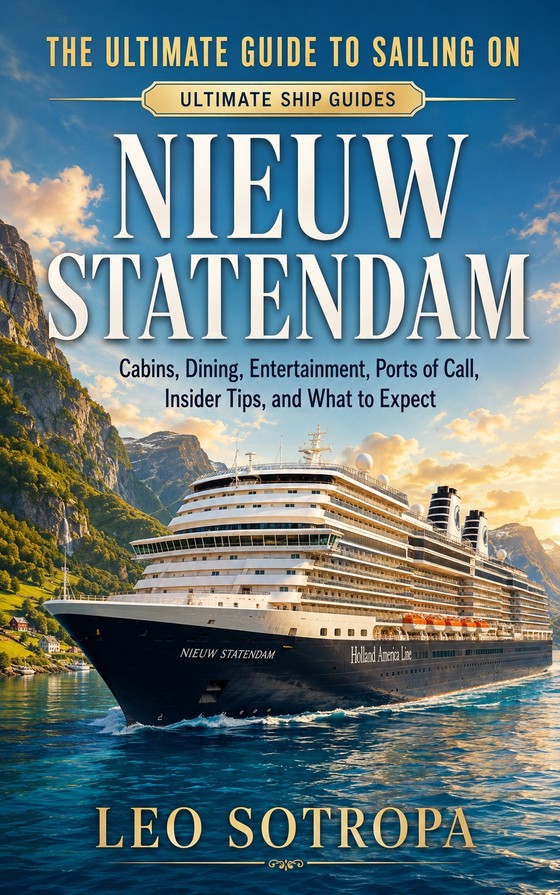
The Ultimate Guide to Sailing on Nieuw Statendam by Leo Sotropa is an independent, ship-specific handbook in the Ultimate Ship Guides series, available on Kindle and paperback, with clear Action Steps in every chapter. It is the practical companion for a Baltic capitals or Norwegian fjords voyage on Holland America Line’s Nieuw Statendam.
Frequently asked questions
Is this an official Holland America Line book?
No. It is an independent, unofficial guide written by Leo Sotropa. That independence is the point: the book is free to tell you which cabins to avoid, when the Have It All bundle stops paying for itself, and which venues are worth your evening, without any obligation to the cruise line. For live details such as current itineraries and venue times, it points you to Holland America’s own Navigator app.
Should I buy the Kindle or the paperback?
Both editions carry the same content, so it comes down to how you like to travel. The Kindle version sits on your phone, which is handy at the gangway or in a port when you want to check something quickly. The 6×9 illustrated paperback is easy to flip through while you plan at home and to hand to a travel companion. Many readers keep the Kindle copy for the trip and gift the paperback, or the other way around.
Is the book up to date if it doesn’t list years or prices?
Yes, and that is deliberate. The guide is written to stay accurate by teaching how the ship and the region work rather than quoting numbers that would date within a season. Prices are kept relative and the reasoning behind them is explained, so the advice holds. For anything that genuinely changes, such as exact ports, venue schedules, and current fares, the book tells you to confirm in the Navigator app before you sail.
Does it cover this ship’s specific ports?
It does. There are eight in-depth destination chapters covering Rotterdam, Copenhagen, Oslo, Stockholm, Helsinki, Tallinn, Visby, and the Norwegian Fjords. The book also makes clear that the Baltic capitals voyage and the Norwegian fjords voyage are different holidays, so you can plan around the one you actually booked rather than a generic European itinerary.
Is it good for first-time cruisers?
Very much so. First-timers tend to worry about the things the book explains most carefully: how embarkation works, what is included versus what carries a charge, how the music venues connect, and where to be for the moments that matter. Because every chapter ends with Action Steps, a nervous first-timer finishes each section knowing exactly what to do next, which takes the guesswork out of the whole trip.
Would it make a good gift?
Yes. For anyone who has just booked Nieuw Statendam, it is a thoughtful and genuinely useful present. The paperback is easy to wrap, the content is specific enough that the recipient will actually use it, and the Action Steps mean it becomes part of their planning rather than sitting on a shelf. It reads as care from someone who wants their trip to go well.
Does it replace the Holland America Navigator app?
No, and it does not try to. The app is where you check live schedules, book venues, and confirm the details of your sailing. The book gives you what the app cannot: judgment, honest opinions, and the reasoning behind each decision, from which cabin to choose to whether Have It All is worth it for your voyage length. Used together, the guide helps you plan and the app keeps you current.

Meet Leo: The Heartbeat Behind ‘A Country A Month’
Journeying through the pages of A Country A Month, you might often feel the rhythm of a storyteller’s heartbeat, pulsating through each line, each image, and each adventure shared. That heartbeat belongs to none other than our remarkable website editor, Leo.
With a lens in one hand and a pen in the other, Leo seamlessly marries his passions for photography and writing. His eye captures moments that words can barely describe, yet his eloquence brings those images to life, transcending borders and connecting us all through shared stories. An avid traveler, every country he’s visited has added another chapter to his expansive tale, and through our platform, he generously shares these chapters with us.