A good Las Vegas food plan is not a list of dishes detached from the trip. It accounts for when people eat, which neighborhoods suit different meals, where reservations matter, what prices mean, and how to recognize a place designed only for passing visitors.
Use this article with the complete Las Vegas travel guide, the three-day itinerary, and the where-to-stay guide.
This is the chapter to dog-ear. Las Vegas rewards a visitor who commits to one district at a time far more than one who tries to see the whole Strip in a single afternoon; the distances are simply too large for anything else to work. Each section below is a self-contained half day, built the same way every time: who the district suits, a walkable (or driveable) route with real landmarks, where to eat and drink along it, the right time of day or week to go, and a quieter alternative when you want the same flavor without the crowd.
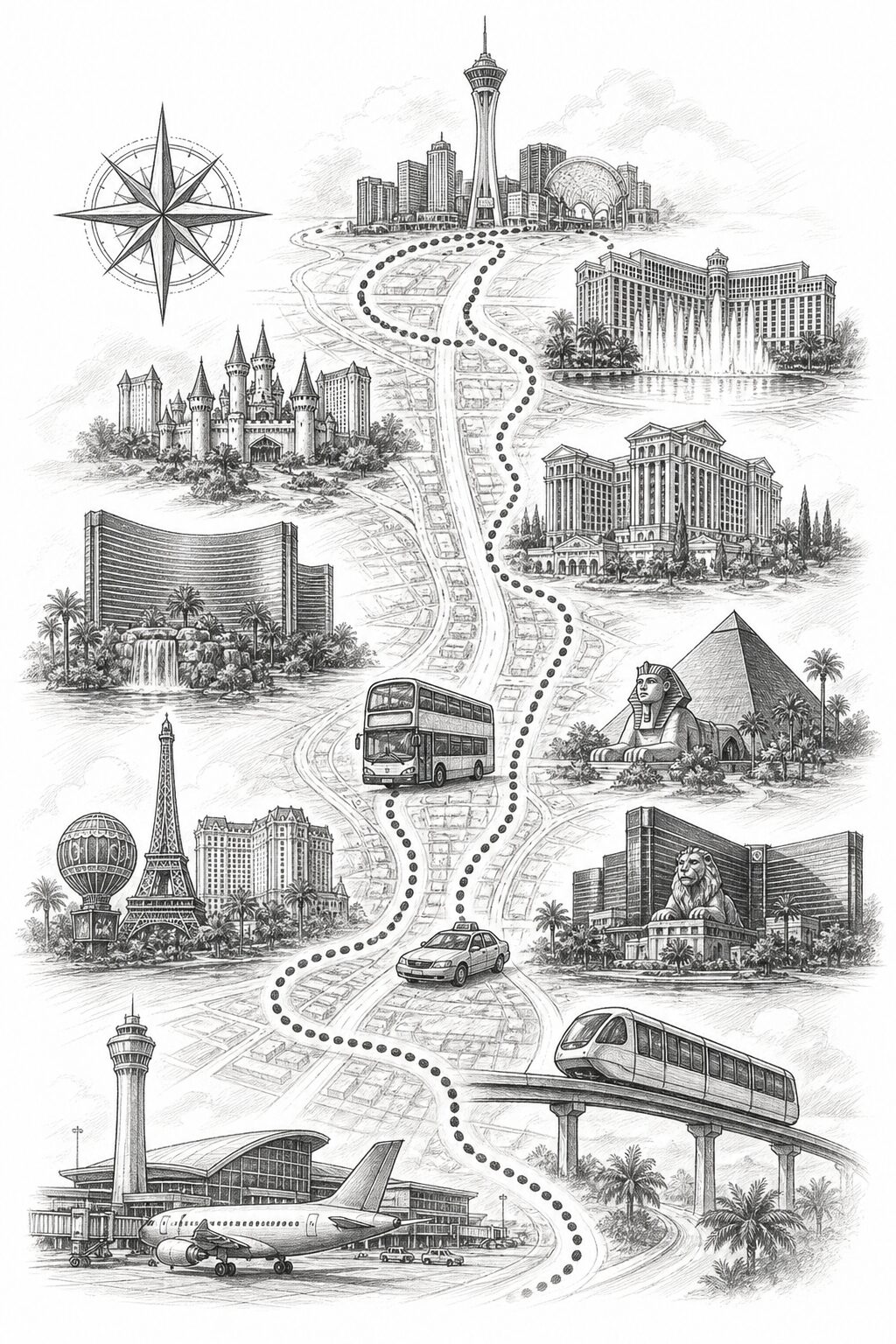
How the city fits together, in one paragraph: Las Vegas Boulevard, the Strip, runs roughly north to south through everything you came for, and it is not technically part of the city of Las Vegas at all, but an unincorporated stretch of Clark County. Center Strip is the postcard heart; North Strip is the newest and most architecturally ambitious end, with the Sphere as its anchor; South Strip leans family-friendly and sits closest to the airport. The LINQ Promenade and Flamingo cut a compact pedestrian corridor between Center and North. Downtown, 4 to 5 miles north of the Strip, is the original city, the neon-soaked Fremont Street that came decades before the megaresorts. The Arts District sits just south of Downtown, a quieter counter-note to both. Chinatown, west of the Strip along Spring Mountain Road, is the best concentrated eating in the valley. And Summerlin, out in the west valley, doubles as your gateway to Red Rock Canyon. Four habits make every one of these routes better: start early, since the desert sun and Strip crowds both build fast after 10am; duck into a casino floor or mall whenever you need air-conditioned relief, no purchase required; carry water, because the dry desert air hides how much you’re sweating; and treat every route below as a spine, not a rail. The detour that catches your eye is usually worth taking.
A note on sequencing, since this article covers more ground than any single trip needs: the Strip districts (Center, North, South, and the LINQ) connect to each other by foot, the Deuce, or the monorail (the complete guide), so stacking two of them in one day works fine if you start early and pace yourself. Downtown, the Arts District, Chinatown, and Summerlin all sit a genuine drive or rideshare away from the Strip corridor, so treat each of those as its own half day or evening rather than trying to bolt one onto a Strip-heavy afternoon. the complete guide shows exactly how a one-day, two-day, and five-day visitor should combine the districts below; this article’s job is simply to make sure each one, on its own, is worth the time.
Center Strip: the postcard heart
Who will love it: first-timers, and honestly, everyone else too, at least once.
The route (about two and a half to three hours): Start at the Bellagio Conservatory and Botanical Garden, the free seasonal display that changes several times a year and takes only 20 to 30 minutes to appreciate properly. Walk the Strip frontage south past Caesars Palace’s Forum Shops, a climate-controlled mall worth ducking into as much for the heat escape as the browsing. Cross to Paris Las Vegas for its half-scale Eiffel Tower and the Champagne Bar underneath it. Continue to the Cosmopolitan, whose chandelier bar sits right in the flow of public space, so walk through it rather than around it. Finish back at the Bellagio for an evening Fountains show, timed every 15 to 30 minutes from midday or 3pm into the night, free and unticketed.
Food: casual counter options fill Caesars’ Forum Shops food court for a quick, cool lunch, and Bellagio’s chef-led dining rooms (confirm the current roster on the resort’s own site, since this tier turns over fastest of any restaurant category in the city) anchor the splurge end. The Champagne Bar at Paris is a genuine institution for a pre-dinner glass with the view.
When to go: early evening is the sweet spot, cooler temperatures and the Fountains at their best; Friday and Saturday nights are the most crowded by a wide margin, so a weeknight visit buys real breathing room.
Quieter alternative: walk the same corridor at 9am instead, before the crowds build and while the morning light still flatters the architecture; you’ll have the Conservatory nearly to yourself.
Worth adding if time allows: a first-time visitor I walked this route with stopped dead in the Cosmopolitan’s chandelier bar, certain she had wandered into a private party by mistake, before realizing the whole gleaming, three-story crystal structure is simply public space you’re allowed to walk straight through, no invitation required; it remains one of the best free “wait, we can just be in here?” moments on the entire Strip. If the Bellagio’s chef-led dining rooms are out of reach for one meal, the Conservatory alone is worth returning to across a single trip, since its seasonal display genuinely changes enough to reward a second look a few days later.
North Strip: the newest and most ambitious cluster
Who will love it: architecture watchers, foodies, and anyone who wants to see where the resort arms race is headed next.
The route (two to two and a half hours, best begun at dusk): Start inside the Venetian and Palazzo’s Grand Canal Shoppes, where indoor gondola rides glide under a painted sky ceiling. Walk north into Wynn and Encore’s interior gardens, free to walk though photography of the casino floor itself is generally not permitted. Continue to the Fontainebleau’s soaring atrium, one of the newer additions to the skyline. Finish outside the Sphere as full dark settles in, when its massive LED exterior wraps the entire building in a display that changes nightly and is, by a wide margin, the most photographed free spectacle in the city right now.
Food: this stretch carries the densest concentration of named chef restaurants in Las Vegas, particularly at Wynn and the Venetian; confirm the current roster before you book, since this is the fastest-changing restaurant tier in the book.
When to go: dusk into full dark, specifically for the Sphere and the lit exteriors; daytime suits the indoor malls better, when the heat outside makes the air-conditioned browsing its own reward.
Quieter alternative: walk the same route at opening hour, roughly 10am, when the malls are nearly empty and the gardens at Wynn are at their calmest.
Worth adding if time allows: the Wynn and Encore gardens reward a slow pace more than any other indoor space on the Strip, real greenery, running water, and daylight piped in through glass ceilings, a genuine sensory reset if the casino floors elsewhere have started to blur together. And if you’re chasing the single best photo of the Sphere’s exterior, the vantage point from across Sands Avenue, rather than directly underneath it, gives you the whole sphere in frame rather than a fisheye-distorted slice of it.
South Strip: family-leaning and closest to the airport
Who will love it: families, and anyone whose flight schedule makes proximity to Harry Reid genuinely useful.
The route (about two hours): Begin at the “Welcome to Fabulous Las Vegas” sign on its South Strip median, ideally early morning for a short photo line rather than the wait that builds by midday. Walk north to New York-New York’s skyline facade and its Brooklyn Bridge replica, a genuinely fun bit of architectural theater. Continue to the Luxor’s pyramid and Sphinx. Detour into Mandalay Bay for the Shark Reef Aquarium, an indoor, air-conditioned win on a hot afternoon. Finish at the quieter, less casino-dense north end near the Four Seasons wing of Mandalay Bay.
Food: Mandalay Bay’s restaurant row anchors this stretch with the widest range in the South Strip corridor.
When to go: any time of day works here; this district runs noticeably less frenetic than Center or North Strip, a real advantage on a hot afternoon or with kids in tow.
Quieter alternative: none really needed. This is already the calmer half of the Strip; if you want quieter still, aim for a weekday morning.
Frequently asked questions
How many days are enough for Las Vegas?
Three well-planned full days cover a strong first visit, while four or five allow slower neighborhoods, additional museums, or a day trip. Count usable sightseeing days rather than hotel nights.
What should be booked first?
Reserve the experience you would be most disappointed to miss, then secure lodging and any limited-entry sights. Verify current rules and opening information on the official operator’s website shortly before travel.
How do you avoid rushing?
Group each day geographically, allow time for security and transport, and treat extra stops as optional. One demanding reservation plus nearby flexible experiences usually produces a better day than a chain of timed entries.
Continue planning Las Vegas
- Complete Las Vegas travel guide
- 3 days in Las Vegas: first-time itinerary
- Where to stay in Las Vegas
- Best things to do in Las Vegas
- Las Vegas food guide
- Las Vegas first-time tips
- Las Vegas on a budget

Meet Leo: The Heartbeat Behind ‘A Country A Month’
Journeying through the pages of A Country A Month, you might often feel the rhythm of a storyteller’s heartbeat, pulsating through each line, each image, and each adventure shared. That heartbeat belongs to none other than our remarkable website editor, Leo.
With a lens in one hand and a pen in the other, Leo seamlessly marries his passions for photography and writing. His eye captures moments that words can barely describe, yet his eloquence brings those images to life, transcending borders and connecting us all through shared stories. An avid traveler, every country he’s visited has added another chapter to his expansive tale, and through our platform, he generously shares these chapters with us.