Planning a trip to Las Vegas is easier when the city is treated as a set of connected neighborhoods and decisions, not a checklist of famous names. This complete guide brings together the essential sights, the right time to visit, transport, places to stay, food, realistic costs, and the choices that most affect a first trip.
Use this article with the complete Las Vegas travel guide, the three-day itinerary, and the where-to-stay guide.
Here is a number that ought to stop you for a second: something like 41 million people fly, drive, or bus into a patch of Mojave Desert every year to see a city that, by any rational measure, should not exist. Las Vegas sits in a valley that gets a few inches of rain annually, ringed by mountains too dry for much besides creosote bush and bighorn sheep, and it has convinced tens of millions of people a year to cross an ocean or a continent for it anyway. Most of them go home already planning the next trip.
That is the paradox this book is built to explain. Las Vegas is not subtle. It is a half-scale Eiffel Tower next to a black glass sphere the size of a stadium, next to a pyramid with a sphinx out front, all lit up bright enough to be seen from space, all standing in a desert so genuine that Red Rock Canyon and Lake Mead sit less than an hour from the loudest casino floor. It is also, once you know how to read it, a city with real rhythms, real neighborhoods, and real people running it: dealers who have worked the same felt for twenty years, a union hall that just brought essentially every major resort under contract, and a Downtown that has nothing to do with the Strip’s polish. Visit it well, and you get both the spectacle and the substance. Visit it badly, and you get an expensive blur of resort fees, sunburn, and a hazy memory of a buffet.
This guide exists to make sure you get the first version. Las Vegas rewards planning in a way that surprises people who arrive thinking they can improvise a casino town. The blocks on the Strip are enormous (walking past a single megaresort’s frontage can eat fifteen minutes on its own), the summer heat is not an inconvenience but a genuine hazard by early afternoon, and the city’s whole business model runs on separating you from your money in ways large and small, from the mandatory resort fee tacked onto every room rate to the $12 bottle of water in the minibar. None of that should scare you off. It should make you want a book written by someone who has already made the mistakes so you don’t have to.
Here is how this one is organized, the same way a longtime local friend would walk you through it. First the city itself: what it feels like to step off the curb and into it, the short, strange history that explains why it looks the way it does, and an honest read on who it suits and who might be happier elsewhere. Then the sights everyone crosses the country for, with straight verdicts on what is worth your time and what is not. Then the planning layer: when to come, how to get from the airport to your resort and around once you are there, and where to base yourself. Then the city up close, neighborhood by neighborhood, each one built as a walkable half-day you could start this afternoon. Then the food, the shows, the day trips into genuinely wild desert, and itineraries built for one day, two days, and five. And near the end, the deeper story: how a railroad water stop became the entertainment capital of the world, and the dealers, housekeepers, sign restorers, and stagehands who keep the whole production running every single night.
A word about honesty, because Las Vegas guidebooks have a reputation for breathless hype. This one does not do that. Where a sight is genuinely worth the money and the queue, this book says so. Where it is a nice-to-have you can skip without regret, this book says that too, and points you toward something better nearby. Prices, fares, and booking rules in this business change property by property and season to season, so wherever a number could move between the writing of this book and your trip, you will see the phrase “as of this writing” and a nudge toward the official source to confirm before you go. Nothing here is padding, and nothing here is fabricated.
One more thing worth knowing before the complete guide: Las Vegas does not really have an off switch. There is no last call, no closing time for the casino floor, no hour when the lights along the Strip dim for the night. That takes some getting used to, and it is also, once you settle into it, one of the most disorienting and genuinely fun things about the place. Consider yourself warned, and consider yourself invited.
Action Steps
- Decide your trip length now: two to three days covers a first Strip-focused visit well, four to five lets you add Downtown and a real day trip, and the complete guide has detailed plans for all three lengths.
- Before you book anything, skim the complete guide for the sights worth timing your trip around and the complete guide for the month that will actually suit you, since Las Vegas’s calendar moves on events and heat, not just seasons.
- Budget real money for resort fees and parking on top of your room rate; the complete guide tells you honestly what to expect so the final bill never surprises you.
Drive in from the airport at night, round the last curve on Interstate 15, and the Strip appears all at once: a wall of light standing up out of total darkness, towers stacked against a black desert sky with nothing else around them for miles. There is no gradual approach the way there is with most big cities, no suburbs thickening slowly into a skyline. One minute you are in the desert. The next minute you are in the middle of the most electrically lit four miles on the planet, and even people who have seen the photographs a hundred times tend to go quiet for a second when it happens to them for real.
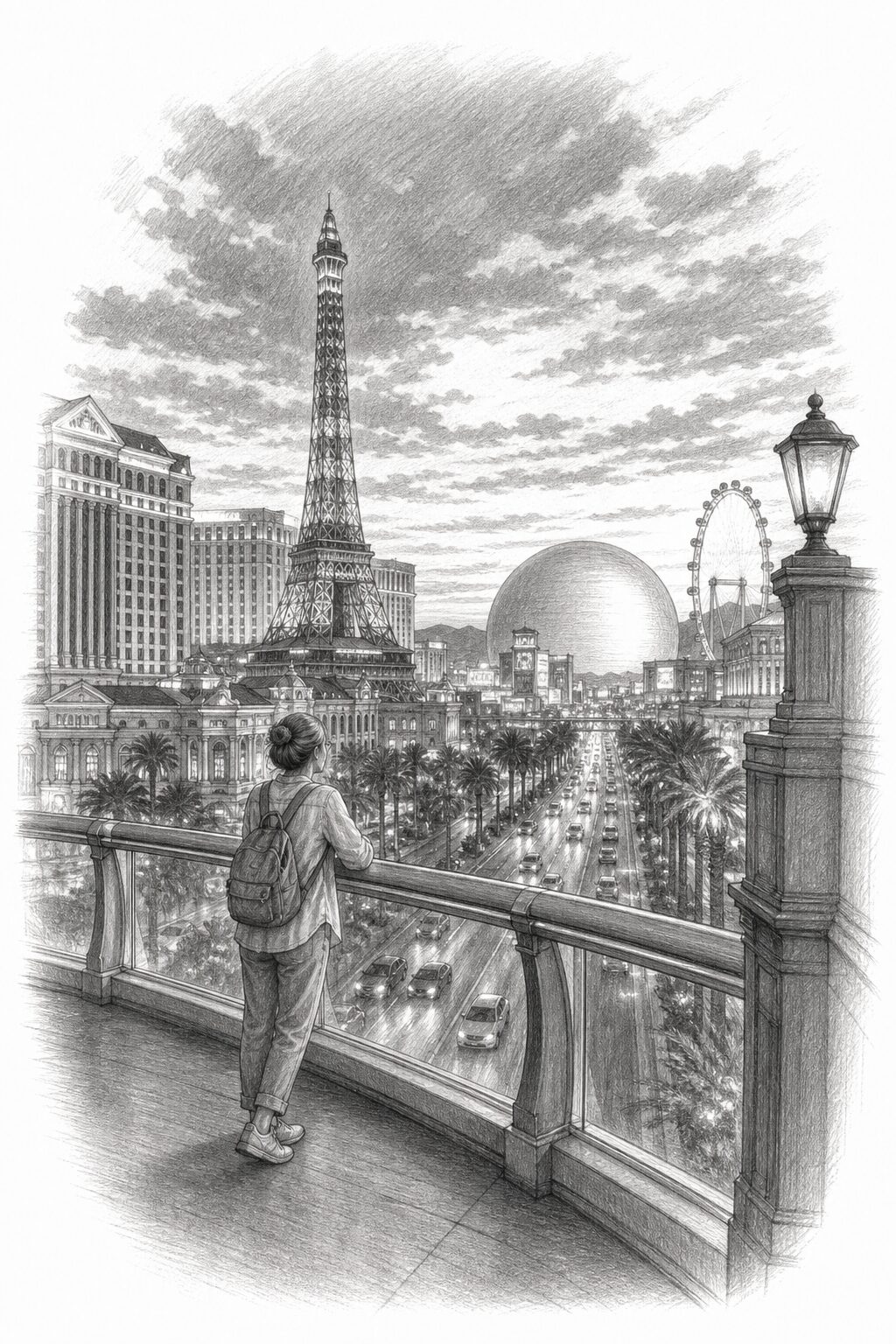
Step out onto Las Vegas Boulevard itself and the scale keeps surprising you. A half-scale Eiffel Tower rises over a Champagne bar. A black glass sphere the size of a domed stadium glows and shifts and occasionally becomes an enormous eyeball, visible from blocks away. A pyramid beams a spotlight straight up into the sky, strong enough that pilots use it as a landmark. None of it apologizes for itself, and none of it pretends to be anything but a machine built to delight you, separate you gently from your money, and send you home already missing it. That combination, unapologetic spectacle plus genuine desert fifteen minutes past the last casino sign, is what makes Las Vegas unlike anywhere else you have been.
How a railroad water stop became the entertainment capital of the world
The valley you are standing in was not always neon. Long before any of it, artesian springs bubbling up through the desert floor made this a reliable stopover for the Southern Paiute people and, later, for Spanish traders working the Old Spanish Trail; the name itself, Las Vegas, is Spanish for “the meadows,” a nod to the grass those springs supported in an otherwise brutal landscape. A Mormon mission tried to settle the spot in 1855 and gave up within a couple of years. The city as you know it really begins on May 15, 1905, when a railroad company auctioned off townsite lots to serve a new rail line between Los Angeles and Salt Lake City. For its first quarter-century, Las Vegas was an unremarkable railroad and ranching town with none of the reputation to come.
Two things happened in 1931 that changed everything. Nevada legalized casino gambling, largely to raise tax revenue during the Depression, and construction began on what would become Hoover Dam, thirty miles southeast. The dam brought thousands of workers and their families through the valley for years, and once it was finished, it sent cheap hydroelectric power back into the city, giving Las Vegas both an early customer base and the infrastructure to grow. In 1941, a resort called the El Rancho Vegas opened on the highway just outside city limits, specifically to dodge the city’s own taxes and regulations. That stretch of highway became the Strip, and organized-crime money, drawn by a form of gambling that was legal nowhere else in the country, financed its early growth. Bugsy Siegel’s Flamingo, which opened in 1946 selling Hollywood glamour rather than a cowboy theme, is the most mythologized of these early resorts; Siegel was murdered the following year in a dispute over cost overruns, and mob-linked money, often laundered through union pension funds, kept building through the 1950s and 1960s. That era gave Las Vegas its Rat Pack glamour, with Frank Sinatra, Dean Martin, and Sammy Davis Jr. headlining showrooms while, not far outside town, the Nevada Test Site’s above-ground nuclear detonations were treated as a genuine spectator event.
The mob era ended the way most eras end here: someone with more money bought it out. Howard Hughes moved into the top floor of the Desert Inn in 1966 and, when the hotel asked him to leave, simply bought the place instead, then several more Strip properties after that. His willingness to own casinos openly, combined with a 1969 Nevada law letting publicly traded companies do the same, opened the door for Wall Street to push organized crime out through the 1970s and 1980s. Then came the transformation that defines the Las Vegas you are looking at right now: Steve Wynn’s Mirage opened in 1989 with an erupting volcano out front, and it is generally credited with inventing the modern “megaresort,” a themed architectural spectacle that is itself the marketing. Excalibur, Luxor, and Treasure Island followed fast, then Bellagio in 1998 and the Venetian and Paris Las Vegas in 1999, each resort competing on scale and theme rather than simply on rooms and tables. The 2000s and 2010s brought Wynn Las Vegas, Encore, CityCenter’s Aria, and the Cosmopolitan; the most recent wave brought Resorts World in 2021 and, in 2023, both the Sphere and the Fontainebleau, alongside a deliberate civic push into major-league sports (the NHL’s Golden Knights, the NFL’s Raiders, the WNBA’s Aces) and the Formula 1 Las Vegas Grand Prix, a street race run down the Strip itself. You will see traces of every one of these eras still standing as you walk the boulevard: the Rat Pack’s showroom glamour in the classic Strip resorts, the mob-built bones of a few survivors, and the megaresort arms race in nearly everything built since 1989. the complete guide tells the fuller version.
The shape of the valley
Las Vegas sits in a flat desert basin ringed by mountains: the Spring Mountains, including Mt. Charleston, to the west, the Sheep Range to the north, and Frenchman and Sunrise Mountains to the east. That basin organizes into pieces that matter for how you plan a trip. The Strip corridor, the four-plus miles of Las Vegas Boulevard where nearly every famous resort sits, is technically not even part of the city of Las Vegas; it is unincorporated Clark County, a legal quirk that surprises most visitors. Downtown, the original townsite from that 1905 rail auction, sits four or five miles north of the Strip and has its own distinct, older, neon-soaked character centered on Fremont Street. And beyond both of those, a ring of suburbs, Henderson, Summerlin, and North Las Vegas, is where most of the roughly 660,000 to 680,000 residents of the city proper actually live, out of a broader Las Vegas Valley and Clark County metro population running to around 2.3 to 2.4 million as of this writing. You could visit Las Vegas for a week and never realize it is a genuine, ordinary residential city with schools and grocery stores and rush hour, wrapped around a four-mile tourist corridor that most locals rarely set foot on.
The headline numbers
Roughly 41 to 42 million visitors come through in a typical recent year, a figure that puts Las Vegas among the most-visited destinations in the country, and the average trip runs about 3.4 nights. What makes that number even more striking is repeat visitation: something like 86 percent of recent visitors had been to Las Vegas before, a proportion almost no other American destination can claim. This is not primarily a bucket-list, once-in-a-lifetime city. It is a city people come back to on purpose, again and again, the way you’d return to a favorite restaurant rather than check a box.
Conventions and trade shows form a huge secondary economy here that most tourists never think about; CES, the giant consumer electronics show every January, alone draws well over 100,000 attendees, and it is one of dozens of major conventions that fill hotel rooms and skew visitor demographics throughout the year. On the gambling side, the average visitor’s gaming budget runs to roughly $820 per trip as of this writing, though that number varies enormously by who is asking and who is answering. And for scale: the Strip itself runs about 4.2 miles end to end, which sounds walkable on a map and is not; you will learn exactly why in the complete guide.
What genuinely makes Las Vegas special
No other city on earth concentrates this much spectacle, architecture built purely to sell you an experience, live entertainment, and round-the-clock energy into one walkable corridor. Other cities have casinos. Other cities have theme parks. No other city has both, stacked twenty stories high, standing shoulder to shoulder along one boulevard, running on a schedule that never actually ends. There is no last call in Las Vegas. The casino floors do not dim for the night. A steak dinner ordered at 4am is unremarkable. That absence of a closing bell is disorienting for the first day and then becomes one of the most genuinely fun things about being here.
The other thing that surprises first-timers is how much of a legitimate outdoor-recreation base this city doubles as. Red Rock Canyon, Lake Mead, and Mt. Charleston are all within an hour’s drive, and each one offers a completely different, quieter version of Nevada than the one on the Strip. Few visitors realize, until they are standing at a Red Rock overlook an hour after leaving their hotel, that Las Vegas can deliver both a Cirque du Soleil show and a genuine desert hike in the same 24 hours.
Now the honest cons, because a longtime friend tells you these before you find them out the hard way. Resort fees and parking fees quietly inflate almost every advertised room rate, often by $50 to $80 or more a night before tax; the complete guide spells out the real math. The Strip is a hard, hot walk: blocks are enormous, and summer sidewalk heat is genuinely dangerous by mid-afternoon, not just uncomfortable. The entire city is built, cheerfully and unapologetically, to separate visitors from their money at every turn, from surge-priced bottled water to windowless casino-floor layouts designed to keep you inside. It is loud, and it can feel relentlessly commercial in a way that wears on some travelers faster than others. And secondhand smoke is still a live issue on many casino floors, despite a growing number of smoke-free gaming areas at newer and renovated properties. None of this should keep you away. All of it is easier to handle when you know it is coming, which is the entire point of this book.
Who this city is best for
Las Vegas is close to a perfect trip for nightlife lovers, live-entertainment and concert fans, foodies chasing the latest celebrity-chef opening, bachelor and bachelorette groups, conference-goers who want their downtime to match the energy of their workday, and anyone who wants a short, high-intensity trip with genuine outdoor day trips bolted on for balance. It is unusually good for solo travelers too, a fact the complete guide covers in detail. And it works for families in real doses, with pool complexes, an aquarium, an indoor theme park, and family-friendly shows, even though the city was not built around kids the way a destination like Orlando was.
Who might prefer somewhere else? Travelers who dislike casinos, cigarette smoke, or dense crowds will find plenty here to irritate them. Anyone hoping for a quiet, slow-paced trip should look elsewhere; Las Vegas does not really do quiet. And families wanting a trip built entirely around children, rather than one where kid-friendly stretches are woven between adult-oriented ones, will likely find more of what they want in a destination designed from the ground up for that purpose. For everyone else, keep reading. This book is about to show you how to do this city right.
Action Steps
- Hold the two-corridor map in your head: the Strip (unincorporated Clark County, the resorts) and Downtown (the original city, Fremont Street), roughly four to five miles apart and genuinely different in character.
- Accept that Las Vegas runs on its own clock: no last call, no closing hour for the casino floor, and plan your energy accordingly rather than fighting it.
- Budget mentally for resort fees and parking on top of any room rate you see advertised; the complete guide gives you the real numbers.
- If heat-sensitive activities matter to you (long Strip walks, Red Rock, Hoover Dam), read the complete guide before you pick your travel dates.
Every city worth a book has a short list of things you would genuinely regret skipping, and in Las Vegas that list is a strange, wonderful mix: a free fountain show that stops traffic, a black sphere the size of a stadium, and a dam built during the Depression that still generates real awe eight decades later. This article is that list, with the practical truth attached to each entry: what it costs, how far ahead to book, when to go, and, where it matters, an honest verdict on whether it earns your limited time.
A note that will save you money and crowds all week: several of the best things on this list, arguably the two best things on this list, cost nothing at all. Spend your money where it actually buys you something the free version cannot.
A quick word on how to think about this list before you start checking things off. Las Vegas sights fall into two very different categories, and confusing them wastes both time and money. The first category is the free spectacle: the Fountains of Bellagio, the Sphere’s exterior, the Fremont Street canopy, the Bellagio Conservatory, and the Venetian’s Grand Canal Shoppes cost nothing, need no advance planning beyond showing up at a good hour, and deliver most of the visual wonder people fly here for. The second category is the paid, bookable experience: a Sphere show, a Cirque du Soleil production, the Neon Museum, the Mob Museum, Hoover Dam’s Powerplant Tour, and Red Rock’s timed vehicle entry all require real advance planning and real money, and each one rewards that planning with something the free layer cannot give you, whether that is a seat inside a headline show or a walk through the actual generator hall of a working dam. Build your itinerary from the free layer outward, and let the paid layer be the deliberate splurges rather than the default.
Fountains of Bellagio
The single best free spectacle on the Strip, and the reason nearly every Center Strip evening ends up here whether you planned it or not. Water, light, and music choreographed across the eight-acre lake in front of Bellagio, with shows running roughly every 15 to 30 minutes from midday or 3pm until midnight, as of this writing. It costs nothing, needs no booking, and works at any hour, though evening is when the lighting makes it genuinely spectacular rather than merely impressive. Allow 15 to 20 minutes per show, though most people watch two or three in a row without meaning to. Worth-it verdict: unmissable. If you see nothing else on this list, see this.
Frequently asked questions
How many days are enough for Las Vegas?
Three well-planned full days cover a strong first visit, while four or five allow slower neighborhoods, additional museums, or a day trip. Count usable sightseeing days rather than hotel nights.
What should be booked first?
Reserve the experience you would be most disappointed to miss, then secure lodging and any limited-entry sights. Verify current rules and opening information on the official operator’s website shortly before travel.
How do you avoid rushing?
Group each day geographically, allow time for security and transport, and treat extra stops as optional. One demanding reservation plus nearby flexible experiences usually produces a better day than a chain of timed entries.
Continue planning Las Vegas
- Complete Las Vegas travel guide
- 3 days in Las Vegas: first-time itinerary
- Where to stay in Las Vegas
- Best things to do in Las Vegas
- Las Vegas food guide
- Las Vegas first-time tips
- Las Vegas on a budget

Meet Leo: The Heartbeat Behind ‘A Country A Month’
Journeying through the pages of A Country A Month, you might often feel the rhythm of a storyteller’s heartbeat, pulsating through each line, each image, and each adventure shared. That heartbeat belongs to none other than our remarkable website editor, Leo.
With a lens in one hand and a pen in the other, Leo seamlessly marries his passions for photography and writing. His eye captures moments that words can barely describe, yet his eloquence brings those images to life, transcending borders and connecting us all through shared stories. An avid traveler, every country he’s visited has added another chapter to his expansive tale, and through our platform, he generously shares these chapters with us.