The safest way to move to Italy is not to begin with the move. Begin with a reversible test.
Italy rewards people who understand local life and punishes people who commit to a postcard before learning how the place works in winter, without a rental car, during a medical appointment, or when a document needs to be filed.
Step 1: Define the life, not the country
Write down the non-negotiables:
- Maximum rent
- Walkability
- Climate
- Distance to a hospital
- Airport and rail access
- Need for English-speaking services
- Tolerance for quiet winters
- Frequency of travel home
- Whether you will own a car
This list eliminates attractive but impractical places quickly.
Step 2: Screen the visa before falling in love
For many retirees, the Elective Residency Visa is the likely route. Assess the strength of your passive-income documentation and identify the correct consulate before spending heavily on scouting or housing.
Affording an Italian town does not guarantee that you qualify for residency. Run both tests.
Step 3: Build three budgets
Create:
- A normal-month budget
- A first-year budget
- A bad-year budget
The first year includes deposits, documents, translations, insurance, furnishings, tax help, travel, and setup costs. The bad year includes a weaker dollar, a medical issue, an urgent trip home, or the need to move apartments.
Step 4: Scout like a resident
Visit candidate places outside peak tourism. Stay in an ordinary neighborhood. Buy groceries, use buses, visit a pharmacy, test the walk to the station, and price a long-term rental.
Ask yourself whether you would still choose the town if no one from home ever visited.
Step 5: Rent before buying
Renting gives you time to learn local micro-markets, building quality, heating costs, condominium rules, and the bureaucracy of ownership. A cheap purchase can become expensive if it is difficult to sell or far from the services you later need.
Step 6: Plan healthcare in phases
Map coverage for:
- The visa and initial period
- The first residence-permit stage
- Longer-term public and private care
- A serious condition
- A temporary or permanent return to the United States
Medicare generally does not cover routine care in Italy. Decide whether maintaining U.S. coverage fits your contingency plan.
Step 7: Get cross-border tax advice
Tax residence can change the treatment and reporting of pensions, investments, accounts, property, and other income. The U.S. filing obligation usually continues for citizens abroad. Italy’s special tax regimes are detailed and should not be relied on without individualized advice.
Step 8: Downsize in stages
Do not ship a household before you know the apartment, the stairs, the storage, and the climate. Bring documents, medication records, a realistic capsule wardrobe, and the items that genuinely matter. Replace ordinary furniture locally.
Step 9: Make the first year reversible
Keep:
- A funded return plan
- Accessible U.S. accounts
- Copies of essential records
- A U.S. mailing solution
- A healthcare contingency
- Enough cash for two moves
- Relationships at home
Reversibility is not pessimism. It is what allows you to enjoy Italy without feeling trapped.
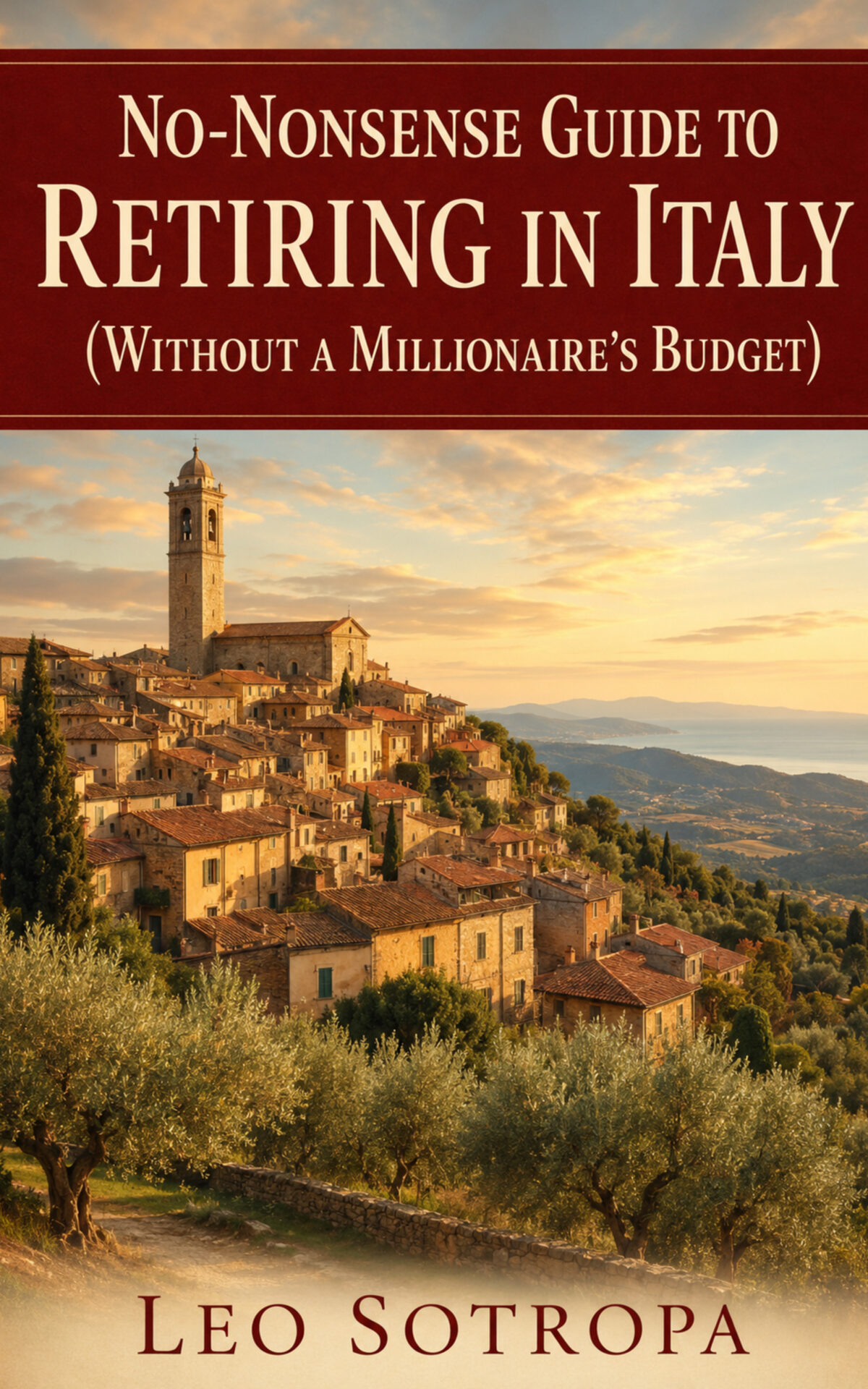
For the complete planning framework, read No-Nonsense Guide to Retiring in Italy. Also see the Italy visa guide and Italy cost-of-living guide.
Get the complete retirement guide
No-Nonsense Guide to Retiring in Italy by Leo Sotropa brings the budget, residency, healthcare, housing, tax, and location decisions together in one practical plan.

Meet Leo: The Heartbeat Behind ‘A Country A Month’
Journeying through the pages of A Country A Month, you might often feel the rhythm of a storyteller’s heartbeat, pulsating through each line, each image, and each adventure shared. That heartbeat belongs to none other than our remarkable website editor, Leo.
With a lens in one hand and a pen in the other, Leo seamlessly marries his passions for photography and writing. His eye captures moments that words can barely describe, yet his eloquence brings those images to life, transcending borders and connecting us all through shared stories. An avid traveler, every country he’s visited has added another chapter to his expansive tale, and through our platform, he generously shares these chapters with us.