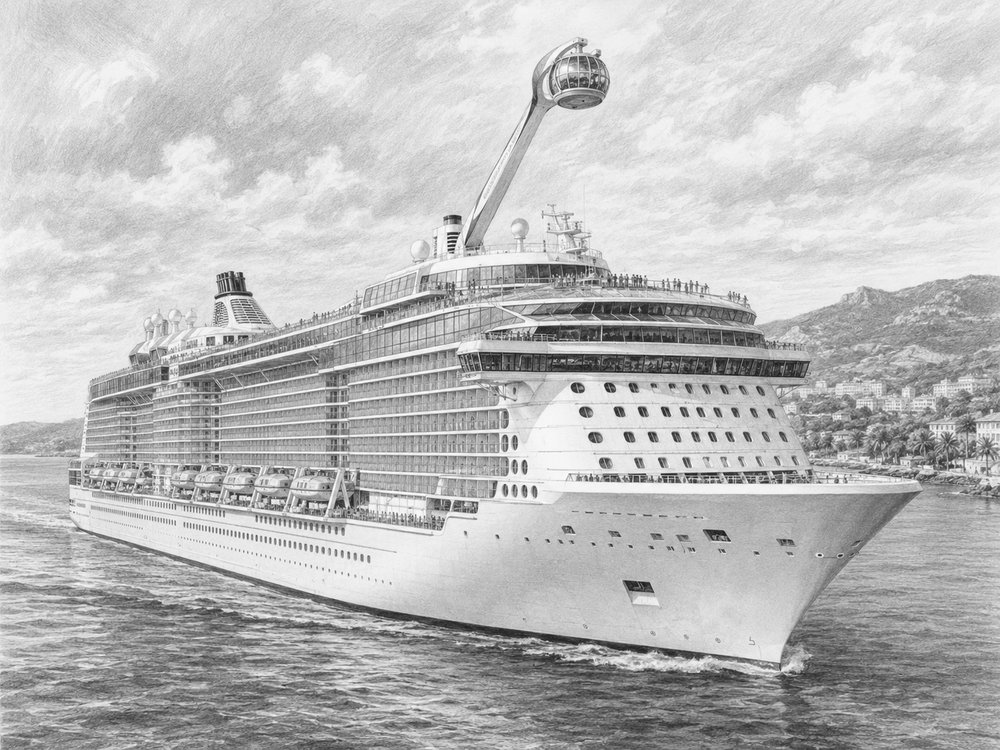
What is Spectrum of the Seas, and is she the right ship for your trip? This Spectrum of the Seas cruise guide answers that up front: she is Royal Caribbean’s first Quantum Ultra-Class ship, purpose-built for Asia and based year-round in Singapore, and for a long time the largest and most advanced cruise ship in the region. At roughly 169,000 gross tons with about 16 guest decks and around 4,200 guests at double occupancy, she carries the full arsenal of Quantum-class thrills — the North Star observation capsule, a skydiving simulator, bumper cars indoors — plus something the earlier Quantum ships never had: a private, keycard-access Suite Class complex reserved for suite guests. If you want a modern, activity-packed ship that pairs Southeast Asian ports with big-ship engineering, she is one of the strongest options afloat. This guide walks through what she is, who she suits, where she sails, and how to plan a smooth trip.

Everything in this article and far more, deck by deck, in The Ultimate Guide to Sailing on Spectrum of the Seas.
Get the book →What Spectrum of the Seas actually is
Spectrum sits in Royal Caribbean’s Quantum family, but she carries the “Ultra” label for a reason. The Quantum ships were already known for stacking technology and indoor venues into a single hull so that weather never dictates your day. Spectrum took that template and refined it for a specific market — Asia — with a longer, redesigned suite area and dining and service touches aimed at guests sailing out of Singapore. She is not a small ship dressed up with gadgets; she is a genuinely large vessel, close to 169,000 gross tons across roughly 16 guest decks, holding around 4,200 guests at double occupancy and up to about 4,900 when every berth is full.
What that size buys you is variety. On a single day at sea you can ride a capsule 300 feet over the water, surf a standing wave, drive a bumper car, eat at a themed restaurant that plays tricks on your senses, and watch an immersive theatre show — without ever needing the weather to cooperate. That indoor-first design matters more than it sounds in a tropical region where afternoon downpours are routine. When the sky opens over the South China Sea, Spectrum barely notices.
Who Spectrum of the Seas suits (and who might look elsewhere)
Spectrum is built for guests who want a lot to do and a lot of choice. She rewards families with children, multi-generational groups, first-time cruisers who want their money’s worth of activities, and couples who like the option of a quiet spa day or a loud night of bumper cars depending on their mood. Solo travelers are unusually well served here too, thanks to dedicated Studio cabins that skip the single supplement that stings on many ships.
She is also a natural fit for anyone new to cruising in Asia. The itineraries are often short — 3, 4 or 5 nights — which lowers the commitment for a first sailing, and the ship’s scale means there is always a backup plan if a port day gets rained out or if the kids get restless. If you are weighing a first Asian cruise, it is worth reading our dedicated take on planning a first-time Asia cruise on Spectrum before you book, because the rhythm of these getaways differs from a week-long Caribbean voyage.
Who might look elsewhere? If your idea of a cruise is long, port-intensive days ashore with minimal time on the ship, some of Spectrum’s shorter round-trip Singapore getaways include sea days or even sail as cruises-to-nowhere with no port call at all. That is by design — the ship is the destination on those voyages. Confirm the itinerary carefully so you know whether you are buying beaches and temples or a floating resort weekend. Both are valid; they are just different trips.
The exclusive Suite Class complex
The single biggest thing that separates Spectrum from her older Quantum siblings is the private, keycard-access suite complex reserved for suite guests. This is not just a nicer cabin; it is a gated section of the ship with its own restaurant, lounge and sundeck that non-suite guests never see. Royal Caribbean split it into tiers, and understanding those tiers is central to any honest Spectrum of the Seas cruise guide because they change the whole shape of the experience.
Golden, Silver and Star
The complex is organized as Golden, Silver and Star Suite Class, and the perks scale up as you climb. Higher tiers can unlock a private restaurant, a private lounge and sundeck, and priority for everything from boarding to shows to disembarkation. At the very top, Star Class adds a dedicated Royal Genie — effectively a personal concierge who arranges reservations, remembers your preferences, and smooths the whole trip. The practical takeaway is simple: if you book into the Suite Class complex, a large and quiet part of the ship opens up to you, and if you don’t, those doors stay closed. Factor that into your cabin decision rather than treating it as a surprise on embarkation day.
For most guests, standard cabins deliver a great trip without the suite premium — the ship’s public venues are excellent on their own. But if you were already leaning toward a suite, Spectrum’s complex is one of the more compelling reasons on the market to commit, because you get an exclusive retreat rather than just extra square footage.
Signature thrills and top-deck attractions
Spectrum carries the full Quantum-class thrill set, and a few of these are genuine bucket-list experiences rather than gimmicks. Book the marquee attractions early through the Royal Caribbean app — the best time slots go fast, especially on sea days.
- North Star — a jewel-shaped glass observation capsule on a mechanical arm that lifts you roughly 300 feet above the sea for 360-degree views. It is often complimentary on sea days, but slots are limited, so reserve early.
- RipCord by iFly — a skydiving simulator built around a vertical wind tunnel that lets you experience freefall without leaving the ship.
- FlowRider — a surf simulator where you can bodyboard or attempt to stand up on a fast sheet of water.
- SkyPad — a bungee-trampoline experience with an optional virtual-reality headset, a Spectrum signature you won’t find on every ship.
- SeaPlex — the largest indoor active space at sea, with bumper cars, roller skating, basketball, an arcade and Xbox, all under a roof so the weather never cancels the fun.

Beyond those headline attractions, Two70 is a multi-story venue with a vast glass wall that frames the ocean by day and transforms into immersive Vistarama and Roboscreen shows by night — the moving screens are worth catching at least once. The Royal Esplanade runs as an indoor promenade through the heart of the ship, home to the Bionic Bar, where robotic arms mix your drink. There is a rock wall for climbers, the Vitality Spa for a slower pace, the Solarium for adults who want calm water, and Adventure Ocean to keep younger kids busy while parents get a break. If you want a fuller room-by-room rundown of these spaces, our guide on what to expect on Spectrum of the Seas goes deck by deck.
Dining on board
Spectrum’s food splits into two categories: included dining that comes with your fare, and specialty restaurants that carry an extra charge. You can eat very well without spending a cent beyond your cruise fare, but a couple of the specialty rooms are worth the splurge, and several lean into the Asian market in a way you won’t see on Royal Caribbean’s Western-based ships.
Included restaurants
Your fare covers the Main Dining Room for a sit-down dinner with a rotating menu, the Windjammer buffet for casual all-day grazing, Café Promenade for quick bites and coffee, and Sorrento’s for pizza when you want something fast and familiar. For many guests, this lineup alone is more than enough for a short getaway, and the Main Dining Room in particular is a relaxed way to end each day.
Specialty restaurants (extra charge)
The paid venues are where Spectrum shows off. Wonderland serves imaginative, theatrical dishes designed to surprise you; Jamie’s Italian brings rustic Italian cooking; Chops Grille is the classic steakhouse; and Izumi handles sushi and Japanese fare. What sets Spectrum apart from her fleetmates elsewhere is the Asian specialty dining built for this region — Sichuan Red and Hot Pot bring bold Chinese flavors aboard, and Teppanyaki delivers the theatrical grill-side show. For a real occasion, the Chef’s Table offers a multi-course tasting menu with wine pairings. You don’t need to book all of them; pick one or two that match your appetite and reserve early, because the best evenings fill up.
A note on how it all runs: the Royal Caribbean app is the command center for your day. It holds your daily schedule, lets you book activities and dining, and shows what’s on. Your SeaPass card acts as your cashless onboard account and your room key. Gratuities may be prepaid or added to your account, and Wi-Fi is a separate paid plan. Because Spectrum serves the Asia market, the onboard currency and some menus reflect that — confirm the specifics for your sailing in the app rather than assuming they match a US-based ship.
Cabins overview
Spectrum offers a full ladder of cabin categories, and choosing well is one of the highest-value decisions you make. Here is the range, from most affordable to most lavish.
| Category | Best for |
|---|---|
| Virtual Balcony interior | Value seekers — a floor-to-ceiling real-time ocean screen without the balcony price |
| Ocean View | A real window and natural light at a modest step up |
| Balcony | Fresh air and private outdoor space; the all-round sweet spot |
| Studio | Solo travelers avoiding the single supplement |
| Suites (up to Grand Loft, Ultra and Owner’s) | Space, plus access to the exclusive Suite Class complex |
The Virtual Balcony interior is a clever bit of engineering: instead of a windowless box, you get a floor-to-ceiling screen streaming a live view of the ocean outside, which makes an inside cabin feel far less closed-in. On a short getaway where you’ll barely be in the room, it is the smartest value on the ship. If you want a bit more, a midship Balcony on the mid-decks is the best all-round choice — you get outdoor space, good light, and the steadiest ride because midship cabins feel the least motion.
A few cabins are worth avoiding, and the deck plan will confirm the specifics for your sailing. Rooms directly under the pool deck or SeaPlex can pick up noise from dragged loungers or activity above. Cabins near Two70 or the nightlife venues can run late and loud. Forward high-deck rooms feel motion most, so anyone prone to seasickness should stay lower and midship. And some lower-deck balconies have their views partly blocked by lifeboats — always check before you commit. For a deeper breakdown with specific recommendations, see our guide to the best cabins on Spectrum of the Seas.
Where Spectrum of the Seas sails
Spectrum is based year-round in Singapore, with round-trip voyages that range from short weekend getaways to longer Southeast Asian loops. She has also seasonally sailed from Hong Kong and elsewhere, and some seasons include Japan repositioning voyages, so always confirm exactly where your voyage departs and calls. Because itineraries and lengths shift, treat the list below as the typical shape of her sailings rather than a fixed schedule, and check current dates and ports in the Royal Caribbean app.
Singapore, the home port
Singapore is a destination in its own right, not just a place to board. Arrive a day or two early to see Gardens by the Bay, Marina Bay Sands, Sentosa and the Merlion, and to eat your way through the hawker centres. Two terminals handle cruise traffic — the Marina Bay Cruise Centre and the Singapore Cruise Centre at HarbourFront — so check which one your sailing uses before you arrange transport. We cover the city and the embarkation logistics in more detail in our Spectrum of the Seas Singapore guide.
Typical Southeast Asia ports
Common calls include Penang, home to the UNESCO old town of George Town with its street-art murals, Kek Lok Si Temple, Penang Hill and a street-food scene famous for char kway teow and laksa. Port Klang is the gateway to Kuala Lumpur — the Petronas Twin Towers, Batu Caves and Merdeka Square — but the transfer runs roughly an hour to an hour and a half each way, so book carefully and budget the drive time. Phuket in Thailand brings Patong Beach, the Big Buddha, Old Phuket Town and boat trips out to Phang Nga Bay.
Longer sailings may add Ko Samui, a tender port with beaches, waterfalls and its own Big Buddha temple, or Melaka, a historic UNESCO trading city built around Jonker Street and the A Famosa fort. Some voyages push further to Vietnam and across the South China Sea. Shore excursions and tours in these ports sell out early, so book the ones you care about well ahead. For a port-by-port rundown, our guide to Spectrum’s Southeast Asia ports covers what to do at each stop and how to make the most of a short day ashore.
How to plan a smooth trip
A few habits make a Spectrum cruise noticeably better. First, download the Royal Caribbean app before you leave home and use it to reserve the North Star, entertainment and specialty dining as soon as bookings open — the marquee experiences are capacity-limited and go quickly. Second, plan around the length of your voyage: a 3- or 4-night getaway means you pack light and prioritize ruthlessly, while a longer loop gives you room to spread out activities and rest between ports.
Third, arrive in Singapore early. Flying in the same day you sail is a gamble in a region where delays happen, and the city rewards even one extra day. Fourth, match your cabin to your voyage — a Virtual Balcony interior for a quick weekend, a midship balcony for a longer sailing, a suite if you want the private complex. Finally, remember that the onboard experience reflects the Asia market, from currency to menus, so confirm the details rather than assuming they mirror a ship you’ve sailed elsewhere. For a fuller checklist of practical advice, our Royal Caribbean Spectrum of the Seas tips cover the small moves that save time and money.
Pack for tropical heat and humidity with a light rain layer, comfortable shoes for temple and old-town walking, and modest cover-ups for religious sites like temples and mosques ashore. Bring reef-safe sunscreen for beach days and a small daypack for port excursions. Because many sailings include sea days or run as getaways with limited port time, don’t over-schedule — leave room to simply enjoy the ship, which on Spectrum is a substantial part of the point.
Get the complete Spectrum of the Seas playbook

Ready to plan every detail? “The Ultimate Guide to Sailing on Spectrum of the Seas” walks you through cabins, dining, thrills and Southeast Asian ports with clear action steps in every chapter. It is part of the Ultimate Ship Guides series by Leo Sotropa, written to turn a good cruise into a great one.
Frequently asked questions
Where is Spectrum of the Seas based?
Spectrum is based year-round in Singapore and sails round-trip Southeast Asian itineraries from there. She has also seasonally sailed from Hong Kong and elsewhere, and some seasons include Japan repositioning voyages, so always confirm exactly where your specific voyage departs in the Royal Caribbean app before you book flights.
What makes Spectrum a Quantum Ultra-Class ship?
She was Royal Caribbean’s first Quantum Ultra-Class ship, an evolution of the Quantum design built specifically for Asia. The headline difference is the private, keycard-access Suite Class complex — a gated area with its own restaurant, lounge and sundeck for suite guests — along with dining and service tuned to the regional market. She keeps all the Quantum thrills while adding that exclusive suite retreat.
Do I need to book a suite to have a good time?
Not at all. The Suite Class complex and its perks are genuinely exclusive, but the ship’s public venues — North Star, SeaPlex, Two70, the specialty restaurants and the pools — are open to all guests and deliver an excellent trip on their own. Book a suite if you specifically want the private complex and its priority service; otherwise a well-chosen balcony or Virtual Balcony interior is plenty.
How long are Spectrum of the Seas cruises?
Many are short 3-, 4- or 5-night getaways round-trip from Singapore, though longer voyages run too, and some sailings are cruises-to-nowhere with sea days and no port call. Lengths and itineraries vary by season, so check the current schedule in the Royal Caribbean app and confirm whether your sailing is port-focused or a floating-resort getaway.
Which cabin should I book on Spectrum of the Seas?
For value, a Virtual Balcony interior on a short getaway is hard to beat — you get a live ocean screen without the balcony price. For the best all-round experience, choose a midship Balcony on the mid-decks for space, light and the steadiest ride. Solo travelers should look at the dedicated Studio cabins to avoid the single supplement.
Is Spectrum of the Seas good for families?
Yes. The indoor SeaPlex with its bumper cars, the FlowRider and SkyPad thrills, Adventure Ocean for younger kids, and the weatherproof design all make Spectrum a strong family ship. The mix of short itineraries and constant onboard activity suits multi-generational groups who want something for every age without depending on the weather.
What is the North Star on Spectrum of the Seas?
The North Star is a jewel-shaped glass observation capsule mounted on a mechanical arm that lifts you about 300 feet above the sea for 360-degree views. It is often complimentary on sea days but has limited capacity, so reserve your slot early through the Royal Caribbean app — the best times fill up fast.
Ready for the whole ship in one place? It is all in The Ultimate Guide to Sailing on Spectrum of the Seas.
Get the book →
Meet Leo: The Heartbeat Behind ‘A Country A Month’
Journeying through the pages of A Country A Month, you might often feel the rhythm of a storyteller’s heartbeat, pulsating through each line, each image, and each adventure shared. That heartbeat belongs to none other than our remarkable website editor, Leo.
With a lens in one hand and a pen in the other, Leo seamlessly marries his passions for photography and writing. His eye captures moments that words can barely describe, yet his eloquence brings those images to life, transcending borders and connecting us all through shared stories. An avid traveler, every country he’s visited has added another chapter to his expansive tale, and through our platform, he generously shares these chapters with us.